Jardin Public is an urban park in the center of Bordeaux. Planned in 1746 by intendant Tourny, it was originally created as a royal garden intended to offer Bordelais a pleasant place and to preserve their health, while also serving as a meeting place suited to business in a commercial city. The garden was inaugurated in 1756 on land then occupied by poor vines and small gardens at the city limits. It was designed in French style by Ange-Jacques Gabriel on about 12 hectares. Its layout included a large circular basin with a water jet at the center, separating four parterres planted with boxwood, laurel, thyme, and flowers. Bowling greens, elm and linden trees, southern porticos, and later additions such as the Manège royal and a jeu de paume court formed part of the ensemble. In 1856, Bordeaux began redesigning the site into an English garden style, which it has retained. Jardin Public is listed as a historical monument.
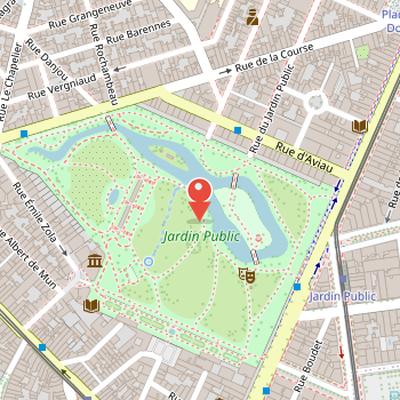
Nearby Objects
-
 Muséum d'histoire naturelle de Bordeaux 200 m away
 -
 Le palais Gallien 400 m away
 -
 Temple des Chartrons 500 m away
 -
 Monument aux Girondins 500 m away
 -
 CAPC musée d'art contemporain de Bordeaux 500 m away
Design History and Heritage Status
The Jardin Public is an urban park located in the center of Bordeaux. It was planned in 1746 by the intendant Tourny, and its first French garden design was completed later. In 1856, the city of Bordeaux began a redesign of the park into an English garden style. The Jardin Public has retained this English garden style to the present day. It is also listed as a historical monument.
Origins and Design of the Garden
The jardin public was created as a royal garden after intendant Tourny decided in 1746 to provide the people of Bordeaux with a pleasant place and to help preserve their health. Tourny also intended it to serve as a meeting place suited to business in a commercial city. The garden was inaugurated in 1756 on land previously occupied by poor vines and small gardens at the edge of the city.
It was designed in the French style by Ange-Jacques Gabriel and covered about 12 hectares. At its center stood a large circular basin with a water jet, dividing four parterres planted with boxwood, laurel, thyme, and flowers. The bowling greens were bordered by elm and linden trees pruned into arbors, balls, or fans. Two southern porticos with Ionic columns were built by Michel Voisin from designs by Andre Portier in 1749. Tourny then extended the garden northward with a riding school known as the ManegE royal, which had an imposing portico, a colonnade, and a pediment sculpted by Claude-Clair Francin. A jeu de paume court was opened beside it.
The gates and fences along the current cours de Verdun were designed by Michel Voisin or Andre Portier. The first gate near the present place Tourny, signed by Antoine Dorse, was completed in 1757, and two others were built in 1761 by Pierre Kauzac. The garden later became the site of the first Bordeaux balloon launch on December 23, 1783, which failed because of wind and caused a riot. On July 15, 1789, about 30,000 Bordelais gathered there after hearing of the fall of the Bastille, and speakers including the future Girondin Boyer-Fonfroede called for enlistment in the National Guard.
During the Revolution, the flowers and shrubs were replaced by lawns, while the large trees were preserved. The garden then served as an amphitheater for civic festivals and later as a cavalry drill ground of the Chateau Trompette. In the 19th century, Charles Burguet took part in its architectural arrangements, rebuilt the terrace, installed a basin, and had the garden gates recast in Bordeaux.
Statues in the Esplanade and Garden
The esplanade of Burguet and the garden contain a series of statues and busts by different sculptors, reflecting several decades of additions. On the esplanade, these include a marble shepherd playing a flute by Henri-Charles Maniglier from 1862, Jeunesse et Chimere by Pierre Granet from 1892, and Rosa Bonheur by Gaston Veuvenot Leroux from 1910. In the garden itself are a bust of Maxime Lalanne by Pierre Granet from 1897, a bronze bust of Leon Valade by Charles-Louis Malric from 1906, a statue of Fernand-Lafargue by Jules Rispal from 1906, a bronze bust of Alexis Millardet called La vigne reconnaissante by Gaston Veuvenot Leroux from 1914, and a bust of Ulysse Gayon by Gaston Veuvenot Leroux from 1935.
Greenhouses and Sculptures
In 1856, Charles Burguet constructed iron and glass greenhouses for the Jardin Public, arranged as three pavilions linked by two low galleries with curved glass roofs. The central pavilion is notably tall, with a height that places it among the largest greenhouses in Europe. The greenhouse locksmith work was assigned to Compan and Gaud of Bordeaux, while the double panes were supplied by Marly, a Bordeaux glassmaker, and later restored by Antoine Bellet. Glass for the greenhouse came from the former Place Saint-Germain, now Place Tourny.
The site also includes sculptural additions. A bronze bust of François Mauriac by Ossip Zadkine was installed at the southeast entrance in 1943, and a bronze sculpture of Carle Vernet by Raymond Martin was placed at the south portico in 1948. In 1970, the grilles of Cours de Verdun were restored with gold leaf by artisans Bernard, Blot, and Lorette.
Remarkable Trees in the Public Garden
Several plant species in the Public Garden were labeled remarkable trees of France in 2012. Among them is the Mexican swamp cypress, Taxodium mucronatum, noted for its significant height and trunk diameter. Another is the pecan tree, Carya illinoinensis, which is the tallest tree in the Public Garden and also has a notable height and trunk diameter. The collection also includes one of the oldest plants in the garden, the cock's comb erythrina, Erythrina crista-galli. This shrub is located at the southwest entrance of the garden facing Bardineau Square. The records identify it as originating from the old Saint-Bruno district Botanical Garden and state that it was moved to the Public Garden around 1850.