The Muséum d'histoire naturelle de Bordeaux is a French natural history museum in Bordeaux, Gironde, Nouvelle-Aquitaine. It is controlled by the Ministry of National Education, Higher Education and Research, receives support from the Regional Directorate of Cultural Affairs of Aquitaine, and is labelled a Musée de France. The museum follows the recommendations of the Museums of France service of the Ministry of Culture and Communication.
Its collections have a long history in the city. They were first created by François-de-Paule Latapie in 1791 for the muséum de Bordeaux and supplemented by Bernard Journu-Auber’s collection in 1804. Among the first public collections created after the French Revolution, the museum later established a natural history cabinet in 1811 in the former hôtel de l’Académie. In 1862, the collections were moved to the hôtel de Lisleferme in the public garden, where the former cabinet became a muséum. The building is a communal property listed as a Supplementary Historic Monument.
The museum closed in 2008 for renovation and safety work and reopened after ten years. Its displays also include a plaque noting the Journu family’s participation in the slave trade.
Nearby Objects
-
 Jardin Public 200 m away
 -
 Le palais Gallien 200 m away
 -
 Monument aux Girondins 500 m away
 -
 Place des Quinconces 600 m away
 -
 CAPC musée d'art contemporain de Bordeaux 650 m away
Institutional Status and Renovation
The Muséum d'histoire naturelle de Bordeaux is a French natural history museum located in Bordeaux, in the department of Gironde, in the region of Nouvelle-Aquitaine. It is controlled by the Ministry of National Education, Higher Education and Research and receives support from the Regional Directorate of Cultural Affairs of Aquitaine. The museum is labeled as a Musee de France and follows the recommendations of the Museums of France service of the Ministry of Culture and Communication. In 2008, it was closed for renovation and safety work, and it reopened after ten years of closure.
From Early Collections to the Hotel de Lisleferme
The history of the Muséum d'histoire naturelle de Bordeaux began with a collection created by Francois-de-Paule Latapie in 1791 for the museum of Bordeaux. This initial collection was later supplemented in 1804 by the collection of Bernard Journu-Auber. The institution is among the first public collections created after the French Revolution, which places it within the early history of public access to scientific and cultural holdings.
In 1811, the natural history cabinet was established in the former hotel de l'Academie, occupying part of the building called Le Musee, which housed several collections at the time. In 1862, the collections were moved to the hotel de Lisleferme in the public garden, and the former cabinet became a museum after this relocation. The hotel de Lisleferme is a communal property listed as a Supplementary Historic Monument.
The museum's display also reflects later historical interpretation, including a plaque noting the Journu family's participation in the slave trade. In 1952, the institution gained three additional rooms in the hotel de Lisleferme after the Prehistoric and Ethnographic museum moved out. By 1960, director professor M. Vigneaux had initiated electrical and heating work for the hotel's centenary.
Renovation, Closure, and Reopening
The museum building was closed for two years for renovations and reopened in 1962, when it again received visitors. In 1982, the ground floor suffered a major flood that affected the Harlle room and parts of the Harlle collection. Later, the municipal council voted for a renovation and expansion project, and the Basalt Architecture group was selected from 67 candidates for the architectural and museographic work. The museum was then scheduled to close for renovation and safety work after the European Heritage Days, while remaining open for school visits until closure. To maintain contact with the public after the closure, it also developed other activities. These activities brought visitors in each year from 2008 through 2013. The city of Bordeaux announced the start of construction at the Lisleferme hotel, and the museum was planned to reopen in 2017 after 11 years of closure.
Spatial Organization and Collections
The Muséum d'histoire naturelle de Bordeaux is distributed across three buildings, each serving a distinct role. The hotel de Lisleferme enlarges the public reception areas and provides space for temporary exhibitions in its basement. Offices and workshops are located in an administrative pavilion set in the old greenhouses of the botanical garden. A collection conservation center has also been built on the city outskirts, with a cold room, packing room, laboratory, reserve, and facilities for receiving researchers and students. The center was presented by France 3 Aquitaine in a television news report on Le 19-20. The permanent exhibition displays about one quarter of the collections, while the remaining objects are kept for semi-permanent or temporary exhibitions, or for specialized consultation at the conservation center.
The Museum Collections
The collections were first assembled in 1811 from private cabinets, including those of Francois-de-Paule Latapie and Bernard Journu-Auber. They have since grown through dozens of donations and acquisitions and now comprise several thousand specimens from around the world. Unlike most French natural history museums, the Bordeaux museum did not historically have a regulatory inventory, which made a retrospective computerized inventory necessary for conservation and for decennial stock-taking. Although the collections were traditionally gathered for scientific and research purposes rather than as unique heritage works, they are now recognized as having historical, patrimonial, and scientific values.
The Collections of the Muséum d'histoire naturelle de Bordeaux
The collections of the Muséum d'histoire naturelle de Bordeaux were notable for their geographic diversity, which derived from the port history of Bordeaux. They included an Asian elephant that died in 1892, the skeleton of a blue whale stranded in 1879, and a blue rorqual skeleton (Balaenoptera musculus). The museum also held the New Caledonia shell collection known as the Lambert-Montrouzier collection, as well as 20th-century collections such as a medical zoology liquid collection.
Prehistoric holdings formed an important part of the museum's identity. These collections consisted mainly of Quaternary vertebrate paleontological series, especially the Harlé and Daleau collections, which differed in composition and in the purposes for which they were assembled. The Harlé collection originated with paleontologist Edouard Harle and included an osteological collection such as a dryopithecus half mandible. The Daleau collection came from late 19th-century excavations by Francois Daleau at Pair-non-Pair cave and contained paleontological remains, with 4000 pieces counted in 1990.
Before the museum closed, these collections were presented under the theme of man and his environment during the Quaternary. In the 2008 presentation, the collections also included specimens of extinct species such as the Tasmanian wolf and a vulnerable Seychelles giant tortoise. During renovation, there were plans to suspend the blue rorqual skeleton from the ceiling in the exhibition rooms.
Exhibition Layout and Later Use
In 1862, the musuem arranged the two upper levels of the building for permanent exhibitions, allocating about a given surface area to them. The general collection of reptiles was placed on the landing near these exhibitions, while a small room on the same level presented curiosities, monsters, and programs for youth and adult audiences. From 1987 to 2014, the museum also hosted temporary exhibitions. It was then closed for renovation until 2017.
Educational and Public Outreach Activities
The Muséum d'histoire naturelle de Bordeaux operates a scientific library that is open to the public by appointment. It also welcomed visitors during a three-week exhibition opening. Beyond its exhibition spaces, the museum developed the educational program Le Muséum chez vous with teachers provided by the national education system. Originally intended for school audiences from kindergarten to high school, the program was later extended to leisure centers, media libraries, and senior residences. It was used to maintain links with the public during the museum's renovation closure. In this program, a scientific mediator travels with samples from the museum collection and provides commentary accompanied by interactive activities.
The museum also works with the association Amuseum, founded in 1988, linking scientific mediators with its educational service activities and public events. Another outreach format is the traveling workshop exhibition Le papier, created by Amuseum. This exhibition includes panels on the history of paper, everyday objects, and a kit for making recycled paper. It has been available since its creation in 2002 and can be offered directly to teachers and leisure center animators.
The museum also took part in the 2014 edition of La semaine digitale in Bordeaux through a partnership with Wikimedia France under the name Wiki-Day.
Location and Site Arrangement
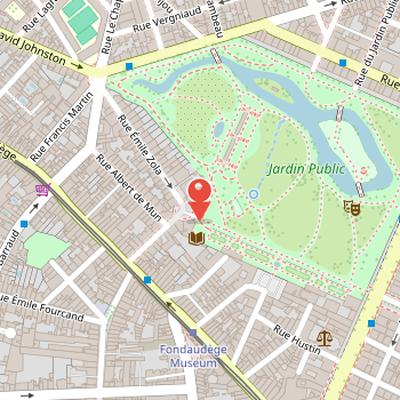
The Muséum d'histoire naturelle de Bordeaux is located in Gironde, at the Jardin public in the Grand Parc quarter. Its site includes two buildings near place des Quinconces and the Chartrons quarter. The hotel de Lisleferme stands at the edge of the garden and was used for future exhibitions until 2017, while public reception is handled in the administrative pavilion in the former greenhouses pavilion of the Jardin botanique. The museum service is accessible only during Jardin public opening hours. It is served by the TBM tramway network through Jardin Public station on Line C and Fondaudege Musuem station on Line D. A third building, the conservation collections center, is located in the Bordeaux suburb of Bacalan.