Père Lachaise Cemetery is a cemetery in the XX arrondissement of Paris and the largest cemetery in Paris intra muros. It is also one of the most famous cemeteries in the world and the most visited cemetery in the world, receiving more than three and a half million visitors annually. The site is known for containing the graves of numerous famous people, which contributes to its historical and cultural importance.
The area’s earlier history includes its identification in the Middle Ages as one of the seven hills of Paris, then called Champ-l'Évêque and belonging to the bishop of Paris. In the 12th century, the hill was named Mont-aux-Vignes for vineyard cultivation. The estate later changed hands several times, including purchase by Régnault de Wandonne in 1430 for a country house, also called a folie. Jesuits acquired the land two centuries later, and the place was named Mont-Louis after a visit by King Louis XIV. The cemetery’s name derives from François d'Aix de La Chaise, known as Père La Chaise, a former resident and confessor of Louis XIV. In 1803, Nicolas Frochot, prefect of the Seine, bought the area.
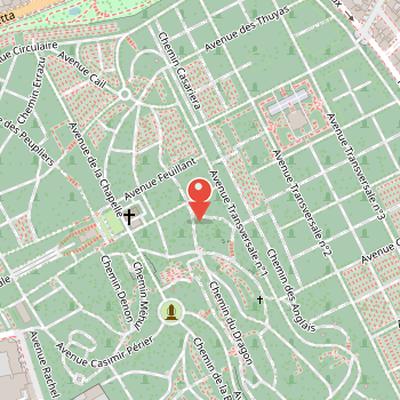
Nearby Objects
-
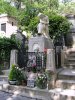 Frédéric Chopin’s tomb 150 m away
 -
 Grave of Victor Noir 200 m away
 -
 Communards' Wall 450 m away
 -
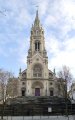 Église Notre-Dame-de-la-Croix 950 m away
 -
 Boulevards of the Marshals 1100 m away
Scale, Location, and Public Importance
Pere Lachaise Cemetery is located in the XX arrondissement of Paris and is the largest cemetery in Paris intra muros. It is also one of the most famous cemeteries in the world and the most visited cemetery in the world, receiving more than three and a half million visitors each year. The cemetery contains the graves of numerous famous people, which adds to its public significance and international recognition.
From Vineyard Hill to Cemetery Land
In the Middle Ages, one of the seven hills of Paris was known as Champ-l'Eveque and belonged to the bishop of Paris. In the 12th century, the hill took the name Mont-aux-Vignes because it was used for vineyard cultivation. A major change came in 1430, when the rich merchant Regnault de Wandonne bought the estate to build a country house, also called a folie. The nearby rue de la Folie-Regnault in the 11th arrondissement still derives its name from this house.
Two centuries later, the Jesuits bought the land and used it as a place for rest and convalescence. The site also became linked to King Louis XIV, who spent some hours there while observing the battles of the Fronde, after which it was named Mont-Louis. The most notable resident was Francois d'Aix de La Chaise, known as Pere La Chaise, who served as confessor to King Louis XIV and lived there from 1675 until his death in 1709. The count de La Chaise, his brother, organized many parties at the estate, and these gatherings contributed to its expansion and improvement.
In 1762, the Jesuit Order had to cede the land because of debt to pere de Jacy. By the end of the 18th century, the gardens had fallen into neglect, and ownership changed several times before Nicolas Frochot, prefect of the Seine, bought the area on March 9, 1803, for a sum of francs.
Design, Expansion, and Memory
Pere Lachaise Cemetery was created in response to a shortage of burial places in Paris after the closure of the Innocents cemetery. At the beginning of the 19th century, new cemeteries were established outside the city boundaries, including Montmartre, East Cemetery, Montparnasse, and Passy. On June 12, 1804, an Imperial Decree on burials set rules for cemetery construction and organization. The transformation of the 17 hectares of Mont-Louis into the cemetery of the East in Paris was decreed, and the design was entrusted in 1803 to the neoclassical architect Alexandre-Thodore Brongniart.
Under Storia's oversight as general inspector of public works, the project was developed with large axes arranged as a vast English garden, with tree-lined avenues and sculpted burial sites. Planned funerary monuments were limited, and only the Greffulhe family monument was realized in a refined neogothic style. The cemetery opened officially on 21 May 1804 with the burial of a five-year-old girl, daughter of a bell-ringer from the Saint-Antoine suburb. Another early burial recorded was that of Reine Fevez, who died at 615 rue Jarente on 18 June 1804.
The cemetery was originally designated for Parisians from one of four right bank arrondissements, to be buried either in common graves or perpetual concessions. Storia noted that many Parisians did not want to be buried on heights outside Paris in a poor and working-class neighborhood, and in 1804 the cemetery contained only 13 graves. The number increased gradually to 44 graves in 1805, 49 in 1806, 62 in 1807, and 833 in 1812. In 1817, the remains of Abelard and Eloise, Moliere, and La Fontaine were transferred there by the mayor of Paris to improve the cemetery's image. After this initiative, the number of graves increased further by 1830.
Pere Lachaise expanded five times in 1824, 1829, 1832, 1842, and 1850. Its area grew from 17 hectares 58 ares to 43 hectares 93 ares. Storia also notes the presence of trees, about one hundred cats, and numerous birds, and reports that the cemetery now receives 3.5 million visitors annually. The site also carries strong historical memory through the events of the Paris Commune in May 1871. During the violent battle, insurgents entrenched there and installed artillery on the hill. On May 28, 1871, 147 surviving communards and 19 captured officers were executed in front of a wall south of the cemetery and buried in a mass grave at its foot. This wall, called the Mur des Federes, became a symbol of the Paris Commune and bears a marble plaque dedicated to the dead of the Commune, dated May 21-28, 1871. Since 1905, except during the German occupation in World War II, an annual commemorative march called Montee au Mur has been held on May 28 and 29.
The Crematory and Columbarium
The crematory and columbarium complex at Pere Lachaise Cemetery began construction in 1894, following a design by Jean Camille Formige dated 1886. Storia describes the ensemble as including a neo-Byzantine chapel and four wings arranged around a large dome made of bricks and sandstone. In the 1920s, the main dome was decorated with stained glass by Carl Maumejeab. The final columbarium has three levels, with two underground and one above ground, and it can hold more than urns or small boxes.
The crematory was the first built in France. The first cremation took place on January 30, 1889, after the law of November 15, 1887 authorized cremation. In its early years, cremation was mainly used by freemasons, anticlericals, and free thinkers, including Charles-Ange Laisant and Andre Lorulot. Its use increased after the Catholic Church revoked its prohibition in 1963. Storia also notes that cremation was favored by AIDS patients starting in the 1980s, including Jean-Paul Aron and Cyril Collard. The number of cremations rose from 49 in 1889 to a higher level in the early 21st century, and in 2012 cremation accounted for 45 percent of funerals in Paris.
The columbarium contains the ashes of numerous celebrities, including director Max Ophuls and humorist Pierre Dac, and it also includes a cenotaph dedicated to soprano Maria Callas.
Religious Organization and Cemetery Design
Pere Lachaise Cemetery was shaped by regulations that linked burial space to religious organization. The decree of 23 pratile year XII (1804), issued under Napoleon, required municipalities to create a cemetery suitable for each religion or to adapt part of a cemetery for each religion. Article 15 of the same decree also allowed cemetery divisions for other religions. In Paris, seven Jewish compartments were established, and the Jewish compartment at Pere Lachaise opened on 28 February 1810 in division 9. This Israelite cemetery was enclosed by a wall, included a purification room and a pavilion for the garden, and the enclosure was locked. Additional Jewish buildings were located in division 97 from 1865 to 1882.
Religious compartments later disappeared after the law of 14 November 1881 repealed the article of 23 pratile, prohibiting such divisions. After this ban, the walls of the Jewish compartments were destroyed and Jews were buried in division 96. The cemetery also had a Muslim compartment. The law of separation of Church and State of 9 December 1905 did not alter the cemetery, since religious symbols remained authorized on private funerary monuments. The cemetery cross was removed in June 1883.
The Christian worship area also had an important architectural history. Brongniart planned a large pyramid suitable for ceremonies of all Christian religions for the house at Pere La Chaise, but the monument was never built. Instead, the chapel was entrusted to architect Etienne-Hippolyte Godde. Its construction began in 1820, financed by the city and by a donation from the widow of Dr. Bosquillon. The chapel was consecrated in 1834 and belongs to the parish of Saint Germain de Charonne. Notable 19th century figures buried in the cemetery included Rachel Felix, David Sintzheim, the Rothschild family, Robles, Singer, and Fould.
The Muslim Area and Mosque
A Muslim area at Pere Lachaise Cemetery was authorized by a municipal council decree on June 17, 1853, and by a prefectural edict on November 29, 1865. It was assigned division 85 to the Muslim cult and used the last expanded cemetery land from 1850. The area was enclosed and measured within a fenced courtyard. Construction of a mosque began in May 1855, following the designs of Marie-Gabriel Jolivet. The mosque included a waiting room, a lavatorium for Muslim purification, and a storage area for worship accessories. Its design used polychrome materials, combining white cut stone and red Vosges sandstone in horizontal bands. The Muslim area opened on January 1, 1857, as the first Muslim cemetery in France.
Between 1856 and 1870, the area recorded 44 burials, including 6 perpetual-use burials, 7 temporary burials, and 31 free graves. The mosque was reduced multiple times. On March 1, 1871, an unused part of the mosque was given to the Israelite cult and incorporated into division 87, which was granted to Jews from 1865 to 1882. After the law of November 14, 1881, prohibited compartments, the closure of the Muslim area was removed, although the 1873 planted hedge was preserved. The Muslim area was redrawn in 1883, and the mosque itself was preserved despite the 1881 law. Later, unfinished mosque construction was begun by Turkey but not continued, and reconstruction started before World War I was interrupted. The mosque was destroyed in 1914, and the project was definitively abandoned in 1923 because of new plans for the Great Mosque of Paris.
Commemorative Practices at the Cemetery
At Pere Lachaise Cemetery, commemorative events have been held for the Paris Commune. These manifestations were mainly organized by socialist and communist parties, as well as by the Freemasons of the Grand Orient of France. After World War II, the cemetery also became a place for commemorations of victims of Nazism. Monuments to the dead from concentration and extermination camps were placed near the Wall of the Federates, linking the site to wider acts of remembrance.
Architectural Heritage and Classified Areas
Conservazione del patrimonio describes Pere Lachaise Cemetery as a true 19th century museum, shaped by famous sculptors and architects including Guimard, Garnier, and Visconti. Étienne-Hippolyte Godde built the chapel and the main entrance on Viale di Ménilmontant in 1823 and 1825. The cemetery also contains major artistic concentrations, such as the monuments in the Quartiere dei Marescialli Imperiali, most of which are attributed to David d'Angers.
Heritage protection extends over much of the site. The romantic part of the cemetery, which represents about half of its total area, was classified by order on 17 December 1962. This classified area includes divisions 4 to 34, 36 to 39, 47 to 58, 65 to 71, 73 to 75, and part of 76. In addition, many funerary heritage elements were inscribed or classified as historical monuments between 1983 and 2008.
Fauna, Flora, and Cemetery Landscape
Pere Lachaise Cemetery is the first intra muros necropolis of Paris and covers 44 hectares. It includes one of the citys most important green spaces, with almost one tree for every three burial sites and a total of 400 green spaces. The main tree species are maples, chestnuts, beeches, walnut trees, and plane trees.
Among its vegetation, two exceptional trees are located in division 77. The first is a Montpellier maple, Acer monspessulanum L., planted in 1883 and measuring 12 meters in height with a circumference of 2.25 meters. The second is a horse chestnut, Aesculus hippocastanum L., planted in 1880 and measuring about 22 meters in height with a circumference of 3.45 meters.
The growth of flora can also affect the site, since excessive and uncontrolled development has partially hidden the San Bartolomeo war memorial and humidity has accelerated monument deterioration. The cemeterys fauna includes about forty bird species, among them crows, owls, and hawks, as well as cats, lizards, bats, marmots, hedgehogs, and red squirrels. Other recorded insects include 264 beetle species and about one hundred butterfly species, and a swarm of bees was found inside the bronze head of Casimir Periers statue.
Management and Burial Rules in the 21st Century
Since 1986, Pere Lachaise Cemetery has been managed by the cemetery service of the city of Paris, which is linked to the department of parks, gardens, and green spaces. The service handles reception services, burial information, surveillance, and burial procedures, and it also promotes the site's architectural and natural heritage. In the 21st century, burial rights are offered through concessions of 10, 30, or 50 years, as well as perpetual concessions. The tariffs are the same as those in all intra muros Parisian cemeteries. In 2012, the prices for perpetual, 50-year, 30-year, and 10-year concessions, as well as for columbarium niches under different durations, were set, although the specific amounts are not provided in the available facts. Burial at Pere Lachaise requires domicile in Paris and death in Paris. The cemetery has been full since the 1950s, which places further limits on its use.
Pere Lachaise in Film
Pere Lachaise Cemetery has also appeared in popular culture through film. In the final scene of Oliver Stone's The Doors (1991), the cemetery is shown with the graves of Georges Bizet, Oscar Wilde, Frederic Chopin, Marcel Proust, Gioachino Rossini, and Jim Morrison. It also appears in some scenes of Fantastic Beasts: The Crimes of Grindelwald (2018), which is set in Paris in 1927 and uses Pere Lachaise Cemetery as a location.
A Cultural Project on Italians at Pere Lachaise
The cultural project L'Italia del Pere-Lachaise. Vies extraordinaires des Italiens de France et des Francais dItalie focused on the lives of 61 illustrious Italian figures buried at Pere Lachaise Cemetery. It was promoted by Comites di Parigi in collaboration with the Consolato Generale dItalia a Parigi, with contributions from the Direzione Generale degli Italiani allEstero and the Politiche Migratorie office of the Ministero degli Affari Esteri e della Cooperazione Internazionale. The project was scientifically coordinated by the archivist Costanza Stefanori and coordinated for communication by Francesco Boscolo Lisetto. It was supervised by Console Generale Emilia Gatto, Presidente Vincenzo Cirillo, and consiglieri Teodoro Bartuccio and Patrizia Bisson.
The initiative produced several forms of public outreach, including a pocket guide published by Labourintus, an illustrated volume published by Skira, and a smartphone application. A comic book release was also planned. The project involved more than 120 volunteer authors, including professionals, students, and teachers of Italian, as well as contributors such as Monica Bellucci, Corrado Augias, Enrico Letta, and Massimo Ranieri. It was presented at the Ambasciata dItalia a Parigi and the Ambasciata di Francia a Roma, and also shown in Napoli, Ravenna, Milano, Bari, Barletta, Pesaro, Livorno, Firenze, Catania, and Sequals. The project received extensive press coverage.