The Communards' Wall is a memorial wall within the enceinte of Père-Lachaise Cemetery, at the southeast corner of the site in Paris. It is associated with the executions of Communard fighters by the Versailles army at the end of the Bloody Week in 1871, after the army entered Paris on May 21 to suppress the Commune insurrection. Fighting continued in the last days of May, including in the Charonne district and near the cemetery, where close combat reportedly took place among the tombs. The wall is part of a broader commemorative landscape and includes a marble plaque with an inscription. It is not the original wall against which the fédérés were shot, as that wall was damaged and rebuilt. The site has become an important place of memory for the Paris Commune, and every May 1st it is honored by several groups, including the Grand Orient of France, Masonic organizations, free-thinkers, the French Communist Party, and unions. In militant memory, it symbolizes emancipation and freedom.
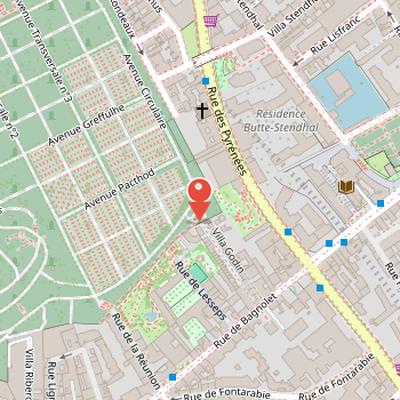
Nearby Objects
-
 Grave of Victor Noir 300 m away
 -
 Père Lachaise Cemetery 450 m away
 -
 Frédéric Chopin’s tomb 550 m away
 -
 Boulevards of the Marshals 700 m away
 -
 The Triumph of the Republic 1300 m away
Location and Historical Significance
The Communards' Wall is part of the enceinte du cimetiere du Pere-Lachaise in Paris, located at the southeast corner of the cemetery. It is associated with the execution of combattants de la Commune by the armee versaillaise at the end of the Semaine sanglante in 1871. This connection gives the site its historical significance within the cemetery.
Memory and Commemoration at the Mur des Federes
The memory associated with the Mur des Federes is rooted in the violent suppression of the Commune insurrection by the Versailles army, which entered Paris on May 21, 1871. According to Histoire, the Bloody Week caused several thousand federates to die and led to massive destruction through intentional fires in capital city monuments and buildings. Only the Belleville district continued to resist on May 27, 1871, when the last communal cannon shots were fired from the heights of Buttes-Chaumont and Pere-Lachaise cemetery. The assault on Buttes-Chaumont began early in the afternoon, and the tricolor flag was quickly raised there. In the same period, the Versailles reserve corps seized the Porte de Montreuil and Porte de Bagnolet, advancing into the Charonne district, while close-combat fighting continued near tombs. Estimates of the number of victims remain contested: Michlele Audin cited sources indicating a minimum of 6,667 victims, plus uncounted individuals burned, thrown in wells, or buried in suburban pits, while Jacques Rougerie considered 10,000 deaths the most plausible figure. Despite the brief and elusive nature of the Commune, with few monuments surviving, remembrance of the repression became concentrated on the Mur des Federes, which acquired symbolic value in militant memory as a site of emancipation and freedom. This commemorative role continues through annual May 1 observances by the Grand Orient of France, Masonic organizations, free-thinkers, the French Communist Party, and unions. In 1982, Prime Minister Pierre Mauroy became the first sitting head of government to lay a wreath there. The site also entered cultural memory through Jules Jouy's 1887 songs Le Tombeau des fusilles and Le Mur.
Memorial Status and Surroundings
The Communards' Wall and other monuments in Pere-Lachaise were classified as a monument historique by decree. The site includes a marble plaque with an engraved inscription, while the original marble plaque was deposited at the premises of Amies et Amis de la Commune de Paris, rue des Cinq-Diamants in Paris. The wall is also closely associated with nearby funerary and commemorative elements: several tombs of communard personalities are located opposite it, including those of Jean-Baptiste Clement, Paul Lafargue, and Laura Marx.
The wall is not the original wall against which the federes were shot, since that wall was damaged and rebuilt. Stones from the original construction were later reused for the monument Aux victimes des revolutions, sculpted in 1909 by Paul Moreau-Vauthier and located in the garden Samuel-de-Champlain. Another related commemorative place is the burial site along the southern wall of the current cemetery, where nearly eight hundred skeletons wearing military clothes were found during demolition work at the Charonne cemetery annex. Examination of uniform buttons identified them as federes shot summarily and buried in common graves at Charonne. They were reburied in 1897 without an epitaph, and a commemorative plaque now marks the site.