Église Notre-Dame-de-la-Croix de Ménilmontant is a Catholic church in the Ménilmontant district of the 20th arrondissement of Paris, France. The present building replaced an earlier chapel that had become insufficient for the needs of the parish. Construction of the new church began in 1863, it became a place of worship in 1869, and work was completed in 1880. Listed as a historic monument since 2017, it is among the largest churches in Paris, ranking fourth by volume.
The church measures 80 metres in length, 33 metres in width, and 16 metres in height under the nave vault. Its architecture combines neo-Romanesque and neo-Gothic elements, with an elongated plan and a narrow central nave. A 65-metre bell tower rises above the building, and a monumental staircase precedes the facade; the church is also built on the steep slope of Ménilmontant hill. Its history includes use for political meetings during the Commune de Paris.

Nearby Objects
-
 Père Lachaise Cemetery 950 m away
 -
 Frédéric Chopin’s tomb 1000 m away
 -
 Grave of Victor Noir 1100 m away
 -
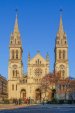 Saint-Ambroise 1200 m away
 -
 Stade Bergeyre 1200 m away
Architecture and Status
The Catholic church is located in the Meningtomont district of the 20th arrondissement of Paris, France. It measures 80 meters in length, 33 meters in width, and 16 meters in height under the nave vault. Its design combines neo-Romanesque and neo-Gothic elements. The building also includes a 65 meter high bell tower and a monumental staircase in front of the facade. By volume, it is among the largest churches in Paris, ranking fourth. The church has been listed as a historic monument since 2017.
From Chapel to Parish Church
For a long time, Ménilmontant was under the authority of the cur of the Saint-Jean-Baptiste de Belleville church. At the beginning of the 19th century, the population of the area increased, and in 1823 the cur of Belleville, abbe Longbois, built the chapel Notre-Dame-de-la-Croix. Abbe Depille was the first cur of the chapel. The chapel became an independent parish in 1858, but by the middle of the 19th century it was no longer sufficient for the needs of the parish, as it could hold only four hundred people. It was then demolished and replaced by the current church. Construction of the new church began in 1863 and was completed in 1880, although it became a place of worship in 1869. During the Commune de Paris, militants used the church for political meetings, and the death of Archbishop Georges Darboy was voted by acclamation there. The name of the church comes from a statue of the Sainte Vierge that was originally located in a Ménilmontant establishment owned by the brothers of Sainte Croix, chanoines reguliers on rue Sainte-Croix-de-la-Bretonnerie in Paris, a building destroyed during the revolution of 1789.
Architecture and Structural Design
The current church was designed under Napoleon III by architect Louis-Jean-Antoine Heret in a neo-Romanesque style, with inspiration from Romanesque and Gothic models. Its plan is elongated, with a narrow central nave. Built on the steep slope of Ménilmontant hill, it requires a staircase of 54 steps between the square and the choir. Architecture and decoration also emphasize its size, describing it as the third longest church in Paris and noting its large surface of slate roofing. A part of the lower copper roofing is original.
The building combines a traditional appearance with modern structural elements. Heret added metal structures to support the vaults, and the attic roof is supported by wooden frameworks with metal beams, complemented by cast iron ribs under the nave vaults. This metal structure is particularly visible beneath the nave vaults, making it one of the defining features of the church interior.
Architecture and Interior Decoration
The architecture and decoration of Notre-Dame-de-la-Croix de Ménilmontant include a range of paintings, sculpture, stained glass, and liturgical furnishings. The oldest painting mentioned is Martyrdom of Saint Crespin, dated 1620 and attributed to Alexandre Durant, whose work is otherwise known only from this painting. Other artworks are mostly dated to the time of the church inauguration. Among them are sculptures of two angels adoring the Sacred Heart in faience by Jules Loebnitz after Leon Chedeville, as well as sketches by Jules Louis Machard for the apse chapel, dated around 1875, showing the Annunciation, Assumption, Stabat Mater, and Visitation. The interior also includes a composition by Albert Chanot in the right transept.
The churchs architectural features include a rose window in the transept, an oculus above the lateral entrance door, and two stained glass windows. Inside, the furnishings include the pulpit and the baptismal font. The organ, built in 1874 by Aristide Cavaille-Coll, is described as having three manual keyboards and 26 stops, with a sound quality that is recognized. Its case is placed on both sides of the organ loft, while the center was left empty to allow passage of bells and avoid blocking the large rose window. The church also has a grand organ, a choir organ, and an organ located behind the altar.
Parish Bulletin and Local Publishing
Since 1945, the curates of the parish have been associated with the parish bulletin LAmi de Ménilmontant. This publication is a Christian local news journal, also known as L'Ami du 20e, and it is described as an independent journal. The bulletin reflects a continuing link between the parish and local Christian communication.