Frédéric Chopin’s tomb is located in the Père-Lachaise cemetery in Paris. It is a funerary monument created by Auguste Clésinger and inaugurated in 1850. The monument is classified as a historical monument, reflecting its recognized cultural and historical significance. Chopin died at the age of 39 at 12 place Vendôme after many years of illness. He had lived there in an apartment rented by his student Jane Stirling since autumn 1849. Following his death, a funeral was held at the church of la Madeleine, where Mozart’s Requiem, the funeral march, and two preludes were performed. The ceremony was attended mainly by artists and men of letters, and the procession then moved to Père-Lachaise cemetery. The tomb stands as the final memorial connected to this funeral and burial sequence.
Nearby Objects
-
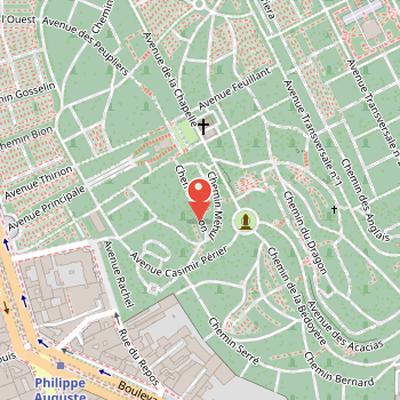
 Père Lachaise Cemetery 150 m away
 -
 Grave of Victor Noir 300 m away
 -
 Communards' Wall 550 m away
 -
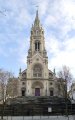 Église Notre-Dame-de-la-Croix 1000 m away
 -
 Boulevards of the Marshals 1200 m away
Frédéric Chopin's Tomb at Pere Lachaise
Frdric Chopins tomb is located in the P re-Lachaise cemetery in Paris. It is a funerary monument created by Auguste Cl singer and was inaugurated in 1850. The monument is classified as a historical monument, reflecting its recognized heritage status.
Death and Funeral
Frédéric Chopin died at the age of 39 in the night at 12 place Vendome. He had lived there in an apartment rented by the student Jane Stirling since autumn 1849, and had suffered from illness for many years. He wished for Mozarts Requiem to be performed after his death.
His funeral took place in the church of la Madeleine and was attended mainly by artists and men of letters. Around three thousand guests were present, and some compared the ceremony to the 1840 return of Napoleons ashes. The music included Mozarts Requiem, the funeral march, and two preludes, performed by Louis James Alfred Lefebure-Wely, Pauline Viardot, Castellan, Luigi Lablache, and Alexis Dupont. At the time, women were not allowed to sing in public during religious ceremonies, but Archbishop of Paris Marie Dominique Auguste Sibour allowed them to sing if their faces were hidden by a black velvet curtain. George Sand was absent. Giacomo Meyerbeer, Eugene Delacroix, Auguste-Joseph Franchomme, and Camille Pleyel held the cords of the pallbearers. The funeral procession then went from the church of la Madeleine to Pere-Lachaise cemetery.
Burial at Pere-Lachaise Cemetery
Frederic Chopin's remains are provisionally buried in a simple vault at Pere-Lachaise Cemetery. The vault has some Polish soil scattered on it from an urn kept since departure from Poland. The burial concession, PA 1849, is located near the Denon path. His remains rest close to Luigi Cherubini, Francois-Antoine Habeneck, and Teresa Milanollo within the cemetery.
Funding and Commemoration
The definitive tomb received fifteen thousand francs from students and a sister to help build the funerary monument, while the remaining funds were gathered through a subscription. Its committee included Albrecht, Eugene Delacroix, Franchomme, Herbault, painter Kwiatkowski, Camille Pleyel, and the student Jane Stirling. The monument was inaugurated on the first anniversary of Chopin's death. In 1880, a new subscription was launched to ensure its maintenance. Jane Stirling, who died in 1859, started the tradition of annual pilgrimages to Pere-Lachaise, and this practice was revived in 1911 by the French musicologist Edouard Ganche, together with Maurice Ravel and Camille Le Senne, through Societe Chopin.
The Heart of Chopin in Warsaw
The monument in Warsaw contains the heart of Chopin in his country of origin. The heart was removed by Cruveilhier during Chopin's autopsy and later brought to Warsaw by Chopin's sister, Ludwika. It was first stored in the family house before being placed in the catacombs of the Holy Cross Church with the help of Bishop Jan Dekert. In 1878, it was transferred to the nave of the Holy Cross Church.
Proposals to Transfer the Remains
In the 1920s, projects were discussed to transfer Chopin's remains to Poland. These plans were supported by Edouard Ganche, who served as president of the Chopin society. Later, in 2010, Alain Duault proposed transferring Chopin's remains to the Pantheon. The related proposal to transfer George Sand's remains to the Pantheon in 2004 did not go ahead.