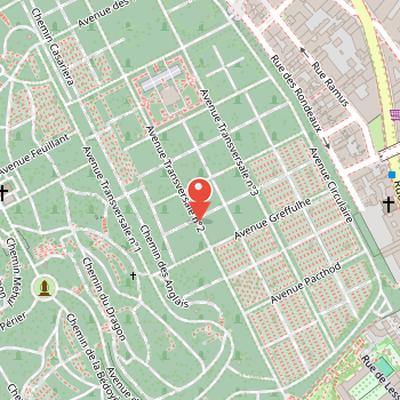
The grave of Victor Noir is located in Père-Lachaise Cemetery in Paris, near the transverse avenue. Victor Noir was a journalist killed by Pierre-Napoléon Bonaparte, and his death led to popular indignation; he later became a republican symbol. After first being buried at the old cemetery of Neuilly-sur-Seine, his remains were transferred to Père-Lachaise after the Paris municipal council granted a burial plot there. The tomb includes a bronze recumbent sculpture by Jules Dalou, created in 1891. Dalou worked on the statue free of charge, and the plaster model was exhibited at the Salon des artistes français before the bronze version was inaugurated at Père-Lachaise. The life-size figure is shown in the state after the gunshot and is rendered in a realistic style without ornamentation. It has an open mouth, gloved hands, unbuttoned clothing, and a rolled hat. A slab beside the figure bears an inscription and Dalou’s signature.
Nearby Objects
-
 Père Lachaise Cemetery 200 m away
 -
 Communards' Wall 300 m away
 -
 Frédéric Chopin’s tomb 300 m away
 -
 Boulevards of the Marshals 950 m away
 -
 Église Notre-Dame-de-la-Croix 1100 m away
Victor Noir's Tomb in Pere-Lachaise
Victor Noir was a journalist killed by Pierre-Napoleon Bonaparte, and his remains were transferred to a tomb in the Pere-Lachaise Cemetery in Paris. The tomb is marked by a bronze recumbent sculpture created by Jules Dalou in 1891. Because of the kinship of Noir's killer with Emperor Napoleon III, Victor Noir later became a republican symbol. The sculpture has also become known for a tradition of touching certain parts of the figure.
Location at Pere-Lachaise Cemetery
The Grave of Victor Noir is buried in the Pere-Lachaise Cemetery in Paris. Its exact position is not specified, but it is located in an area of the cemetery near the transverse avenue. This placement situates the grave within one of the cemetery's well-known burial grounds.
Transfer to Pere-Lachaise and the Dalou Monument
Victor Noir was killed by Pierre-Napoleon Bonaparte and first buried at the old cemetery of Neuilly-sur-Seine. His murder, carried out by a cousin of the emperor, caused popular indignation, and he became a republican symbol. As his tomb at Neuilly was no longer maintained, the Paris municipal council granted him a burial plot at Pere-Lachaise cemetery, and his remains were transferred there. Jules Dalou created a recumbent statue for the grave without charge. The plaster model was exhibited at the Salon des artistes francais, and the bronze statue was later inaugurated at Pere-Lachaise cemetery.
Design and Appearance
The grave features a life-size bronze representation of Victor Noir shown in the state after the gunshot. It is modeled in a realism style without ornamentation, which is exceptional among Dalou's monumental works. The figure has an open mouth, gloved hands, unbuttoned clothing, and a rolled hat. Dalou first modeled the nude figure before dressing it, sculpting the genitalia under the trousers. The sculpture is long, corresponding to Victor Noir's tall stature during life. Next to the figure, on the right side of the feet, a slab carries an inscription, and Dalou's signature appears in the bottom left corner of the slab.
Superstition and Public Interaction
The tomb of Victor Noir became closely associated with superstition and repeated physical contact. People were reported to touch the realistic anatomical effigy, which led to oxidation and bronze erosion over time. Accounts also noted similar degradation in Henriette Caillaux's work dedicated to Dalou. The most frequently touched areas were said to include the face relief, the bullet impact, the penis bulge under the pants, and the shoes. A folklore tradition developed around the grave claiming that women with fertility issues could touch or straddle the effigy in order to become fertile.