Montmartre is a historic neighborhood in the 18th arrondissement of Paris, France, and is not an administrative district. Until 1860, it was a commune in the department of Seine before most of its territory was annexed to Paris, with a small part assigned to Saint-Ouen. Traditionally bounded by rue Custine, rue Caulaincourt, boulevards de Clichy and Rochechouart, and rue de Clignancourt, it is known for narrow, steep streets and long staircases. The area is dominated by the basilica of Sacré-Cœur and includes the highest point of Paris on the Montmartre hill, one of the gypsum hills of the Paris area. Montmartre is also recognizable for its white appearance, linked to Château-Landon stones. The neighborhood has been associated with many artists, including Picasso and Modigliani, and became a symbol of a rural and autonomous life within the metropolis.
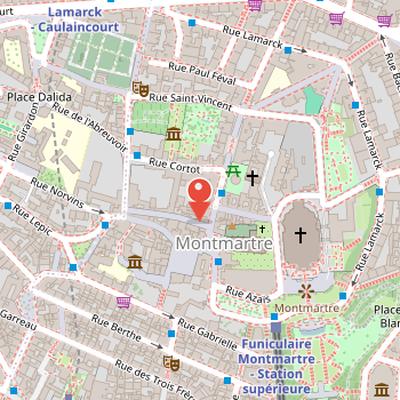
Nearby Objects
-
 Place du Tertre 40 m away
 -
 Saint-Pierre de Montmartre 70 m away
 -
 Musée de Montmartre 90 m away
 -
 Dalí Paris 110 m away
 -
 Sacré-Cœur 140 m away
History and Urban Character of Montmartre
Montmartre is a historical neighborhood in the 18th arrondissement of Paris, France, rather than an administrative district. Until 1860, it was a commune in the department of Seine. In that year, the commune was annexed by Paris, except for a small part assigned to Saint-Ouen. Most of its territory was then integrated into the 18th arrondissement, named des Buttes-Montmartre, which also includes the administrative quarters of Grandes-Carrieres, Clignancourt, Goutte-d'Or, and La Chapelle.
The neighborhood is traditionally bounded by rue Custine to the north, rue Caulaincourt to the west, boulevards de Clichy and Rochechouart to the south, and rue de Clignancourt to the east. It is known for narrow, steep streets lined with long staircases, and it remains a highly touristic area in northern Paris.
Montmartre is dominated by the basilica of Sacre-Coeur and contains the highest point of Paris on the Montmartre hill. This hill is one of the gypsum hills on both sides of the Seine known as the collines de Paris. The natural ground altitude inside the Calvaire cemetery reaches 130 meters. The neighborhood is also adjacent to the Saint-Pierre church, the oldest church in current Paris.
Montmartre hosted many artists, including Picasso and Modigliani, and became a symbol of a rural and autonomous life within the metropolis.
Distinctive White Appearance
Montmartre is recognized by its characteristic white color, which comes from the use of Chateau-Landon stones. These stones whiten when they come into contact with water, giving the area its well-known pale appearance.
The Name and Etymology of Montmartre
The toponymy of Montmartre offers a dual etymology. One explanation links the name to mons Martis, or the mount of Mars, based on a Gallo-Roman temple dedicated to Mars near a temple to Mercure at the site of the current Saint-Pierre church. Another tradition connects it to mons Martyrum, meaning the mount of Martyrs, associated with Saint Denis and his companions Rustique and Eleuthere, who were said to have been beheaded there during anti-Christian persecutions. The name may have shifted from a pagan reference to a Christian one, but this substitution remains hypothetical. The form mont de martre is also presented as a popular development. The dual interpretation as both mount of Mars and mount of Martyrs is still proposed.
Montmartre in the Middle Ages and Early Modern Period
The history of Montmartre is closely linked to the church of Saint-Pierre de Montmartre, which is mentioned for the first time in 850 in the Liber miraculorum S. Dionysii. The village was pillaged by the Normans during the siege of Paris in 885. In 1133-1134, King Louis VI founded the royal abbey of the Ladies of Montmartre near the church of Saint-Pierre. This abbey, known as the abbaye d'en haut, later shaped the local territory, whose lordship extended over the west part of the current area, the north part of another area, and part of Batignolles.
In 1686, the abbaye d'en haut was abandoned for new buildings built mid-slope around present rue Yvonne-Le-Tac, known as the abbaye d'en bas. The cloister of the upper abbey, adjacent to Saint-Pierre, was destroyed, while other buildings were reused as barns or stables. The parish boundary with Saint-Eustache was fixed at several routes that later became rue Saint-Lazare, rue Lamartine, and rue Bleue. Two annex chapels were also founded: Notre-Dame-de-Lorette before 1646 for the Porcherons quarter and Sainte-Anne in 1656 for the Nouvelle France quarter. The Sainte-Anne chapel later became the origin of the church Saint-Vincent-de-Paul.
Montmartre also remained a strategic place in later conflicts. Henri IV installed two artillery batteries during the siege of Paris in 1590. In the mid-18th century, the Clignancourt porcelain manufacture was founded in the hamlet dependent on Montmartre, with the intention of using alabaster from Montmartre quarries. By the 19th century, the commune was made up of two main centers, and the construction of the Thiers enceinte in 1840-1845 left a small part of its territory outside the enclosure, which was attached to Saint-Ouen in 1860.
Montmartre: Boundaries, Views, and the Maquis
Montmartre is described as a historical Parisian neighborhood rather than an administrative one, and it has no precise geographical boundaries. Its traditional limits are given as rue Custine to the north, rue Caulaincourt to the west, the boulevards de Clichy and de Rochechouart to the south, and rue de Clignancourt to the east. The commune of Montmartre was suppressed by law during the extension of Paris from mur des Fermiers generaux to enceinte de Thiers, with territory redistribution.
The Histoire section presents Montmartre through a series of works that show its changing appearance over time, including Canons de Paris ported to Montmartre in 1789 by Jean-Louis Prieur, Montmartre under snow by Georges Michel around 1800, La Plaine vue de Montmartre around 1848 by Theodore Rousseau, Vue de Montmartre in 1850 by Johan Barthold Jongkind, and Le sommet de la butte Montmartre with the tour Solferino around 1870. It also includes Vue de la butte Montmartre from La Plaine Saint-Denis in the mid-19th century.
Between the late 19th and early 20th century, Haut-Montmartre was described as disreputable compared with Bas-Montmartre. Haut-Montmartre included the maquis de Montmartre, located between rues Lepic and Caulaincourt. The maquis was a vacant lot inhabited by poor populations, including workers, uprooted peasants, and bohemian artists living in wooden shacks. A remnant of this area can still be seen today as a small park with a boulodrome and passage de la Sorciere.
Local Population and Social Life
Histoire describes Montmartre as a place whose population was mostly made up of winemakers, laborers, and millers. It also notes that these same groups ran taverns or guinguettes on Sundays and holidays, suggesting a local social life centered on informal public gathering places. This detail highlights the everyday working character of Montmartre and the role of leisure and hospitality in its community life.
Demographic Evolution and Annexation
The demographic evolution of Montmartre is documented through population censuses taken in the commune between 1793 and 1856, including a count of the commune population in 1856. This record also notes a major administrative change in 1860, when the commune ceased to exist as an independent entity after being annexed by Paris. The former commune is said to correspond mostly to the western half of the new entity formed after this annexation.
Geological Formation of Montmartre Hill
Montmartre hill is one of the hills of Paris and is described as a witness hill formed on both sides of the Seine. These hills are Oligocene in age and are composed of gypsum horizons and Ludian intercalary marls. They are remnants of the former extension of resistant limestone platforms, which consisted of coarse Lutetian limestone and Cretaceous chalk. According to the geological description, these platforms were incised by regressive erosion, leaving the hills as surviving forms of that earlier landscape.
Montmartre in Cinema
Montmartre has frequently appeared in cinema as both a real location and a shaped screen image. In 1950, Montmartre au cinema filmed several scenes in the stairs and streets of the hill in Le Chateau de verre, including scenes among ruins that remained after aerial bombings by allied forces. The district was also used as a complete setting for French Cancan in 1955, where all the action took place entirely in Montmartre. In 1956, Montmartre au cinema presented the last sequence of Si Paris nous etait conte at place du Tertre.
The district also appears through adaptations and later film and television works. Sous les toits de Montmartre was adapted from Emmerich Kalman's operetta Violette de Montmartre and was later shown on Soviet television for the first time on an unspecified date. François Truffaut's films Les Quatre Cents Coups, Baisers voles, and Le Dernier Metro were partly set in Montmartre. More recent films continued to use the area as a visual reference: Le Fabuleux Destin d'Amelie Poulain created an original representation of Montmartre in 2001 and depicted the Cafe des 2 Moulins on rue Lepic as a place attracting tourists worldwide. In the same period, Moulin Rouge portrayed Christian meeting Henri de Toulouse-Lautrec and falling in love with Satine, while Woody Allen's Minuit a Paris showed several Montmartre images from Sacre-Coeur to Moulin-Rouge in 2011. Montmartre was also the setting for Bruno Podalydes' segment of Paris, je t'aime, and for the short film Le Reve des Apaches by Helie Chomiac, set in early 20th century Montmartre.
Montmartre in Cinema
Montmartre has appeared in several film productions under the label Montmartre au cinema. These include Dede la musique, also known as Dede de Montmartre, directed by Andre Berthomieu, as well as Les nuits de Montmartre, released in 1955. In 1979, Catherine Breillat directed Tapage nocturne, which depicted Solange, a filmmaker. Montmartre also appears in Les Mauvaises frequentations, also known as Du cote de Robinson, directed by Jean Eustache in 1963. In that film, Daniel and Jackson meet at Place Clichy and later approach a woman in the streets of Montmartre. Another production, Le Reve des Apaches, featured Parisian thugs played by Damien Jouillerot and Cyril Descours. Later, Les Arpenteurs de Montmartre was produced in 1993 and directed by Boris Eustache. These films show Montmartre as a recurring setting and subject in cinema across different decades.
Montmartre in Comics
Montmartre dans la bande dessinee presents the neighborhood and the history of the Paris Commune through a detailed reconstruction of the 1870s and 1880s. The subject appears in a two-part comic by Francois Bourgeon titled Le Sang des cerises, and it also reflects Jacques Tardi's attachment to the city in almost all his albums. Tardi's work on the capital extends beyond comics to numerous lithographs, serigraphs, pigment prints, posters, and postcards. The material also includes a depiction set in Montmartre featuring Nestor Burma, the detective created by Leo Malet, as well as comic adaptations of Burma's adventures by Tardi.