Sacré-Cœur stands at the summit of the Montmartre hill in the Clignancourt district of Paris, France, near one of the highest points in the city. It is a major religious building and a property of the municipality of Paris. Built after the post-war period of 1870, it was declared of public utility by a law passed by the National Assembly in 1871 and was officially completed in 1923. Its dome rises to a height that makes the building visible from far away.
The site of Montmartre has long been associated with changing forms of worship, from pagan and Gallo-Roman temples to Christian devotion after the martyrdom of Denis of Paris. The present church was linked to this longer religious history and to the project inspired by Alexandre Legentil’s vow in December 1870. An urn in the crypt recalls that vow. Today, Sacré-Cœur receives nearly eleven million pilgrims and visitors per year and is the second most visited religious monument in Paris after Notre-Dame Cathedral.
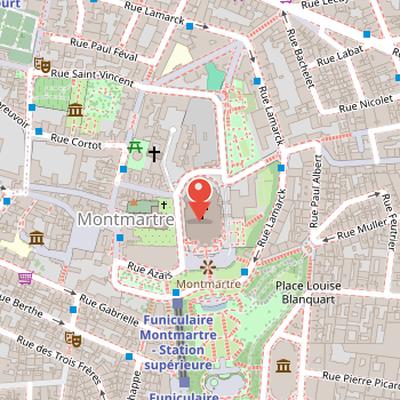
Nearby Objects
-
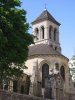 Saint-Pierre de Montmartre 70 m away
 -
 Montmartre 140 m away
 -
 Place du Tertre 160 m away
 -
 Montmartre Funicular 160 m away
 -
 Musée de Montmartre 200 m away
Location, Construction, and Public Importance
Sacre-Coeur is located at the summit of Montmartre hill in the Clignancourt district of Paris, France, at an altitude near one of the highest points in the city. It is a major religious building and a property of the municipality of Paris. The building was constructed following the post-war period of 1870, and it was declared to be of public utility by a law passed by the National Assembly in 1871. Sacre-Coeur was officially completed in 1923. Its dome rises to a height that makes the building visible from far away. As a religious monument, it receives nearly eleven million pilgrims and visitors each year, making it the second most visited religious monument in Paris after Notre-Dame Cathedral.
Montmartre and the Early Religious History of the Site
Montmartre hill has a long religious history that predates the present Sacre-Coeur context. According to tradition, it was first a place of pagan worship, later associated with Gallo-Roman temples dedicated to Mercure and probably Mars. After the martyrdom of Bishop Denis of Paris in the 3rd century, Christian worship developed on the hill. A chapel later surmounted the crypt of the martyrium of Saint Denis, and another chapel, Saint-Martyre, stood on the southern flank of the hill to commemorate the traditional place of execution of the martyrs.
The name Montmartre is traditionally explained in two ways, either from Mons Martis or Mons Martyrum. In the 4th century, Mont de Mars was reinterpreted as Mont des Martyrs, or Mons Martyrum, and later evolved into Mont de Martre in Old French. This substitution of a pagan mount by a Christian mount, together with the dual etymology, is still conventionally proposed. A written record also noted that the spoken name before the 12th century would help clarify the origin of the name change.
In the 12th century, the church of Saint-Pierre was constructed for the royal abbey of Montmartre by King Louis VI and Adelaide de Savoie. The church replaced Roman temples and was dedicated to the saints martyrs Denis of Paris, Rustique of Paris, and Eleuthere.
Project Origins and Construction
The origins of the Sacre-Coeur project lay in a religious and political response to the crises of 1870 and the following years. On September 4, 1870, the day the Third Republic was declared, Felix Fournier wrote to the priests of his Nantes diocese and attributed France's defeat in the Franco-Prussian War to divine punishment after a century of moral decline since 1789. In December 1870, Alexandre Legentil made a personal vow before his confessor Father Gustave Argand in the chapel of the Saint-Joseph college in Poitiers. An urn on a column in the chapel of the dead in the crypt recalls that this vow inspired the construction of the Sacre-Coeur Basilica in Montmartre.
Legentil's vow, together with the efforts he began with Hubert Rohault de Fleury, helped turn the project into one with national reach. Both men were disciples of Frederic Ozanam, and Legentil's strong personality in the Parisian Catholic landscape contributed to the project's wider recognition. The promoters sought official recognition from the Assembly of National as a church of public utility. The Assembly elected in February 1871 had a membership dominated by royalists, mostly Catholics, and Emile Keller acted as rapporteur for the project. The law of public utility was voted on July 30, 1873 by 355 votes, with 227 deputies abstaining. The vote took place in a political body composed of 400 monarchists, 200 republicans, 100 moderates, and 30 bonapartists.
The Montmartre site was chosen after Archbishop Joseph Hippolyte Guibert was given the option to acquire the land by expropriation. The targeted terrain behind Saint-Pierre church was then occupied by guinguettes, fairground activity, and garden plots. This choice made Sacre-Coeur the highest and most visible building in Paris. The basilica was planned to be consecrated and completed.
The construction was closely linked to conservative efforts to establish a moral order in the National Assembly of 1871, and it was also associated with the events of the Paris Commune, though the initial project was not explicitly related to them. No inscription or dedication in the basilica explicitly links it to the Commune, yet the building contains many explanatory inscriptions about its origin, motivations, construction stages, and spiritual meaning. Hubert Rohault de Fleury made a statement during the laying of the first stone. The choice of Montmartre also coincided with the site of the first Commune executions, and historian Mathilde Larrere emphasized the provocative nature of erecting the structure there, where the Commune began and ended.
Interpretations of the basilica's meaning varied. Michel Bony, in 1893, described Montmartre as the mountain of martyrs and a pilgrimage place for saints and believing France, while also stressing that it had become a center of impious and revolutionary action. He drew a parallel between the basilica's construction and the Commune events that it was meant to atone for. Jacques Benoist later moderated the role of the Commune in the project's genesis without denying it entirely, while Eric Fournier is cited as a historian specializing in the Commune. Over time, the association with the Commune developed gradually, and the basilica became for many Parisians close to the communards a symbol of repression. David Harvey described its construction as penance for the excesses of the Commune and noted that it remains a political symbol today. In contemporary times, the association with the Commune has intensified, and the green space below the basilica was named Square Louise Michel in 2004. Left-wing political figures often state that the basilica was built on the blood of communards. The construction and its motivations have therefore remained the subject of extensive debate, especially in a period of increasing secularism in France.
Design and Construction of Sacre-Coeur
Paul Abadie won the competition for the construction of Sacre-Coeur and designed a Romano-Byzantine basilica with a dome, turrets, and a campanile. His project was presented as a reaction against the neo-baroque style. The building campaign then passed through several architects and managers over time: Honoré Daumet replaced Abadie from 1884 to 1886, followed by Charles Laisne from 1886 to 1891, during whose period Emile Hirsch was involved in creating stained glass. Henri-Pierre Rauline managed construction from 1891 to 1904, with Charles Garnier serving as consulting architect. Lucien Magne directed the work from 1904 to 1916, and Jean-Louis Hulot managed construction from 1916 to 1924. The project was mostly funded by numerous French people through a national subscription, which did not require each supporter to pay a large amount, only what was possible.
Construction, Donation, and Architectural Development
The project for Sacre-Coeur was shaped by the Souscription des Pierres, an idea imagined by Hubert Rohault de Fleury to encourage families and groups to fund stones, columns, or chapels. Donors could have their full names, initials, or coats of arms engraved on the elements they purchased. Over fifty years, the project collected nearly forty-six million francs from nearly ten million faithful donors. The archbishop of Paris, Cardinal Joseph Hippolyte Guibert, laid the first pink marble stone of the basilica near the old Moulin de la Galette, and the church became known by the people of Montmartre as Notre Dame de la Galette. It was entrusted to the congregation of Oblats de Marie-Immaculee.
The site required major groundwork because the Solferino tower, destroyed in 1874, had stood approximately where the project later developed. Months were needed to consolidate the foundations with underground galleries and by replacing thirty-three meters of soft earth with stone and cement. The galleries were filled with concrete and linked by strong arcatures acting as pillars reaching the solid layer under the clay mound. A temporary chapel was inaugurated next to the works on January 1, 1875. Construction of the crypt began in 1878, and construction of the basilica itself began in 1881. The interior nave was inaugurated on June 16, 1919.
Architecturally, Rauline and Magne kept Abadie s original plan but added neo-Renaissance elements such as rounded window shapes and elongated domes. Abadie had planned Roman-Byzantine hemispherical domes, but Magne replaced them with oval-shaped neo-Renaissance elongated domes. This change was made to correct an optical deformation perceived by pilgrims on the church s forecourt. During the period of sequestration, the Third Republic sought to remove the Church's use of the basilica and convert it into a people's house or theater, until the Clemenceau government ended the sequestration by law on April 13, 1908.
Construction and Later Additions
Work on Sacre Coeur progressed over several decades. The campanile tower-lantern, topped by a cross, was completed in 1912, while the full facade was not finished until 1914. The church had originally been scheduled for consecration on June 29, 1915, but this was postponed because of the war. It was eventually consecrated on June 16, 1919, and elevated to minor basilica status on the same day. The ceremony was celebrated by Cardinal Antonio Vico and attended by Cardinal Leon Adolphe Amette, Archbishop of Paris, as well as many bishops, ecclesiastical dignitaries, clergy members, civil personalities, and faithful. The building was officially completed in 1923 with interior decoration, including apse mosaics.
Stained glass windows were installed between 1903 and 1920, but they were destroyed during the Second World War and later replaced with contemporary ones. In the 1930s, annexes such as a sacristy, offices, and a dormitory were added to accommodate pilgrims. The building was definitively completed after the Second World War.
Architecture and Materials
Sacre-Coeur is not built according to the traditional basilical plan. Instead, it has a Greek cross shape adorned with four domes, and its eclectic style was inspired by Romanesque and Byzantine architecture as well as specific cathedrals and basilicas. The central dome, whose height under the keystone made it the highest point in Paris before the construction of the Eiffel Tower, is topped by a lantern formed of a colonnade. A spiral staircase with 237 steps leads to the dome's inner and outer galleries, from which visitors can see inside the church or take in a circular panorama.
The basilica is oriented north-south rather than the more usual east-west arrangement, a choice linked to the narrow plateau topography and symbolic reasons. It is built with lacustrine limestone from the quarries of Chateau-Landon and Souppes-sur-Loing, a white fine-grained limestone selected by Paul Abadie for its hardness and self-cleaning properties. This stone was also used for parts of the Arc de Triomphe, the bases of the Eiffel Tower, and sections of the Louvre and Tuileries. The structure rests on gypsum, with pillars passing through overlying marls and sands.
On the southern facade, the basilica has two levels, with a lower porch of three arcades. The porch contains three bronze doors with tympanums featuring bas-reliefs by Leon Fagel and Hippolyte Lefebvre, and it is covered by a terrace with balusters and two equestrian statues installed in 1927. The building's design also influenced several other 20th-century religious buildings.
Sculptural Program and Exterior Details
The exterior of Sacre-Coeur includes several sculptural elements that define its architectural character. In the left sculpture, replacing Saint Georges in 1891, Saint Louis is shown brandishing his sword with one hand and the crown of Christ with the other. The right sculpture, which replaced Saint Martin in 1925, represents Jeanne d'Arc. The building also features a Christ Blessing statue, replacing Gustave Michel's model that was present from 1907 to 1927. Additional decoration appears in the tympans of the lateral bays, where bas-reliefs depict Marie Madeleine and the Samaritaine. A campanile completes the composition, with angels sculpted by Jean Dampt at the exterior angles of its loggia.
The Bell Tower and La Savoyarde
Sacre-Coeur includes a large square tower finished in 1914, which serves as a bell tower. Its most notable bell is La Savoyarde, the largest bell in France. The bell was cast in Annecy in 1895 by the foundry of the brothers Paccard and was given as a gift by the four dioceses of Savoie. It arrived on the hill on April 16, 1895. La Savoyarde measures 2.03 meters in diameter and weighs 18,835 kilograms. Its support weighs 28,000 kilograms, and its hammer weighs 500 kilograms.
Interior Chapels and Sacred Decoration
Sacre-Coeur contains a series of interior chapels accessible from the main door, beginning on the right side. The basilica also has a crypt designed with the same layout as the church above it. Around the crypt runs a four-meter-wide saut-de-loup with windows and oculi in the wall, while the central space is occupied by the chapel of the Pieta. This chapel includes a monumental statue of the Virgin at the foot of the Cross by Jules Coutan from 1895, as well as the first stone of the basilica. Beneath it are the tombs of important persons, including cardinals Guibert and Richard. Other crypt features include statues and sculptures such as Saint Hubert de Liege, Saint Malo, Saint Jean de Dieu caring for a sick person, Saint Bruno the Carthusian, and a statue and funeral slab of Cardinal Joseph Hippolyte Guibert.
The crypt is organized by ambulatory walkways serving seven lateral chapels on the east and seven on the west, corresponding to the basilica aisles. The apse chapel is dedicated to the Holy Family and contains a Sacred Heart statue by Robert Falcucci from 1960. Another chapel is dedicated to Saint Peter and is placed on multiple steps with columns dominating the crypt; it corresponds to the basilica choir. The Saint-Michel or Army chapel is adorned with military ex-votos and dedicated to Saint Joan of Arc, with statues of Saint Michael by Louis Noel and Saint Joan of Arc by Leon Fagel. The Saint-Louis chapel was offered by the bar association and magistrature and includes bas-reliefs by Hippolyte Lefebvre and mosaics by Pascal Blanchard. Other chapels and tribunes include the Commerce and Industry chapel, the chapel of Marguerite-Marie Alacoque, and chapels dedicated to Saint Benedict Labre, Saint Francis of Assisi, Saint John the Baptist, Saint Joseph, Saint Ignace de Loyola, Sainte Ursule de Cologne, Saint Vincent de Paul, Saint Isidore of Seville, Sainte-Radegonde of Poitiers, Sainte-Clotilde, Sainte-Bathilde, and the Marine.
The choir is marked by an apse covered with the largest mosaic in France, made with Emaux de Briare across 475 square meters. Designed by Luc-Olivier Merson and executed from 1918 to 1922 by Parisian mosaic artists from the Guilbert-Martin workshop, it depicts the Sacred Heart of Jesus surrounded by the Virgin Mary, Saint Michael, the pope, and Jeanne d'Arc. A Latin inscription on the frieze means, To the Most Sacred Heart of Jesus, penitent, fervent, and grateful France. The master altar in Sienna marble was designed by Henri-Pierre Rauline, with a retable by Lucien Magne showing Christ on the cross surrounded by apostles, and a gilded silver ciborium designed in 1902 above the tabernacle. In front of the master altar stands a golden altar from the crypt. The choir also contains silver statues of the Sacred Heart of Christ and the Virgin and Child, created by Eugene Benet and Paul Brunet respectively. Hippolyte Lefebvre executed a major part of the basilica's sculpted decoration, and the campanile bears symbols of the four evangelists sculpted by Henri Bouchard in 1911.
The Great Organ of Sacre-Coeur
The Grandes orgues de la basilique du Sacre-Coeur were built by Aristide Cavaille-Coll in 1898. Originally made for the chateau d'Ilbarritz, the organ was later bought by the basilica after being stored in Cavaille-Coll-Mutin warehouses. It is described as the last great instrument of Cavaille-Coll and has four manual keyboards and a pedalboard. After modifications, it was inaugurated by Charles-Marie Widor, Marcel Dupre, and Abel Decaux, the first titular organist.
The instrument underwent several changes in the 20th century. Société fermiere des etablissements Cavaille-Coll carried out modifications in 1930-1931, and Jean Perroux performed a relevaage in 1948 that removed three high ranks of the solo cornet. In 1959, Beuchet-Debierre, under the direction of Rolande Falcinelli and Marcel Dupre, transformed the organ further. During these works, some stops were modified, cut, shifted, and exchanged between keyboards. The principal of the positive was tuned in Unda Maris, a cymbal was added to that keyboard, the bassoon-oboe at the combination stop lay was replaced by a recorder, mixtures were recomposed, the solo tremolo was removed, and two stops were added to the solo keyboard. At the vicar's request, the central part of the organ case was also removed, splitting the solo's expressive box. Joseph Beuchet suggested electric transmissions, but Marcel Dupre opposed this, preserving the original Cavaille-Coll console.
By the early 1980s, the organ had deteriorated to the point of being nearly unplayable, and a restoration program was led by Daniel Roth. The 1985 restoration removed the 1959 additions and replaced parts according to the original aesthetic standards. The cymbal of the positive was replaced by a progressive cornet, the Mutin stop was transformed into a reed stop, the recital plein-jeu was recomposed with a resultant 16, and the three high ranks of the solo cornet were restored. The organ was inaugurated again after the restoration in 1985. It is currently maintained by Bernard Dargassies, but it is heavily dusted by soot from candles, and a further restoration is currently under study.
Organists and Musical Stewardship
The organ-related stewardship associated with Sacre-Coeur includes several named musicians with additional church appointments. Gabriel Marghieri is also organist at the Sanctuary Saint-Bonaventure in Lyon. Philippe Brandeis is also co-holder of the organ at Saint-Louis des Invalides. Claudine Barthel has held the position since 1969, and she was also holder at the churches Sainte-Genevieve and Notre-Dame-du-Perpetuel-Secours in Asnieres-sur-Seine. These overlapping responsibilities place Sacre-Coeur within a wider network of church musical practice and professional appointments.
Interior and Exterior Features of Sacre Coeur
The images show both the interior and exterior of Sacre Coeur, highlighting its religious decoration and distinctive architectural details. Inside the basilica, the choir, the apse, and a mosaic are visible, along with a stained glass window depicting the Sacred Heart of Jesus. Other devotional elements include a holy water font, the Stations of the Cross, and a monstrance with the consecrated Host. The basilica is also shown as a place of perpetual Adoration, emphasizing its ongoing liturgical use.
Several images focus on the building's domes and coverings. One view shows the dome with four angels, each carrying a symbol of the Passion of Christ. Another displays the domes adorned with alternating plain and scale-sculpted longitudinal bands. The covering of the chevet, small apses, and naves is shown as simulating rectangular tile surfaces.
Exterior views include the facade seen from rue du Cardinal-Dubois, a view of boulevard Marguerite-de-Rochechouart, and nighttime images of the basilica. The surrounding cityscape also appears, with views of the Eiffel Tower and the Montparnasse Tower with the Stade de France in the background. A video of visitors on Montmartre and at the basilica further indicates its public visibility and visitor interest.
Sanctuaire catholique at Sacre Coeur Basilica
Sanctuaire catholique at the Sacre Coeur Basilica in Montmartre is dedicated to the Eucharistic Adoration of the Blessed Sacrament. Since 1885, it has maintained continuous prayer by the faithful without interruption, and at its consecration it received the mission of constant intercession for the Church and the world. The sanctuary also reflects a broader effort of faith revitalization, responding to the hesitations of the faithful influenced by media waves and seeking to change perceptions toward others of all conditions and religions.
Its activities include organizing meeting hubs and deepening sessions in homes, led by Father Morand and extended across the Paris region and beyond. Young people trained in the basilica help animate these meetings. The sanctuary's evangelization initiatives showed visible results during the first part of the pontificate of John Paul II, and its succession by Maxime Charles's successors, including Francois de Vorges, marked the permanent influence of the basilica. Since 1995, it has changed accompaniment methods, stopped organizing pilgrimages to Chartres, and no longer holds Communion on knees, a practice that had been specific to the basilica until that date.
Controversies and Heritage Status
The construction of the basilica drew criticism from artists such as Theophile Alexandre Steinlen and Adolphe Leon Willette, as well as writers Francisque Sarcey and Emile Zola, who described it as a symbol of obscurantism. Public controversy around the site continued into the 20th century. In 1904, the municipal council of Paris seized land near the basilica that had been held by the archbishopric, and in the same year it decided to erect a statue of Francois-Jean Lefebvre de La Barre nearby. That statue, sculpted by Armand Bloch, was inaugurated in 1905. The municipal council also renamed rue de La Barre as rue du Chevalier-de-La-Barre in 1907. The statue was moved to Square Nadar in 1926 as a gesture to the Catholic community, then removed and melted down in 1941; a new statue was inaugurated in Square Nadar in 2006.
The basilica also remained a subject of political and artistic dispute. In 1912, the painter Felix Del Marle published a Futurist Manifesto in Paris Jour and called for the destruction of Montmartre's butte and its replacement with skyscrapers and transport networks, prompting a dispute with the futurist Gino Severini over Montmartre's future. In the 1990s and again in 2013, left-wing politicians including Lionel Jospin and Ian Brossat requested the basilica's destruction or transformation, linking it to repression of the Paris Commune. Despite these debates, the basilica received a unanimous favorable opinion from the Ile-de-France heritage commission in 2020. It was recognized as a major monument of 19th and 20th century art and architecture, had not been protected before that decision, and its inscription as a historic monument became effective in 2021. After further delay linked to left-wing opposition and the 150th anniversary of the Commune in 2021, the basilica was added to the list of classified historic monuments by the French state on June 15, 2022.
Sacre-Coeur in Popular Culture
Sacre-Coeur has appeared in several contemporary screen productions. The video clip for Here It Comes Again by The Fortunes was filmed on the basilica's forecourt, while the video clip for Tout le Pays by French rapper Gab was filmed on the basilica's roof. The basilica also features in cinema, as a large part of the final act of John Wick: Chapter 4 takes place near Sacre-Coeur. These appearances show the building's visibility as a cultural backdrop in both music videos and feature film.