Place du Tertre is a square on the hill of Montmartre in the Clignancourt district of Paris, France, at an altitude of 130 meters. It is the main square of the former village of Montmartre and the center of the old village, near the basilica of Sacré-Cœur and Saint-Pierre church. The square is widely known for its painters and terraces, and many artists set up their easels there every day for tourists. It is one of the most visited places in Paris.
The square recalls the modern art era associated with artists such as Toulouse-Lautrec, Poulbot, Picasso, Modigliani, and Utrillo, who lived in Montmartre. It also contains the first town hall of Montmartre, installed in 1790 at the home of the first mayor, Félix Desportes, and the restaurant À la Mère Catherine, founded in 1793. Place du Tertre is served by metro line 12 at Abbesses station, metro line 2 at Anvers station, and bus line 40.
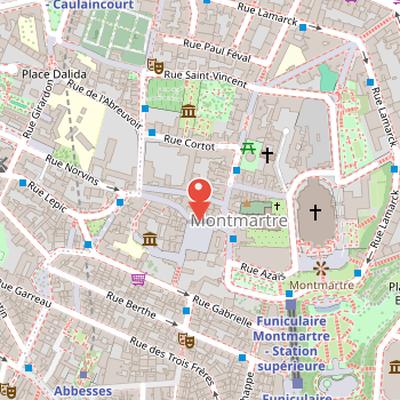
Nearby Objects
-
 Montmartre 40 m away
 -
 Saint-Pierre de Montmartre 80 m away
 -
 Dalí Paris 80 m away
 -
 Musée de Montmartre 120 m away
 -
 Sacré-Cœur 160 m away
Place du Tertre in Montmartre
Place du Tertre is located on the hill of Montmartre in the Clignancourt district of Paris, France, at an altitude of 130 meters. It is the main square of the former village of Montmartre and is famous worldwide for its painter artists and terraces. Many artists set up their easels there every day for tourists, which contributes to its strong public appeal. Place du Tertre is also one of the most visited places in Paris.
Location, Access, and Cultural Role
Place du Tertre lies in the center of the old village of Montmartre, near the basilica of Sacre-Coeur and Saint-Pierre church. It is one of the most visited places in Paris by tourists and is known for the many artists who set up easels there every day for visitors. The square evokes the modern art period associated with painters such as Toulouse-Lautrec, Poulbot, Picasso, Modigliani, and Utrillo, who lived in Montmartre. It also contains the first town hall of Montmartre, installed in 1790 at the home of the first mayor, Felix Desportes, as well as the restaurant A la Mere Catherine, founded in 1793. The place is recognized in France and abroad, including Liiege in Belgium, where a square has hosted artists, artisans, musicians, and draftsmen during a festival named Place du Tertre since 2005. Access is provided by metro line 12 at Abbesses station, metro line 2 at Anvers station, and bus line 40, the only bus line circulating on Montmartre hill.
Origin of the Name
The name of Place du Tertre is linked to its location on the heights of Montmartre. Its origin may also be connected to the Dutertre family. One member of this family, Guillaume Dutertre, was engaged in 1503 by the abbess Marie Cornu of Montmartre as receiver of the abbey's goods. This possible family connection remains part of the discussion around the place name.
Historical Development and Artistic Use
Place du Tertre was formed together with rue Saint-Eleuthere on part of the enclosure ceded in 1635 by the nuns of the Montmartre abbey. The abbey itself had been located at the top of the hill before its transfer in 1686 to a site east of place des Abbesses and around rue Yvonne-Le-Tac. The area was planted with trees, with a prohibition against causing damage under a penalty of a thirty livres fine payable to the nuns. It appears on the Jouvin de Rochefort plan of 1672.
Over time, the site accumulated several public and political associations. It hosted the gallows of the abbesses of Montmartre and later became the center of the former Montmartre commune, which existed from 1790 until its annexation to the City of Paris in 1860. At the end of the Siege of Paris, the National Guards stored part of the 171 cannons on the hill at place du Tertre. General Lecomte then attempted to remove cannons there, provoking a riot that triggered the Paris Commune of 1871. A petroleum car driven by Louis Renault also reached place du Tertre, marking the start of the French automobile industry.
Since the 1980s, the space reserved for artists has decreased drastically in favor of restaurant terraces and cafe owners. In 1983, the Paris mayor's office decided to create an artists' square at place du Tertre. In the 1990s, the Association for the Defense of the Rights of Painters of place du Tertre opposed a public space regulation act that divided the place into 140 spots for painters, portraitists, and silhouettists and required an annual fee for authorization. The Council of State ruled in favor of the Paris mayor's office. By 2018, artists had access to 50 percent of the artists' square space.