The Musée de Montmartre is a French art museum located in the Montmartre district of the 18th arrondissement of Paris. It is installed within a group of buildings that includes the Hôtel Demarne, the Maison du Bel Air, and the atelier-apartment of Suzanne Valadon and Maurice Utrillo. Inaugurated in 1960, the museum was revamped starting in 2011 to allow the programming of two temporary exhibitions each year.
Its permanent collection traces the history of Montmartre and its artists. The museum consists of two distinct buildings, including the Maison du Bel-Air, built in 1660, which houses the permanent collections. The Maison du Bel-Air is one of the oldest buildings on the Butte Montmartre and was long believed to be the Rosimond manor, an attribution later disproved by a heritage study conducted by GRAHAL. The buildings at 12, rue Cortot were also a meeting and residence place for Montmartre artists, including Auguste Renoir and Suzanne Valadon. The museum opened in 1960 as the musée du Vieux-Montmartre, was created by Paul Yaki, and later became the musée de Montmartre - Jardins Renoir in 2003, when it also obtained the label musée de France.
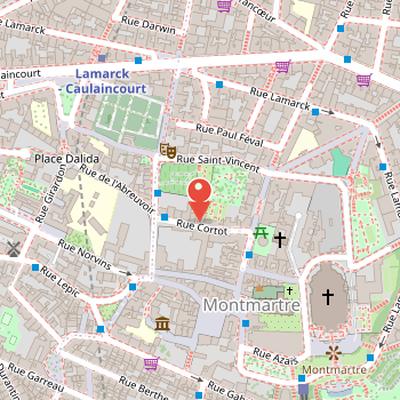
Nearby Objects
-
 Royal Abbey of Montmartre 60 m away
 -
 Montmartre 90 m away
 -
 Au Lapin Agile 110 m away
 -
 Place du Tertre 120 m away
 -
 Dalí Paris 150 m away
Museum Setting and Collections
The Musee de Montmartre is a French art museum in the Montmartre district of the 18th arrondissement of Paris. It is installed within a group of buildings that includes the Hotel Demarne, the Maison du Bel Air, and the atelier-apartment of Suzanne Valadon and Maurice Utrillo. The museum was inaugurated in 1960 and was revamped starting in 2011 to allow for two temporary exhibitions each year. Its permanent collection traces the history of Montmartre and its artists.
Maison du Bel-Air and the Museum Buildings
The Musee de Montmartre consists of two distinct buildings. One of them, the Maison du Bel-Air, was built in 1660 and houses the permanent collections of the museum. It is also one of the oldest buildings on the Butte Montmartre. For a long time, the Maison du Bel-Air was believed to be the Rosimond manor, and Rose de Rosimond, a contemporary actor of Moliere, was said to have lived there. However, a heritage study conducted by GRAHAL disproved this attribution.
Artists at 12, rue Cortot
The buildings at 12, rue Cortot served as both a meeting place and a residence for Montmartre artists. Auguste Renoir rented a studio there in 1876, and it was at this address that he painted Le Bal du moulin de la Galette, La Balancoire, and Jardin de la rue Cortot. Suzanne Valadon settled at 12, rue Cortot in 1898, returned there in 1912, and stayed until 1926 with Maurice Utrillo and Andre Utter. The three artists, nicknamed the Trio infernal, also depicted the studio and garden in several paintings. The site is therefore closely associated with artistic life and production in Montmartre across several decades.
From the Vieux-Montmartre Museum to the Renoir Gardens
The museum opened in 1960 as the musee du Vieux-Montmartre, created by Paul Yaki, a member of the Societe d'histoire et d'archeologie du Vieux Montmartre. Its first curator was the urban planner Claude Charpentier. In 2003, the institution became the musee de Montmartre - Jardins Renoir and received the label musee de France. In 2011, management was entrusted to the society Kleber-Rossillon in Paris under an emphyteutic administrative lease, and the museum also partnered with the society of history and archaeology Le Vieux Montmartre.
A major part of the museum identity is formed by the Jardins Renoir, redesigned in 2012 from an inspiration drawn from Auguste Renoir's paintings made during his stay on rue Cortot. The gardens include fruit trees such as pear trees and almond trees, together with shrubs, lilacs, roses, and climbing hydrangeas. They offer a view of the Montmartre vineyard, which existed in the Middle Ages and was replanted in 1933. The gardens also overlook the old woods at 8 rue Cortot, which have been preserved as an ecological reserve containing maple trees, sycamores, horse chestnut trees, and locust trees.
The museum also expanded its exhibition spaces through a rehabilitation program that redesigned the gardens and increased the exhibition surface. Its Cafe Renoir, inaugurated on the ground floor of the hotel Demarne and in the Jardins Renoir, welcomes visitors under a heated glass roof in winter and places tables in the garden in summer. This setting corresponds with Pierre-Auguste Renoir's work Le Bal du moulin de la Galette.
The museum further developed its presentation of interiors with the inauguration of an atelier-apartment reconstructed to resemble its original state. Designed by Hubert le Gall, the reconstruction relied on archives, including photographs, letters, period writings, and artworks by Suzanne Valadon. This research made it possible to recover typical furniture and original spatial volumes. In December 2016, the permanent collection was reorganized, and new rooms on the last floor of the Bel Air building were dedicated to emblematic artists of Montmartre, including Pierre-Auguste Renoir, Emile-Othon Friesz, and Raoul Dufy, as well as artists who stayed at 12 rue Cortot.
Collections and archival holdings
Musee de Montmartre preserves a collection of 6,000 artworks that includes paintings, posters, illustrations, sculptures, art objects, prints, and photographs. Together, these works illustrate the artistic, religious, political, festive, and folkloric history of Montmartre. The museum also holds more than 100,000 archival pieces related to the history, artists, and daily life of Montmartre. Within these holdings, there is a specific archive dedicated to French chanson. The collections are complemented by a library of 3,000 books and abundant documentation, making the museum an important resource for the study of Montmartre's cultural history.
Collections and Historical Themes
The collections of the Musee de Montmartre belong to the Societe d archeologie et d histoire du Vieux Montmartre, an organization created in 1886. Their mission is to preserve and enrich artistic, historical, and ethnological testimonies of Montmartre. The collection includes works connected to the bohemian and artistic atmosphere of Montmartre in the 19th and 20th centuries, as well as material evoking the creative life of ateliers such as Bateau-Lavoir and atelier Cortot. It also displays the atmosphere of celebrated cabarets including Lapin Agile and Moulin Rouge.
A separate room is dedicated to shadow theatre and contains zinc plates from the cabaret du Chat Noir by Henri Riviere. The collections also present key historical themes linked to the district, including the annexation of Montmartre to Paris in 1860, its urbanization and the gradual disappearance of windmills, the history of the Commune in Montmartre, and the construction of the Sacre-Coeur.