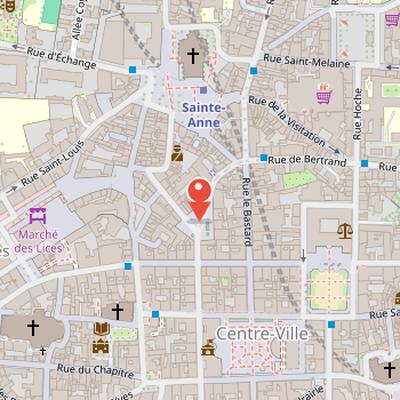
Place du Champ-Jacquet is a square in the historic heart of Rennes, in the Centre district. It is formed by the Y-shaped intersection of the streets Champ Jacquet and rue Leperdit, near place de la République and accessible via Sainte-Anne station on metro lines a and b. The square takes its name, like rue du Champ Jacquet, from porte Jacquet of the old ramparts, located near the top of rue Chateaurenault and not far from the square.
The place includes tall half-timbered houses dating from the medieval period and the hotel Hay de Tise at number 5, with timber framing, white stone, and granite. In the middle of the square stands a statue of Jean Leperdit, shown tearing a list condemning people to the guillotine. The statue has a complex history: a first project was proposed in 1839, later decisions followed in 1879 and 1883, the bronze statue was installed in 1892, melted down under the Vichy regime, recast in 1991, and reinstalled in 1994. In 2022, a three-year work plan with a budget of 4 million euros planned vegetation and reduced circulation to favor pedestrian access.
Nearby Objects
-
 Basilique Saint-Sauveur de Rennes 150 m away
 -
 Place Sainte-Anne 150 m away
 -
 Rennes City Hall 150 m away
 -
 Place de la Mairie 200 m away
 -
 Rennes Opera House 200 m away
Location and access
Place du Champ-Jacquet is located in the historic heart of the city, in the Centre district. It is formed by the Y-shaped intersection of Champ Jacquet street and rue Leperdit. The site is accessible by metro lines a and b through Sainte-Anne station. It is also close to the transport hub at place de la Republique, about 300 meters to the south.
Origin of the Name
Place du Champ-Jacquet takes its name, together with rue du Champ-Jacquet, from porte Jacquet of the old ramparts. Porte Jacquet was located near the top of rue Chateaurenault, not far from place du Champ-Jacquet. The place name therefore preserves the memory of a former defensive gate that once marked this part of the city.
Planned Redevelopment of Place du Champ-Jacquet
In 2022, Historique presented a three-year work plan for place du Champ-Jacquet with a budget of 4 million euros. The plan included vegetating the site as part of the redevelopment. It also proposed restricting circulation in order to favor pedestrian access. These measures indicate a shift toward a more planted and pedestrian-oriented public space.
Historic Buildings and the Jean Leperdit Statue
Place du Champ-Jacquet is marked by a group of notable historic buildings, including tall half-timbered houses dating from the medieval period. Among them is the Hotel Hay de Tise at number 5, which combines timber framing, white stone, and granite. At the center of the square stands the statue of Jean Leperdit, a major feature of the site and a reminder of the square's civic memory.
The history of the statue reflects several unrealized and completed projects. In 1839, Pierre-Jean David d'Angers offered to sculpt a statue of Jean Leperdit for the city without charge, but although the city accepted the offer, the work was never carried out. In 1879, the municipal council decided to erect a statue of Leperdit tearing a royal edict, but that project was not followed up. In 1883, the council decided instead to place a bronze statue of the former mayor Jean Leperdit, made by Emmanuel Dolivet, at Place du Champ-Jacquet. The statue was installed in 1892.
The monument later disappeared during the Vichy regime, when it was melted down as part of non-ferrous metal mobilization. Its bust was cut out and preserved at the Museum of Fine Arts. The statue was recast in 1991 and reinstalled on its pedestal in 1994. The statue shown is of Jean Leperdit tearing a list condemning people to the guillotine.