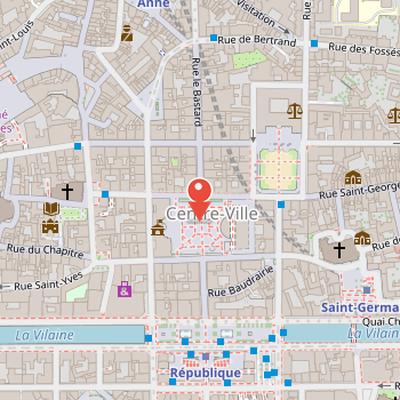
Place de la Mairie is a rectangular pedestrian square in Rennes. The west side is occupied by the Rennes city hall and the east side by the Rennes opera. The square is bordered to the south by rue Ferdinand-Buisson and rue de Coetquen, and to the north by rue de l'Hermine and rue de Brilhac. It also gives access to rue Le Bastard, a major shopping street to the north.
Archaeological excavations in the square uncovered burials dated to around the 1st and 3rd centuries AD at the top of the site, as well as more recent skeletons dating to around the 14th century at the bottom. The excavations also revealed ancient streets and medieval buildings burned during the 1720 Rennes fire. The place known as Place de la Mairie developed at the beginning of the 18th century after that fire. Historical accounts state that Jacques V Gabriel designed the Mairie de Rennes building for the town hall and the presidial, separated by the belfry. The square also includes a full-length statue of Louis XV. In the 19th and 20th centuries, it became a transport hub, first as a tramway interchange from 1897 until 1952, then as an important road junction. It was pedestrianized on 17 September 2007.
Nearby Objects
-
 Rennes City Hall 50 m away
 -
 Rennes Opera House 60 m away
 -
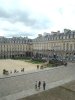 Place du Parlement-de-Bretagne 130 m away
 -
 Place du Champ-Jacquet 200 m away
 -
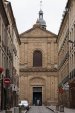 Basilique Saint-Sauveur de Rennes 200 m away
Layout and Access
Place de la Mairie is a rectangular pedestrian square. The Rennes city hall occupies its west side, while the Rennes opera stands on the east side. The square is bordered to the south by rue Ferdinand-Buisson on the southwest side and by rue de Coetquen on the southeast side. To the north, it is bordered by rue de l'Hermine on the northwest side and by rue de Brilhac on the northeast side. Place de la Mairie also gives access to rue Le Bastard to the north, which is a major shopping street.
Historical Layers of Place de la Mairie
Archaeological excavations at Place de la Mairie revealed a long and layered history beneath the square. Burials were found at the top of the square dating to around the 1st century AD and the 3rd century AD, while more recent skeletons were identified at the bottom of the square and dated to around the 14th century. Archaeologists also suggested that the site may have contained the Saint-Pierre-du Marche church mentioned in city historical documents, although its exact location was not known. Excavations further exposed ancient streets and medieval buildings that had been burned during the 1720 Rennes fire.
The square itself originated at the beginning of the 18th century, after the fire. Louis XV sent architect Jacques V Gabriel to rebuild the destroyed city, and Gabriel designed the Mairie de Rennes building to house the town hall and the presidial, separated by the belfry. The square also includes a full-length statue of Louis XV. In 1793, the guillotine was installed there, and conspirators Charles Elliot and Rene Maloeuvre were executed on the site.
During the 20th century, Place de la Mairie became an important road hub with the rise of the automobile. From 1897 until 1952, it was also the main tramway interchange in Rennes. On September 17, 2007, mayor Edmond Herve inaugurated the pedestrianized square, which was then made free of automobile traffic.