Rennes City Hall was constructed between 1734 and 1743 by Jacques V Gabriel after the 1720 fire in Rennes. Its final plans were validated by the municipal council under mayor Toussaint-François Rallier du Baty, and the first stone was laid weeks after his death. The building is composed of two classical structures linked by a quarter-circle offset with a recessed clock tower. It houses most municipal services, with the visitor entrance on the ground floor of the north wing and the mayor’s office, first deputy’s office, and general director of services on the first floor.
The building was later adapted for new uses. From 1840, the north wing housed the law and science faculties, and the current mayor’s office once contained a chemistry cabinet used by professor Faustino Malaguti until 1855. Major remodeling was carried out by Emmanuel Le Ray during Jean Janvier’s first term as mayor, including a monumental staircase in the south pavilion and interior modifications for improved functionality. The south wing contains two honor salons used for municipal council meetings, weddings, and official receptions. The north wing also includes the “Panthéon rennais” memorial room for war dead, with painted decor by Camille Godet.
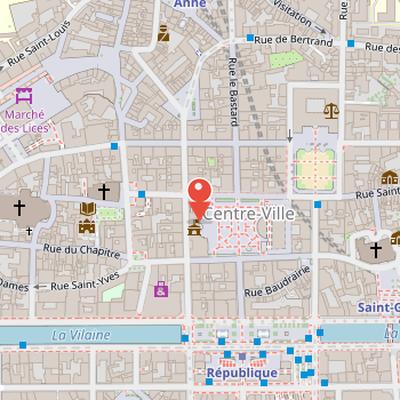
Nearby Objects
-
 Place de la Mairie 50 m away
 -
 Rennes Opera House 110 m away
 -
 Basilique Saint-Sauveur de Rennes 140 m away
 -
 Hôtel de Blossac 160 m away
 -
 Place du Champ-Jacquet 150 m away
Construction, Expansion, and Memorial Spaces
Rennes City Hall was constructed between 1734 and 1743 by Jacques V Gabriel, following the fire of 1720. The final plans were approved by the municipal council under Mayor Toussaint-Francois Rallier du Baty, and the first stone was laid only weeks after his death. The building is composed of two classical structures linked by a quarter-circle offset, with a recessed clock tower at the center. The south wing vestibule includes a portico with pink marble columns.
The city hall later underwent major remodeling during the first term of Mayor Jean Janvier, when Emmanuel Le Ray carried out work that included a monumental staircase in the south pavilion and other interior modifications intended to improve functionality. From 1840, the north wing also hosted the law and science faculties, and the chemistry cabinet occupied by Professor Faustino Malaguti remained in what is now the mayor's office until 1855.
Today, the building houses most municipal services. Its north wing contains the Panthereon rennais memorial room for the war dead, a space whose creation was decided under Janvier's municipality and designed by Emmanuel Le Ray. The memorial room features painted decor 26 meters long by Camille Godet, who used sketches from the front to depict French and allied soldiers. Preparatory studies for this decor are held by the Union des Combattants d'Ille-et-Vilaine. The memorial room was inaugurated on an unspecified date.
Heritage Protection History
Rennes City Hall underwent an initial historical monument classification in 1922, initiated by Jean Janvier. The record also notes the annulment of the 1922 facade classification order. Later, the building received a full monument inscription by decree on an unspecified date. It was then the subject of two further classification decrees on unspecified later dates.
Interior Use and Symbolic Faade
Rennes City Hall is organized through a division of functions across its wings and floors. The visitor entrance is located on the ground floor of the North wing, while the office of the mayor, the first deputy, and the general director of services are on the first floor of the same wing. The South wing contains the municipal council meeting spaces, weddings, and official receptions, held on the first floor in two honor salons. The rest of the building is occupied by offices for elected officials and civil servants, the mayors cabinet, and meeting rooms.
At the center of the building, beneath the clock tower, there is a niche that has carried different symbolic sculptures over time. It originally held a statue of Louis XV, but this was destroyed during the revolution. It was later replaced by a sculpture group by Jean Boucher representing the Union of Brittany to France. The group depicted Anne de Bretagne kneeling before a female allegory of France. This work was called the monument of national shame by Breiz Atao. In 1932, during the Union of Brittany to France festivities, the sculpture group was destroyed. The destruction was claimed by an unknown group named Gwenn ha Du, and the city hall never restored the sculpture group.