The Hôtel de police de Marseille is located in the Palais épiscopal on rue du Commissaire-Divisionnaire-Antoine-Becker. The building was begun in 1648 and now houses the Police nationale services, which explains why it is commonly referred to as l’évêché. Its façades, roofs, and street portal are registered as historical monuments.
The site has a long episcopal history in Marseille. The bishopric occupied several different locations before settling, from the 13th century, near the medieval ramparts beside a large stone tower called la Tourette. The palace was enlarged in 1337 by bishop Jean Gasc and again in 1351 by Robert de Mandagout, who acquired the tower. In 1524, Imperial troops commanded by the Duke of Bourbon attacked the area, and the palace was razed during defensive demolitions. Later, Bishop Étienne de Puget began new construction works on land chosen by d’Épinay de Saint-Luc. A polychrome mosaic discovered in 2008 near the cathedral of the Major also illustrates the decorative richness associated with the episcopal complex.
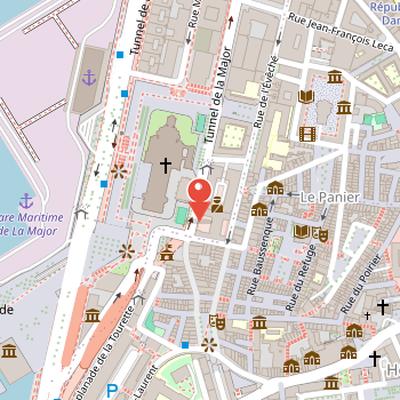
Nearby Objects
-
 Vieille Major 50 m away
 -
 La Major 100 m away
 -
 Place de Lenche 150 m away
 -
 La Vieille Charité 200 m away
 -
 Notre-Dame-des-Accoules Church 300 m away
Le Palais episcopal and the Marseille police headquarters
Le Palais episcopal is a building in Marseille on rue du Commissaire-Divisionnaire-Antoine-Becker. Construction began in 1648. The building houses the Hotel de police de Marseille, and it is also referred to as l eveche by metonymy because it is occupied by the Police nationale services. Its facades, roofs, and street portal are registered as historical monuments, giving the site both administrative and heritage significance.
The Episcopal Palace Mosaic
In 2008, a polychrome mosaic was discovered at the Euromediterranee urban development site near the cathedral of the Major. The mosaic, which appears to have originally been about twice its present size, is made up of thousands of tesserae in black, white, ochre, yellow, red, sky blue, and copper green. It is set on a bed of crushed bricks bound with lime mortar.
The decoration shows vases with acanthus bouquets, two pairs of multicolored peacocks facing each other, and a rose stem between them. Its motif is typical of 4th century paleochristian iconography. The composition is framed by polychrome braids and wheels arranged in geometric patterns.
According to the historical record, the mosaic decorated a room in the episcopal palace, part of a complex that also included a church and baptistery discovered during 19th century cathedral construction. Its luxurious character has been interpreted as an assertion of power by the bishop of Marseille over the bishops of Arles and Aix-en-Provence.
From Episcopal Residence to Modern Administration
From the 13th century, the bishopric stood near the medieval ramparts beside a large stone tower known as la Tourette. The episcopal palace was enlarged in 1337 by Bishop Jean Gasc and again in 1351 by his successor Robert de Mandagout. The bishops also acquired the tower called tour de la Tourette, buying it from Rostan de Sabran and the widow of Gui de Chateauneuf for 90 gold florins. In 1524, the site was attacked by Imperial troops commanded by the Duke of Bourbon, and preventive defense led to the destruction of several buildings near the ramparts. The episcopal palace was razed together with the convent of the Friars Minor, which had housed the relics of Saint Louis d'Anjou. After this destruction, the bishops lived in private houses, and the bishop died a few months later.
A new episcopal residence was later built on land chosen by d'Epinay de Saint-Luc. The site had previously hosted a foundry of bells and cannons, and Bishop Etienne de Puget helped finance the work by ceding the jurisdiction of Saint-Marcel to Marseille. Saint-Marcel had previously belonged to the city of Aubagne. His successor, Toussaint de Forbin-Janson, completed the construction works. Around 1736, Henri de Belsunce added a gallery to the palace. During the Revolution, the palace became national property and was used as an equipment depot. It was returned to the bishopric by royal ordonnance during the Restoration, and repair works costing 35,000 francs were completed in late 1825. Pierre Paulin Andrieu was expelled from the bishopric on November 28, 1906 under the Law of Separation of Churches and State.
Police Occupation and Later Additions
The bishopric premises of the site were occupied by the National Police starting on December 9, 1906. In 1950, a modern building designed by architect Rene Egger was added to the police premises and constructed by the Labalette company for the police services. The complex is commonly nicknamed The Bishops Palace, a reference to the former episcopal palace. It currently houses the central police station of Marseille and the Interregional Judicial Police Directorate (DIPJ). Its police services may relocate during the 2020s because of the building's obsolescence and unsuitability.