Vieille Major is a former cathedral in Marseille connected to the city’s early Christian history. Historical evidence suggests that a church in Marseille existed by the 3rd or 4th century, and the first cathedral is thought to have been built in the early 5th century inside the city walls, away from the administrative center. The earliest cathedral site is associated with the baptistery of Saint-Jean-Baptiste, which remained in use until the 13th century and was later rediscovered in the 19th century. After periods of instability and urban retreat, the cathedral may have been abandoned before its restoration in 977 under Bishop Pons. The building was then rebuilt, with construction completed between 1050 and 1073. In the middle of the 12th century, the cathedral was entirely rebuilt. It is constructed with pink stone from La Couronne, a detail that contributes to its architectural identity.
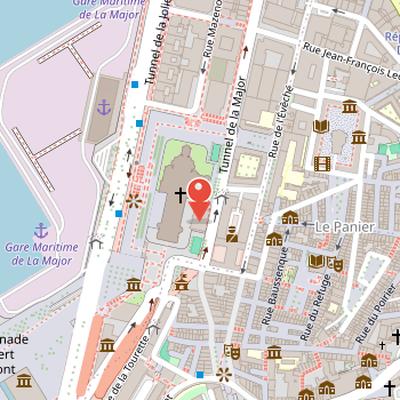
Nearby Objects
-
 Hôtel de police de Marseille 50 m away
 -
 La Major 50 m away
 -
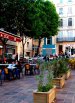 Place de Lenche 200 m away
 -
 La Vieille Charité 200 m away
 -
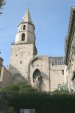 Notre-Dame-des-Accoules Church 350 m away
Early Christian Marseille
Historic accounts describe ancient Marseille as a city divided between an upper city around the Acropolis and a lower city, and rediscovered rampart remains indicate that it covered more than 50 hectares. These sources also point to Marseille's contacts with the Eastern Mediterranean, including early Christians. A key piece of evidence is an epitaph found for Fortvnatvs and Volvsianvs, marked with a Christian symbol; the individuals named are said to have suffered fire torture and to date from the 3rd or 4th century. On this basis, the church of Marseille must have existed by the 3rd or 4th century. The first confirmed bishop is Oresius, who attended the Council of Arles in 314. In the early 5th century, Bishop Proculus disputed with Aix-en-Provence over the location of the metropolitan see, and in 417 Pope Zosimus made Arles primate of the Viennese and the two Narbonnaise provinces.
Early Cathedral History and Rebuilding
Historique, relaying Jean-Maurice Rouquette, places the first cathedral in the early 5th century. It was built inside the walls, but far from the administrative center, and was associated in the 6th century with a baptistery called Saint-Jean-Baptiste. This baptistery, identified as the site of the first cathedral, was later found in remains reported in the 12th century and rediscovered in 1850 by Esperandieu. It was described as the largest in Provence, with an interior diameter of 22 meters, and remained in use until the 13th century. François Roustan's study locates it where the right collateral of the new cathedral stands.
Historique also notes that Notre-Dame Cathedral was built west of the city near Ourse cove and Porta Gallica. After invasions by Wisigoths, Burgundians, Ostrogoths, Franks, Saracens, and Lombards, the city retreated to Saint-Laurent hill, and the cathedral may have been abandoned while the bishop moved to Saint-Victor Abbey. In 977, the Major was restored under Bishop Pons, and the city walls were rebuilt at the same time. The 5th-century church was replaced in the 11th century, with cathedral construction completed between 1050 and 1073. Historique further states that the cathedral was entirely rebuilt in the middle of the 12th century.
Architecture of Vieille Major
Vieille Major is built with pink stone from La Couronne and is designed according to a Latin cross plan. It is a Romanesque example of Provenhal architecture. The cathedral includes a choir with an apse, apsidioles, and aisles. Its vaults are barrel-shaped, and an octagonal dome on pendentives marks the crossing of the transept. The heptagonal apse is covered by a half dome in a cul-de-four shape. The bell tower was only built in the 16th century, and a bay was added between the 17th and 18th centuries, with a transverse bay on the north face.
Renaissance Decor and Chapel Altars
The old cathedral decor of the Vieille Major includes the altar of Saint Lazarus, made from Carrara marble and sculpted by Francesco Laurana between 1475 and 1481. It is located in the north transept arm, where the paired arcature also shows Renaissance style decoration. This Renaissance decor is noted as one of the first manifestations of the style in France. The building also contains the Saint-Serenus chapel, which holds an altar-reliquary of Saint-Serenus in marble from the 15th century. In the same chapel, a faience bas-relief of the Deposition from the Cross is attributed to the workshop of Luca della Robbia and dated to the late 15th or early 16th century. In 1794, Luigi Oxilia purchased the cathedral choir paneling and wooden pulpit and transferred them to the Basilica San Nicolo in Pietra Ligure, Italy.
Partial Demolition and Later Restoration Work
The partial destruction of Historique's old cathedral was decided in 1852, after the construction of the New Saint Mary Major Cathedral in Marseille had already caused damage to the older building. Louis Napoleon Bonaparte laid the first stone of the new cathedral, and the old cathedral was subsequently downgraded to a parish church during the new construction. In 1853, the French Society for the Conservation of Monuments protested in an effort to save parts of the structure. After demolition began, the cathedral was preserved only in part, with the choir and one bay retained. The building was reduced by two bays, but it remained in use for worship until the 1950s. Much later, in 1994, heavy wooden shoring was placed against the cathedral to support its bearing walls. In 2009, Mayor Jean-Claude Gaudin ordered the removal of this shoring as part of a renovation project intended to prepare for Marseille-Provence 2013. The plans included renovation of the altar of Saint Lazarus and of 300-meter galleries under the cathedral, while foundation reinforcement work began with a budget of one million euros.
Heritage Protection Status
La Vieille Major is included among the 934 monuments historiques listed as protected in 1840. The protection statement also notes that the buildings and soils forming the Sainte-Marie-Majeure cathedral complex are subject to an inscription by arrete, excluding La Vieille Major. This places the building within the wider protected context of the cathedral complex while also identifying it separately in the historic monuments listing.