La Vieille Charité is located at 2, rue de la Charité, in the Panier district of Marseille, within the official Grands-Carmes district. Built in the 17th century on plans by Pierre Puget, it was created to house the city’s indigent and poor under the name Notre Dame de la Charité. The complex is associated with the Marseille implementation of the “grand enfermement” described by Michel Foucault.
Architecturally, the building is a major example of 17th-century design. It consists of four wings arranged around a rectangular courtyard, with three levels of galleries and windowless outer walls. At its center stands a chapel with an elliptical dome, a distinctive feature of the complex. A porch with Corinthian columns was added between 1861 and 1863.
The chapel and hospice were classified as historic monuments in 1951. After losing its original function, the building was extensively renovated from the 1960s to the 1980s and is now one of the City of Marseille’s cultural institutions.
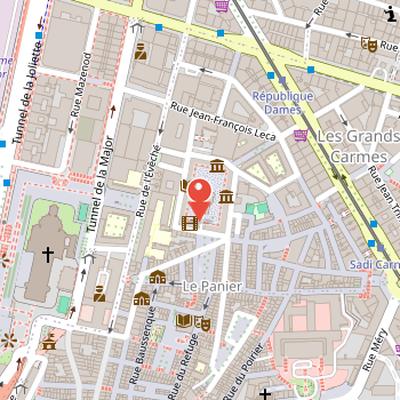
Nearby Objects
-
 Vieille Major 200 m away
 -
 Hôtel de police de Marseille 200 m away
 -
 La Major 250 m away
 -
 Notre-Dame-des-Accoules Church 300 m away
 -
 Place de Lenche 350 m away
History and Architecture of La Vieille Charite
La Vieille Charite is located at 2, rue de la Charite, in the Panier district of Marseille, within the official Grands-Carmes district. Built in the 17th century on plans by Pierre Puget, it was intended to house the indigent and poor of the city. The building is associated with the Marseille implementation of the grand enfermement described by Michel Foucault in Histoire de la folie a l age classique (1962). It is also notable as an example of 17th-century architecture, especially because of Pierre Puget's chapel and its ovoid dome.
By the end of the 19th century, La Vieille Charite gradually lost its original purpose and was nearly extinct in the 1950s, when it was occupied only by poor inhabitants living in miserable conditions. The chapel and hospice were classified as historic monuments on March 10, 1951. Extensive renovation took place from the 1960s to the 1980s, and the site is now one of the cultural institutions of the City of Marseille.
Architecture and Early Function
La Vieille Charite began as the 17th century hospice Notre Dame de la Charite, created by the Marseille city council. It was located near the cathedral of the Major, at place de l'Observance on the north slope of the Butte des moulins. Its first provisional buildings were started after the laying of the first stone by Emmanuel Pachier, and it received indigents for the first time in an unspecified year.
The hospice was designed as a large rectangular complex with four wings, closed externally by windowless walls and opening onto an interior courtyard. Around this courtyard ran three levels of superimposed galleries with round arcades. On the axis of the entrance door stood a central chapel beneath an elliptical dome in Baroque style. The porch, added between 1861 and 1863 by the architect Blanchet, has Corinthian columns in Second Empire style and depicts Charity welcoming indigent children, flanked by two pelicans feeding them.
Its history as an institution was marked by strict control of the poor. Guards called chasse-gueux seized beggars, expelled foreigners, and confined local people. The hospice also had workshops where beggars worked in different productions, and children were placed as domestics, ship's boys, or apprentices with passementiers or bakers. Its interned population rose from 850 in 1736 to 1059 in 1760, then fell to 250 in 1781 as support for poor reclusion declined.
Decline, Occupation, and Preservation
During the 20th century, La Vieille Charite went through a long period of decline before later renovation. In 1905, it served as accommodation for colonial nurses. In 1922, it housed evicted tenants from demolished neighborhoods behind the Bourse, and in 1943 it hosted some evacuated families during the German occupation dynamiting of Vieux-port neighborhoods. As its premises deteriorated, it was occupied by a very poor population. In the 1940s and 1950s, nearly 150 families lived there in precarious conditions, along with around thirty Little Sisters of the Poor. Activities such as anchovy and banana packing were also practiced on the site. In the 1930s, some scholars mobilized to prevent its disappearance, and in the immediate post-war period Le Corbusier denounced its state of abandonment. La Vieille Charite was later classified as a historic monument, and all residents were relocated before it was closed in 1962.
Restoration in the 20th Century
Restoration of La Vieille Charite began in 1961, after long-term abandonment and marine air had caused severe damage to the buildings. Because of the site's architectural and historical interest, a large restoration program was undertaken. In 1968, Andre Malraux, Minister of Culture, granted funds to save the deteriorating complex. The work included renovation of the facades of the three galleries surrounding the interior courtyard, using stone replacement in drawer style, as well as the rooms and the chapel. Restoration of the chapel was completed in 1981, and restoration of all the buildings was completed in 1986.
Cultural and Research Uses of La Vieille Charite
La Vieille Charite serves as a cultural and museographic center with several institutions based inside its buildings. Its courtyard hosted numerous performances during the Marseille festival until 2004, when the festival moved to parc Henri Fabre. Today, the site contains a range of cultural structures and academic activities.
The Mediterranean Archaeology Museum is located on the first floor, where it brings together three departments. On the second floor, the Museum of African, Oceanian, and Amerindian Arts presents works from three continents. These museums give the site a strong public and exhibition role within Marseille.
La Vieille Charite is also associated with higher education and research. Campus EHESS Marseille, which develops teaching and research activities in the humanities and social sciences, is mainly located at Vieille Charite and the Bernard Du Bois building. It includes several Marseille research and service units under EHESS supervision, as well as an administrative, logistical, and management service called SALG.
Another major presence is the Centre Norbert Elias (UMR 8562), a research unit that groups researchers from various humanities and social sciences disciplines. It is located at Vieille Charite in Marseille and at the Hannah Arendt campus at Avignon University. The center includes about 50 researchers, 30 doctoral students, and a support team, and it is associated with three doctoral schools and five master's programs. It also coordinates several national and regional research projects. Created in 2010 as a mixed research unit under EHESS, CNRS, Avignon University, and Aix-Marseille University, it succeeded SHADYC and, in 2024, joined the Maison Mediterraneenne des Sciences de l'Homme (MMSH). Since 2024, it has operated under a new scientific program contract for 2024 to 2028 and has been led by anthropologist Dorothee Dussy.
Centre international de poesie Marseille
La Vieille Charite includes the Centre international de poesie Marseille, a cultural and museum space created by the city of Marseille in 1990. The center organizes weekly public poetry readings, meetings, and exhibitions, and it features French and foreign contemporary poets, journals, and publishers. Its activities also include thematic conferences, awareness campaigns, writer residencies, foreign interventions, and translation workshops. Since its creation, it has hosted more than 1500 authors. The center is complemented by a specialized library, internet tools development, and an editorial policy.