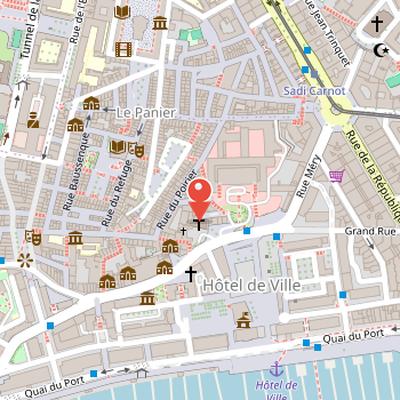
Notre-Dame-des-Accoules is an ancient medieval collegiate church in the Accoules district of Marseille, located at Place Daviel in the 2nd arrondissement. The church was built on the ruins of the temple of Minerva and was probably rebuilt in the thirteenth century, with a reconstruction date of 1205 known from an inscription on a preserved column. It was a southern Gothic style building divided into five bays and marked externally by flying buttresses, with two superimposed sanctuaries and access by a large stairway on the south side.
The church was destroyed during the Revolution after having hosted assemblies in 1793. Only part of the structure survived, including the bell tower and the back wall, which retains ogival traces of the three naves and has been classified as a historic monument. In 1820, a crypt representing the Holy Sepulchre and a rocaille calvary were arranged in front of the back wall, creating the Place du Calvaire. A new church was later constructed to the right of the calvary beginning in 1824.
Nearby Objects
-
 Maison Diamantée 100 m away
 -
 Place de Lenche 300 m away
 -
 La Vieille Charité 300 m away
 -
 Hôtel de police de Marseille 300 m away
 -
 Vieille Major 350 m away
History and Surviving Elements
Notre-Dame-des-Accoules is an ancient medieval collegiate church in the Accoules district of Marseille, located at Place Daviel in the 2nd arrondissement. The church was razed during the Revolution, but its bell tower survived and was classified as a historical monument. A crypt and a calvary were arranged in front of the back wall of the destroyed church in 1820. Starting in 1824, a new church was constructed to the right of the calvary.
Name and Origin of Notre-Dame-des-Accoules
La collegiale Notre-Dame-des-Accoules takes its name from its arch-shaped structure. Some authors have suggested that the word accoules may come from two Latin words connected to a nearby spring. This interpretation is linked to a stream that was discovered near the port during the excavation of place Jules-Verne. The available facts therefore connect the churchs name both to its architectural form and to a possible local water source.
Architecture and Destruction
Notre-Dame-des-Accoules was a southern Gothic style church built on the ruins of the temple of Minerva at place Daviel. Its reconstruction in 1205 is known from an inscription on a preserved column, and it was probably rebuilt again in the thirteenth century. Before its destruction, the building was divided into five bays marked on the exterior by flying buttresses. It was attached to the observatory hill and included two superimposed sanctuaries. Access was provided by a large stairway on the south side at the bottom of montee des Accoules.
The church measured fifty meters in length and twenty meters in width, with three naves rising to a height of ten to seventeen meters. In 1793, it hosted assemblies of a communal section involved in the federalist insurrection against the Convention. After the defeat of the federalists, representatives ordered the demolition of buildings used as headquarters, including Notre-Dame-des-Accoules. The church did not survive the punishment inflicted on Ville-sans-Nom and was destroyed except for the back wall, which still retains ogival traces of the three naves of the destroyed building. This back wall was later classified as a historic monument by an official decree.
The Calvary and the 1820 Mission
At the back wall of the old church, the calvary in 1820 featured a crypt representing the Holy Sepulchre, surmounted by a rocaille calvary. It was arranged around a leveled square known as Place du Calvaire, which was enclosed by a grille. This setting marked the beginning of a post-revolutionary evangelizing mission preached in all the parishes of Marseille. The mission was led by abb
The New Church at Place du Calvaire
The new church was developed after the mission when Place du Calvaire became a pilgrimage site. In 1821, it was managed by the congregation of the Missionnaires de Provence at Rue du Poirier, using an old residence of the chanoines des Accoules near Place du Calvaire. A wooden chapel was arranged in front of the crypt, and a construction project was launched with a subscription opened to support it. Construction began in 1824, before the favorable deliberation of the municipal council. The church was later opened for worship and consecrated by Bishop Charles-Fortune de Mazenod under the name Notre-Dame-du-Bon-Secours. It completed the settlement of the Missionnaires de Provence in Marseille and was already in existence when the Missionnaires de France left the city.
Louis Gaufridy and the Accoules Affair
Reports state that Louis Gaufridy, curer of Notre-Dame-des-Accoules, was accused of sorcery and magic on the basis of declarations made by two Ursuline nuns of Aix-en-Provence, Madeleine de Demandolx de la Palud and Louise Capeau. Madeleine de Demandolx de la Palud is described as the daughter of a rich parishioner of the Accoules. Gaufridy was later judged guilty after being subjected to dungeon confinement and interrogation. He was then burnt alive at Place des Precheurs in Aix-en-Provence, an event said to have had great impact throughout the kingdom.