The Montmartre funicular is a double inclined elevator in the 18th arrondissement of Paris, France. Opened in 1900 and fully renovated in 1991, it provides access to the summit of Montmartre hill and the Basilica of the Sacré-Cœur without using the stairs. The installation is 108 meters long and climbs 36 meters in elevation in less than one minute thirty seconds. It is managed by RATP, the public transport operator in Île-de-France.
The funicular runs along rue Foyatier, alongside a staircase with more than 220 steps and landings. Its low station is located between places Saint-Pierre and Suzanne-Valadon, while the high station is on rue du Cardinal-Dubois. The current installation was built by Akros, a company taken over by Pomagalski, and consists of two independent cabins with sixty seats each. The stations have transparent architecture designed by François Deslaugiers, and the cabins, with large glazed parts, were designed by Roger Tallon. Their partly glazed roofs allow views of the Basilica of the Sacré-Cœur and the Paris panorama.
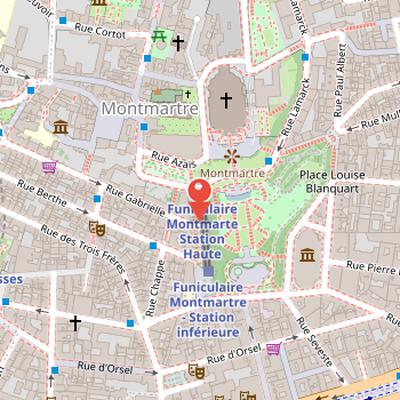
Nearby Objects
-
 Sacré-Cœur 160 m away
 -
 Saint-Pierre de Montmartre 150 m away
 -
 Place du Tertre 200 m away
 -
 Montmartre 200 m away
 -
 Dalí Paris 250 m away
Access to the Montmartre Summit
The Montmartre funicular is a double inclined elevator in the 18th arrondissement of Paris, France. It provides access to the summit of Montmartre hill, allowing visitors to reach the Basilica of the Sacre-Coeur without using the stairs. Opened in 1900, it was fully renovated in 1991.
The installation is 108 meters long and climbs 36 meters in elevation in less than one minute and thirty seconds. It is managed by RATP, the public transport operator in Ile-de-France. In the 2010s, it carried approximately 2 million passengers per year, reflecting its role as a practical link between the lower streets of Montmartre and the hilltop site.
Design and Operation of the Montmartre Funicular
The Montmartre funicular runs every day and mainly serves tourists, pilgrims heading to Sacre-Coeur, Parisians, and visitors attracted by the atmosphere of Place du Tertre. Its lower station is located between Place Saint-Pierre and Place Suzanne-Valadon, while the upper station is on rue du Cardinal-Dubois. The line follows rue Foyatier, alongside a staircase of more than 220 steps with landings.
The current installation was built by Akros, a company later taken over by Pomagalski, and began operation on the stated date. It consists of two independent cabins with 60 seats each and a total capacity per hour and per direction. The system rises 36 meters over 108 meters in less than one minute and 30 seconds, using a double track with standard gauge and a track slope reaching 35.2 percent. It is derived from elevator technology and is administratively considered two parallel inclined elevator lines, which means it does not have to comply with legislation on ski lifts and funiculars.
The stations have a transparent architectural design by architect Francois Deslaugiers. The cabins, designed by stylist Roger Tallon, have large glazed parts and partly glazed roofs that allow views of the Montmartre basilica and the Paris panorama. The cables are supplied by the French company Montagne et Neige Developpement. The cabins are powered by a winch and independent sets of cables, can operate independently, and allow traffic to continue if one cabin is immobilized for maintenance. During periods of high traffic, both cabins can move upwards simultaneously. The system operates without cabin attendants and uses electronics for automatic operation.
Construction and Early History
The construction of the Montmartre funicular was decided by the Paris municipal council in 1900, with the aim of serving the Basilica of Sacre-Coeur on Montmartre hill. The Basilica itself was inaugurated later, on 16 June 1914. An initial project planned electric traction and a route with six stations plus two termini, but the line was finally built with only two terminal stations and used water counterweight funicular technology. Sources differ on the opening date, giving either 12 July 1900 or 3 May 1900. Operation was granted to the Decauville establishments under a concession ending in 1935. However, the funicular was closed from 1900 to 1906 because prefectural authorization to operate had not yet been obtained. The line has two standard gauge tracks equipped with a Strub rack for braking.
Technical Evolution and Service History
The original Historique system was shaped by the instability of the terrain. Its tracks were supported by metal girder beams on concrete bases, and the cabins were held by a braking system on the rack railway. The system was powered by two watertight tanks of five cubic meters under each cabin floor. At the upper station, one cabin tank was filled so that the loaded cabin descended by gravity while pulling the opposite cabin upward, and steam machinery at the lower station pumped the water back to the top. Each cabin held forty-eight passengers in four stepped closed compartments, with the end platforms reserved for the conductor, or serre-frein. For about thirty years, the system transported one million passengers per year.
The operation was modernized and managed by the Societe des Transports en Commun de la Region Parisienne, assigned by Paris and the Seine department. However, the rack railway braking system was considered dangerous and was abandoned, leading to the cessation of operation on December 31, 1934. Service was then replaced by bus line BB using small Renault KX1 buses. The water-powered funicular returned to service on April 16, 1935, now with two electrically powered cabins. This version used a winch driven by a fifty-horsepower electric motor, moving cabins with a fifty-person capacity in seventy seconds. The cabins also changed in form, no longer stepped and instead using a single compartment with a horizontal floor, while the braking system used jaw brakes acting on the running rails.
After the Liberation, the system came under RATP following the nationalization of STCRP and CMP. In 1950, it operated from 7:00 AM to 11:00 PM in winter and until midnight in summer, and ticket validation was done at the station entrance using bus ticket stamping. Traffic reached 1,000,000 passengers in 1957, when operation stopped for several weeks for renovation. The service reopened during snow presence with poulbots and Montmartre's president Emile Kerambrun. Passenger numbers later exceeded two million in 1962, leading to deep renovation after fifty-five years and two million passengers annually.
A tunnel extension to metro Anvers station was negotiated between RATP and Paris city hall, but the plan was abandoned because of high cost. The funicular was entirely rebuilt by RATP in 1990 and 1991 on the same model. Traffic ceased completely on September 11, 1991, and was temporarily replaced by increased Montmartrobus minibus service between Place Pigalle and the top of the hill. The new funicular began service on December 16, 1991. The old stations were destroyed and rebuilt according to architect Francois Deslaugiers' designs, with construction carried out by the Schindler elevator company at a cost of 70 million francs. After this reconstruction, the funicular used inclined elevator technology with electric traction.
Technical Design and Operation
The historic machinery is located at the upper station and uses two independent Akros winches driven by 72 kW motors. The cabins are substantial in weight, at six tons empty and ten tons when fully loaded, and they are equipped with a service brake, a track brake, and an emergency brake. The carriages and chassis were designed by Skirail, while the drive system and electrical cabinets were manufactured by Poma.
Operation is fully automated. Passenger presence is detected by electronic scales and station radars, and a computer controls cabin departures with cabin display indicators. The system runs at two speeds, 2 m/s or 4 m/s, depending on passenger flow density. For safety, platform doors open only when a cabin is present.
The funicular also has a documented maintenance and incident history. On January 28, 2019, a cabin crash occurred during a loaded brake test after a traction cable base rupture. The interruption affected residents, who experienced time losses because of insufficient bus frequencies, and local businesses reported a turnover decrease of 20 to 30 percent compared with the same month in 2018. One cabin returned to service on December 10, 2019, and the second on January 6, 2020. Full maintenance, including cabin removal, is carried out every 10 years or 20,000 km, with another full maintenance scheduled for early 2026.
Access and Fare Arrangements
The Montmartre funicular is treated as part of the metro network for practical purposes, with similar fare pricing. Both the lower and upper stations are equipped with gates fitted with magnetic ticket readers and Navigo card readers, and the stations accept all RATP fares, from single tickets to a range of subscription packages. However, it remains a special line and does not follow the metro-train-RER ticket transfer rules that replaced ticket t+ on July 1, 2006. Travelers arriving from the metro with a pre-validated ticket must therefore use a separate, identical ticket for the funicular, and tickets validated on the funicular cannot be reused in the metro.
The line is also linked to other local transport options. It has a direct connection with the bus network at the only Montmartre hill route with a stop on rue du Cardinal-Dubois, with a bus stop in front of the upper funicular station. The lower station is within walking distance of two metro stations via public roads: Anvers on line 2, about 450 meters south, and Abbesses on line 12, about 600 meters west.
The station codes recorded for the lower and upper stations are 31-02 and 31-03, with sector code 31 for Pigalle, or FUNB and FUNH.
The Funicular in Culture
The Montmartre funicular appears repeatedly in cultural works connected with Paris and Montmartre. It is featured in the film Bob le flambeur by Melville in 1956, shown in Céline et Julie vont en bateau by Rivette in 1974, and appears in Ripoux contre ripoux with Thierry Lhermitte and Philippe Noiret in 1990. It is also present in Les Randonneurs in 1997, Louise (take 2) in 1998, and El Tourbini in 2002. In animated form, it appears in Un monstre a Paris during the 1910 Seine flood. The funicular is also included in the video game Fahrenheit, released in 2005.
Its presence extends beyond screen media. Jean Marchand painted Le funiculaire de Montmartre around 1930, and the work is included in the collection of the Musee d'Art Moderne de Paris. It is also the subject of the short story L enigme du funiculaire by Boileau-Narcejac in 1966 and is mentioned in the poem Le funiculaire de Montmartre by Jacques Charpentreau. In 2009, the funicular was the site of singer Cali's performance of La Fin du monde for the Blogotheque. It is also reproduced in miniatures at France Miniature in Elancourt and at Mini-Europe in Brussels.
Peripheral Funicular Projects
Studies requested from RATP considered funicular systems in peripheral areas. Among the proposed projects were systems at Issy-les-Moulineaux, linked to the restructuring of Fort d'Issy, and a connection between Meudon-sur-Seine tramway station and Bellevue station. The Meudon proposal was also intended to recreate the old Bellevue funicular at Meudon, which had been removed.