The Panthéon is a monument in the 5th arrondissement of Paris, France, located in the Latin Quarter at the centre of the square named after it. Built between 1758 and 1790 from designs commissioned by King Louis XV, it was intended as a church dedicated to Saint Genevieve, Paris’s patron saint, whose relics were to be housed there. The building was modelled on the Pantheon in Rome and is an early example of Neoclassicism. Its dome is influenced by Bramante’s design for St Peter’s. After the National Constituent Assembly voted in 1791 to transform the Church of Saint Genevieve into a mausoleum, the building underwent repeated changes of use during the 19th century. These shifts affected its sculpture, dome finial, windows, and interior atmosphere. The Panthéon now serves as a mausoleum, and by December 2021 the remains of 81 people had been transferred there.
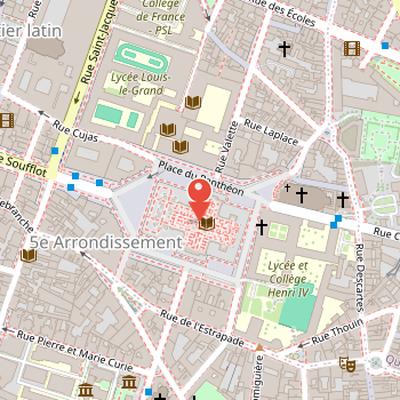
Nearby Objects
-
 Sainte-Geneviève Library 100 m away
 -
 Abbey of St Genevieve 130 m away
 -
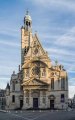 Saint-Étienne-du-Mont 150 m away
 -
 Boulevard Saint-Michel 400 m away
 -
 Saint-Nicolas-du-Chardonnet 450 m away
Architecture and Changing Uses of the Panthon
The Panthon is a monument in the 5th arrondissement of Paris, France, standing in the Latin Quarter at the center of the square that was named after it. It was built between 1758 and 1790 from designs by Soufflot at the behest of King Louis XV, who intended it as a church dedicated to Saint Genevieve, Paris's patron saint, whose relics were to be housed there. The building was modeled on the Pantheon in Rome, and its architecture is an early example of Neoclassicism. It is surmounted by a dome influenced by Bramante's designs.
Neither Soufflot nor Louis XV lived to see the building completed. In 1791, the National Constituent Assembly voted to transform the Church of Saint Genevieve into a mausoleum. The first occupant was honored there, although his remains were removed a few years later. During the 19th century, the building was twice restored to church usage, and Soufflot's remains were transferred inside in 1829. In 1881, the French Third Republic decreed its exclusive use as a mausoleum, and Victor Hugo's remains were placed in its crypt in 1885. By December 2021, the remains of 81 people had been transferred there, with more than half of these transfers made under Napoleon's rule during the First Empire.
Successive changes in purpose led to alterations in the building itself. The pedimental sculptures were modified, the dome was capped by a cross or a flag, some original windows were blocked up with masonry, and the interior was made darker and more funereal. In 1851, Léon Foucault demonstrated diurnal motion there by suspending a pendulum from the ceiling, and a copy of that pendulum is still visible inside the building.
Early History of the Site
The site of the Panthheon had great significance in the history of Paris. It stood on Mount Lucotitius, a height on the Left Bank where the forum of the Roman town of Lutetia was located. The place was also the original burial site of Saint Genevieve, who was said to have led the resistance to the Huns when they threatened Paris in 451. In 508, Clovis, King of the Franks, constructed a church on the site, and he and his wife were later buried there in 511 and 545. The church was first dedicated to Saints Peter and Paul, then rededicated to Saint Genevieve, patron saint of Paris. It became the centre of the Abbey of Saint Genevieve, which was a centre of religious scholarship in the Middle Ages. The relics of Saint Genevieve were kept in the church and used in solemn processions. In 1744, King Louis XV vowed to replace the church of the Abbey of St Genevieve if he recovered from illness.
Soufflot's Design and Construction
In 1755, the director of the King's public works chose Jacques-Germain Soufflot to design the church of Saint Genevieve, after Louis XV had recovered but waited ten years before beginning reconstruction. Soufflot had studied classical architecture in Rome between 1731 and 1738, and most of his early work was done in Lyon. Saint Genevieve became the central work of his career and was not finished until after his death. His first design, completed in 1755, was influenced by Bramante's work as studied in Italy. It proposed a Greek cross plan with four equal naves and a monumental dome over the crossing, as well as a classical portico with Corinthian columns and a peristyle with a triangular pediment on the main facade. The design was modified five times, with additions including a narthex, a choir, and two towers, and it was finalized in 1777. Foundations were laid in 1758, but progress was slow because of economic problems. Soufflot died in 1780 and was replaced by his student Jean-Baptiste Rondelet. The remodeled Abbey of St. Genevieve was completed in 1790 after the start of the French Revolution.
Structural Design and Dome
The Panthon measures 110 metres long, 84 metres wide, and 83 metres high. The crypt beneath it is the same size as the building above. Its ceiling was supported by isolated columns, which carried an arrangement of barrel vaults and transverse arches. The massive dome was supported by pendentives resting on four massive pillars, although critics argued that the pillars could not bear such a large dome. In response, Soufflot strengthened the stone structure with a system of iron rods, an early predecessor of modern reinforced buildings. These rods had deteriorated by the 21st century, and a major restoration project to replace them was carried out between 2010 and 2020.
The dome is actually composed of three domes fitted within one another. The lowest dome has a coffered ceiling with rosettes and is open in the centre, allowing the second dome to be seen through it. The second dome is decorated with the fresco The Apotheosis of Saint Genevieve by Antoine Gros. The outermost dome, visible from the outside, is built of stone bound together with iron cramps and covered with lead sheathing. Unlike common French practice of the period, it is not constructed of carpentry. Additional support is provided by concealed buttresses inside the walls.
Revolutionary Transformation
By the time the French Revolution began in 1789, the Church of Saint Genevieve was nearly complete, with only its interior decoration unfinished. In 1790, the Marquis de Vilette proposed turning it into a temple devoted to liberty, modeled on the Pantheon in Rome. This idea was formally adopted in April 1791, after the death of The Comte de Mirabeau, President of the National Constituent Assembly, on April 2. On April 4, 1791, the Assembly decreed that the church would become a temple of the nation. It also stated that the tomb of a great man would become the altar of liberty and approved a new inscription over the entrance:
From Church to Pantheon
The Panthheon underwent repeated architectural and symbolic changes as its purpose shifted between church and national monument. In the early 19th century, approved alterations were made to give the interior a darker and more solemn character. Quatremere de Quincy bricked up the lower windows, frosted the glass of the upper windows, removed most of the exterior ornament, and took away the lanterns and bells from the facade. Earlier religious friezes and statues had been destroyed in 1791 and replaced with statuary and murals on patriotic themes, while the pediment sculpture by Jean Guillaume Moitte was replaced by a religious-themed work by David d'Angers. Relics of Saint Genevieve were found and restored to the church, and in 1822 Francois Gerard was commissioned to decorate the pendentives of the dome with Justice, Death, the Nation, and Fame. Jean-Antoine Gros also redid his fresco on the inner dome, replacing Napoleon with Louis XVIII, and the new version of the cupola was inaugurated in 1824 by Charles X.
In 1816, Louis XVIII restored the Panthheon, including the crypt, to the Catholic Church, and the church was officially consecrated in his presence. Yet after the French Revolution of 1830 and the accession of Louis Philippe I, the church became the Pantheon on 26 August 1830. The crypt remained closed to the public and no new remains were added. During the Second French Republic, the building was designated the Temple of Humanity and a plan was proposed for sixty new murals honoring human progress. One notable temporary installation was Leon Foucault's pendulum, hung beneath the dome in 1851 to illustrate Earth's rotation, before its removal in December of that year after complaints from the Church.
After Louis Napoleon became Emperor in 1852, the Pantheon was returned to the church with the title of National Basilica. The remaining relics of Saint Genevieve were restored, and two sculptural groups commemorating events in her life were added, while the crypt stayed closed. The Basilica later suffered damage from German shelling during the 1870 Franco-Prussian War and further damage during fighting between Commune soldiers and the French Army in May 1871. Under conservative governments in the early Third Republic it functioned as a church, though the interior walls were largely bare. Beginning in 1874, the interior was redecorated with new murals and sculptural groups by Puvis de Chavannes, Alexandre Cabanel, and Antoine-Auguste-Ernest Hebert, including the mosaic Christ Showing the Angel of France the Destiny of Her People. A decree in 1881 then transformed the Church of Saint Genevieve into a mausoleum again, with Victor Hugo the first to be placed in the crypt. Later interments included literary figures such as Emile Zola, approved in 1908, and leaders of the French socialist movement such as Leon Gambetta and Jean Jaures in 1920 and 1924. The Third Republic also called for sculpture representing golden ages and great men of France, including The National Assembly commemorating the French Revolution, a statue of Mirabeau, and patriotic murals in the apse by Edouard Detaille and Marie-Desiree-Hector d'Espouy. In 2021, Josephine Baker was inducted into the Pantheon.
The Dome of the Panthheon
The final plan for the Panthheon dome was accepted in 1777, and the dome was completed in 1790. It was designed to rival the domes of St. Peter's Basilica in Rome and St Paul's Cathedral in London. The structure was built entirely of stone, unlike the wooden framework dome in Paris, and was created as three domes, one within the other, with the painted ceiling on the second dome. At 83.0 metres high, it was capped with a cross.
The dome originally had a different intended feature at its summit, as a statue of Saint Genevieve was first planned for the top. A cross was temporarily placed there in 1790, and after the transformation into a mausoleum in 1791, there was a plan to replace it with a statue representing Fame. That project was later abandoned. The top of the dome changed again between 1830 and 1851, when a flag was placed there. The cross was restored after Louis-Napoleon Bonaparte returned the building to church use, replaced by a red flag during the Paris Commune in 1871, and then subsequently returned to the dome.
Architectural Program and Interior Art
The Panthéon combines architectural forms and decorative programs that were repeatedly adapted to changing uses and political contexts. On the east side, its facade and peristyle are modeled after a Greek temple, with Corinthian columns and a pedimental sculpture by David d'Angers completed in 1837. The sculpture represents The Nation distributing crowns handed to her by Liberty to great men, civil and military, while history inscribes their names. To the left are figures of distinguished scientists, philosophers, and statesmen, including Rousseau, Voltaire, Lafayette, and Bichat. To the right are Napoleon Bonaparte, soldiers from each military service, and students in uniform from the Ecole Polytechnique. The inscription To the great men, from a grateful nation was added in 1791, removed during the Restoration of the monarchy, and reinstated in 1830. Below the peristyle are five sculpted bas-reliefs, along with two bas-reliefs over the main doors representing Public Education and Patriotic Devotion. The facade originally had large windows, which were replaced when the church became a mausoleum.
Inside, the dome and nave areas contain a substantial painted program. From 1811 to 1834, the dome displayed Apotheosis of Saint Genevieve by Jean-Antoine Gros. The painting uses a triangle in its center to symbolize the Trinity, includes Hebrew characters spelling the name of God, and shows Saint Genevieve seated on a rocky promontory. It also presents groups of Kings of France made during the Restoration of the Monarchy, including Clovis to the left of Saint Genevieve, Charlemagne, Louis IX of France with the Crown of Thorns, and Louis XVIII with his niece looking up at Louis XVI and Marie-Antoinette. Angels carry the Chartre, the document by which Louis XVIII re-established the church after the French Revolution. The four pendentives supporting the dome were decorated with paintings by Francois Gerard, including Glory, Death, The Nation and Justice between 1821 and 1837. In the Western Nave, a series of paintings begins in the Narthex with the lives of Saint Denis and Saint Genevieve. Works by Puvis de Chavannes, Alexandre Cabanel, and Jules Eugene Lenepveu are included, while the Southern and Northern Naves contain paintings of Christian heroes such as Charlemagne, Clovis, Louis IX of France, and Joan of Arc.
The building also served as a setting for scientific and sculptural display. It hosted Leon Foucault's 1851 demonstration of Earth's rotation with a pendulum beneath the central dome, and the original sphere from the pendulum was shown temporarily in 1995 during Musee des Arts et Metiers renovations before a copy was installed after its return. From 1906 to 1922, the Panthéon was also the site of Auguste Rodin's sculpture The Thinker. Since 1920, it has been listed as a monument historique by the French Ministry of Culture.
The Pantheson's Crypt and National Honors
Interment in the crypt of the Pantheson is severely restricted and is allowed only by a parliamentary act for National Heroes. Those buried there include historical military leaders such as Napoleon, Turenne, and Vauban, as well as major cultural and political figures including Voltaire, Rousseau, Victor Hugo, Emile Zola, Jean Moulin, Louis Braille, Jean Jaures, and Soufflot. In 1907, Marcellin Berthelot was buried in the crypt with his wife Mme Sophie Berthelot. Marie Skłodowska-Curie was interred in 1995 as the first woman interred on merit, followed by Genevieve de Gaulle-Anthonioz and Germaine Tillion in 2015 as heroines of the French resistance. Simone Veil was interred in 2018, alongside Antoine Veil.
The Pantheson has also been used for prominent acts of national commemoration. The story that Voltaire's remains were stolen in 1814 and thrown into a garbage heap is false; the coffin was opened in 1897 and the remains were confirmed to still be present in the crypt. On 30 November 2002, six Republican Guards carried Alexandre Dumas's coffin to the Pantheson in an elaborate procession from Cimetiere de Villers-Cotterets in Aisne, with the coffin draped in a blue-velvet cloth inscribed with the Musketeers' motto, Un pour tous, tous pour un. President Jacques Chirac said that an injustice was corrected by this proper honoring. In January 2007, he also unveiled a plaque for more than 2,600 people recognized as Righteous Among the Nations by Yad Vashem, commemorating those who saved Jews from deportation to concentration camps during the war.