Saint-Étienne-du-Mont is an église located on the Montagne Sainte-Geneviève in Paris 5e, near the Lycée Henri-IV and the Panthéon. It replaced a 13th-century building and was constructed from the end of the 15th century as a parish church for the quartier around the abbaye Sainte-Geneviève. Construction began at the chevet and clocher in 1491 and was completed with the façade in 1624. The church was one of the 51 urban parishes of the diocèse de Paris in 1790.
During the Révolution française, it was briefly transformed into a temple de la Piété filiale before being returned to parish use in 1801. Since then, it has remained in that function. The church conserves the châsse of sainte Geneviève, emptied of relics since the Revolution, and houses an orgue whose origins and buffet date back to the 1630s. It is also the last Parisian church where a jubé can still be seen. Classified as a monument historique by the 1862 list, Saint-Étienne-du-Mont is associated with the long religious history of the abbaye Sainte-Geneviève.
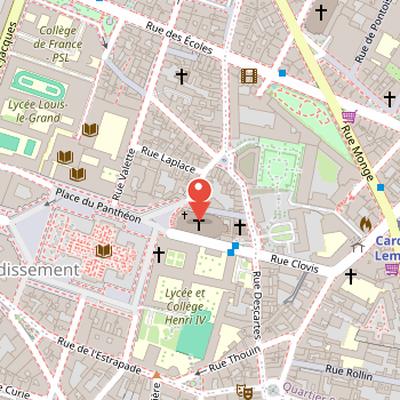
Nearby Objects
-
 Abbey of St Genevieve 70 m away
 -
 Panthéon 150 m away
 -
 Sainte-Geneviève Library 150 m away
 -
 Saint-Nicolas-du-Chardonnet 350 m away
 -
 Arènes de Lutèce 400 m away
History and Features of Saint-Etienne-du-Mont
Saint-Etienne-du-Mont is an eglise located on the montagne Sainte-Genevieve in Paris 5e, near lycee Henri-IV and the Pantheon. It replaced a 13th century building and was built from the end of the 15th century as a parish church for the quarter around the abbaye Sainte-Genevieve. Construction began with the chevet and clocher in 1491 and was completed with the facade in 1624. In 1790, it was one of the 51 urban parishes of the diocese of Paris. During the French Revolution, it was briefly transformed into a temple de la Piete filiale, then returned to parish use in 1801, a function it has kept since. The church preserves the chasse of Sainte Genevieve, although it has been empty of relics since the Revolution, and it houses an organ whose origins and buffet date to the 1630s. It is also the last Parisian church where a jubee can still be seen. Saint-Etienne-du-Mont was classified as a monument historique in the 1862 list.
From Parish Chapel to Completed Church
Saint-Etienne-du-Mont originated from the Sainte-Genevieve abbey, where Sainte Genevieve was buried. A chapel called Saint-Jean-du-Mont, located in the abbey high church crypt, served the parish near the abbey, and a chaplain is attested there in a 1141 text. In 1222, Pope Honorius III authorized the founding of an autonomous church to replace this chapel, and the new church was dedicated to Saint Etienne, the patron of Paris's former Saint-Etienne cathedral.
The church was enlarged in 1328 as population density increased around the Sorbonne and the colleges, but by the 15th century a complete reconstruction was necessary. In 1492, the Genevieve monks donated land for the new building. Architect Etienne Viguier began work on the apse and bell tower in 1494, and the first two bells were cast in 1500. The flamboyant Gothic choir was completed in 1537, followed by the installation of the roof frame in 1538. A rood screen was built around 1530 to 1535, and in 1541 Bishop Guy of Megara blessed the altars of the chevet chapels. That same year, the parish commissioned stained glass windows and statues from Parisian artisans.
The Renaissance-style nave was not vaulted until 1584. In 1610, Marguerite de Valois laid the first stone of the facade and gave 3000 livres toward the work. Jean-Francois de Gondi, as the first archbishop of Paris, dedicated the church. Later additions included large organs installed in 1636, made by Pierre Pescheur with a buffet by Jean Buron, and a new pulpit in 1651. Priest housing and sacristan quarters were also created on the premises. During the 17th and 18th centuries, the church hosted major processions in which Sainte-Genevieve's shrine visited Notre-Dame.
Historical Memory and Religious Use
Saint-Etienne-du-Mont has long been associated with important religious and historical memories. The church welcomes the remains of Pierre Perrault, father of the author Charles Perrault, as well as those of the painter Eustache Le Sueur and Pascal. In 1711, it also received the remains of Racine and Isaac Lemaistre de Sacy, transferred from Port-Royal. During the French Revolution, the building was closed and transformed into the temple de la Piete filiale, before Catholic worship was restored in 1801 under the concordat.
The church became an autonomous building in 1802 after the demolition of the Sainte-Genevieve abbey church and the opening of rue Clovis. In 1803, it received the stone of Sainte Genevieve's tomb, transported by Francois-Amable de Voisins. The site was later restored by Victor Baltard under the Second Empire, including the facade and statues, and he also built the catechism chapel. Saint-Etienne-du-Mont was the parish of Frederic Ozanam, who founded the Societe de Saint-Vincent-de-Paul in 1833.
The church is also marked by later events and commemorations. Archbishop Sibour was assassinated there by Father Jean-Louis Verger on 3 January 1857, and a plaque marks the place where he fell. Another plaque near Sainte Genevieve's tomb commemorates prayers during the 1914 Battle of the Marne, and the church also recalls Sainte Genevieve's historical act of diverting Attila from Paris in 451. It hosted a mass celebrated by Pope Pius VII on 15 June 1805 and another by Pope John Paul II during the World Youth Day visit to Paris on 30 August 1997.
Architectural Transition and Interior Features
Eglise Saint-Etienne-du-Mont is a church built between 1610 and 1622 that marks the transition between flamboyant Gothic, Louis XII style, and Renaissance architecture. It is described as a witness to transitional architecture from Gothic to Renaissance. The church has a basilical structure with very high side aisles and no outwardly projecting transept. Its choir axis is inclined relative to the nave axis, and the building lacks axial symmetry. The facade is flanked by a tall, narrow, atypical bell tower.
The interior also reflects this architectural transition, with the choir and nave differentiating flamboyant Gothic and Renaissance styles. A meridian is installed on the southern buttress wall thickness, and a pendentive keystone or fleuron projects 3 to 4 centimeters in the transept. This pendentive keystone is considered a remarkable work because of both its installation and sculpture.
The church also contains a shrine that formerly held the relics of Saint Genevieve until 1793; after that date, the relics were discarded and only a bone fragment remains. It also contains the tomb of Blaise de Vigenere, Blaise Pascal, Louis Nivelle, Racine, and Sibour. In the broader context of Gothic churches, it is notable that most have lost their rood screens or jubes, a fact that helps frame the church's preserved historical features.
The Jube of Saint-Etienne-du-Mont
The church of Saint-Etienne-du-Mont contains one of the most curious and remarkable jubes, and it is the only one still existing in Paris. Jubes served certain rites in modern churches, but they also isolated priests from congregants, and they have disappeared from modern church use. Several French cities still preserve examples.
The jube at Saint-Etienne-du-Mont is notable for combining a Gothic structure with Renaissance ornamentation. It was probably constructed between 1550 and 1600. Its balustrade is sculpted from Saint-Leu limestone and resembles a lacework of stone. The monument also includes two staircases spiraling around pillars, which serve both the jube and the walkway.
The author of the construction is unknown, although most of the artisans involved are known. Among them, the sculptor Pierre Biard l'Aine is credited with the two figures of young men associated with the jube.
Stained Glass Remains at Saint-Etienne-du-Mont
Saint-Etienne-du-Mont still preserves a series of stained glass windows, although most are fragments of the original decoration. Before the Revolution, all of the church's windows were adorned with stained glass, and the ossuaries adjoining the church and surrounding the small cemetery were also decorated in the same way. Much of this glass was created by Nicolas Pinaigrier, Jean Cousin le Jeune, and Engrand Leprince. Its survival was helped by the care of Saint-Etienne's wardens and by restorations begun in 1734 by Pierre Le Vieil, but many windows, especially in the lower parts, were later broken, and few remain intact.
The church also retains a collection of painted enamel stained glass windows in the Communion chapel. These date from the late 17th or early 18th century. They were mutilated and dispersed during the Revolution, then reassembled in 1834. Only 12 of the original 22 windows remain. In 2026, the Communion chapel with these windows was inaccessible to the public.
Stained Glass and Interior Art at Saint-Etienne-du-Mont
The documented interior of Saint-Etienne-du-Mont includes a substantial range of stained glass, painted works, and liturgical furnishings. The stained glass subjects recorded in the church include La Paques juive, Les lavements et la synagogue, Elie defie les prophetes de Baal, Eucharistie, Le Pressoir mystique, Annonciation et la Cene, and La Visite des trois anges a Abraham. These titles indicate a strong emphasis on biblical and Eucharistic themes.
Other photographed elements of the church interior include the Adoration du saint sacrement, the Mise au tombeau, the Autel de la Vierge in a chapel, and the Chasse de sainte Genevieve. The church also preserves a chaire dated 1651, with photographed details of the chaire itself, its base, and carved imagery associated with it, including La Force et la Charite. Together, these features show a setting where devotional art and ecclesiastical furnishings are closely integrated.
The record also includes a number of paintings and other images associated with the church. These include works titled Bernar en oraison after Philippe de Champaigne, Saint Charles Borromee distributing alms, Deposition de croix, La Visitation, Marie Madeleine repentante, and La Manne dans le desert, as well as a depiction of Lapidation de saint Etienne. In addition, the documentation mentions images by Charles Marville of Eglise St. Etienne du Mont and Eglise St. Etienne-du-Mont from the mid-19th century, along with a photograph of the paroisse Saint-Etienne-du-Mont at Montagne Sainte-Genevieve in Paris.
Taken together, these records present Saint-Etienne-du-Mont as a church whose interior is notable for its layered artistic program, combining stained glass, paintings, sculpture, and historic liturgical elements.
The Organs of Saint-Etienne-du-Mont
Saint-Etienne-du-Mont is notable for its organs, which reflect several centuries of work and modification. The organ buffet was constructed by Jean Buron in 1630 and is considered a masterpiece of woodworking. The main organ itself was made by Pierre Pescheur in 1636, then severely damaged in a fire in 1760. It was rebuilt by Cliquot in 1777 and later enhanced by Aristide Cavaille-Coll in 1863 and 1873. Further improvements were carried out by Theodore Puget in 1911, followed by a radical transformation by Beuchet-Debierre in 1956, initiated by Maurice Durufle. The instrument was reharmonized and the console was changed by Danion-Gonzalez in 1975, and restored by Bernard Dargassies in 1991 and again in summer 2011. It was the tribune of Maurice Durufle and Marie-Madeleine Durufle, and its current organists are Vincent Warnier and David Cassan. Thierry Escaich served as co-titular organist from 1997 to 2024 before later becoming titular organist of Notre-Dame de Paris.
The church also has a choir organ built by Puget in 1902. Located on the north side of the choir behind the stalls, it has 14 stops, of which 12 are actual, as well as two manuals with 56 notes each and a pedalboard with 30. Its transmission uses pneumatic action. The instrument is housed in a neo-Gothic two-tiered case on a high base, arranged in a tripartite design with six pipe faces: 7/17/7 on the first tier and 5/9/5 on the second tier.
Saint-Etienne-du-Mont in Literature and Film
Saint-Etienne-du-Mont appears in several literary and cinematic works. In Honore de Balzac's Le Pere Goriot, Eugene de Rastignac attends mass alone for Jean-Joachim Goriot's funeral. Joris-Karl Huysmans also mentions the choir of Saint-Etienne-du-Mont in the autobiographical novel En Route. Laurence Plazenet notes the church's link with Port-Royal, as illustrated in Augustin ou Le Maitre est la. In cinema, Michel Servin's novel Deo gratias inspired Jean-Pierre Mocky's 1963 film Un drole de paroissien, whose action is set multiple times in Saint-Etienne-du-Mont.