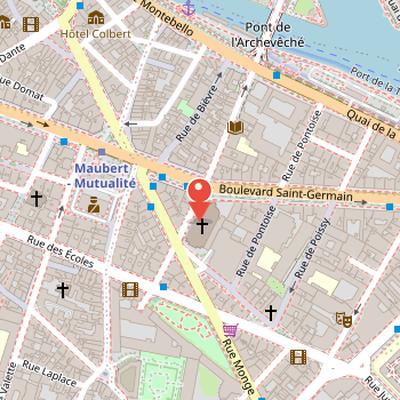
Saint-Nicolas-du-Chardonnet is a church building located at 23 rue des Bernardins, on the corner of rue Saint-Victor in the quartier Saint-Victor, near the maison de la Mutualité in Paris. The present building was reconstructed on the site of an earlier church and was completed in 1937. It is unofficially associated with the Fraternité sacerdotale Saint-Pie-X and has served as the main place of worship for the traditionalist Catholic movement in Paris. The site has a long history: the clos du chardonnet is mentioned in a census of 1126, and the area was later included in Philippe Auguste’s enclosure. In 1230, land was conceded to Bishop Guillaume d’Auvergne for a chapel and presbytery near a cemetery. The chapel was dedicated to Saint Nicolas, became a parish, and was replaced by a church in 1243. The church was later enlarged in 1545 and received a new bell tower in 1625. In the mid-17th century, a decision was made to rebuild a new church beside the old one, with a northward axis because of space limitations.
Nearby Objects
-
 Mémorial des Martyrs de la Déportation 300 m away
 -
 Saint-Étienne-du-Mont 350 m away
 -
 Saint-Julien-le-Pauvre 400 m away
 -
 Sainte-Geneviève Library 400 m away
 -
 Abbey of St Genevieve 400 m away
Location, Reconstruction, and Later Use
Saint-Nicolas-du-Chardonnet is located at 23 rue des Bernardins in Paris, at the corner of rue Saint-Victor in the quartier Saint-Victor, near the maison de la Mutualite. The church was reconstructed on the site of a previous building, and this reconstruction was completed in 1937. Since the 1970s, it has been illegally occupied by associates of the Fraternite sacerdotale Saint-Pie-X. It is also unofficially associated with that group and serves as the main place of worship for the traditionalist Catholic movement in Paris.
The Clos du Chardonnet
The name Saint-Nicolas-du-Chardonnet is linked to the clos du chardonnet, which is mentioned for the first time in a census of 1126. This domain was located on the left bank of the Seine, extending from the fosses de l abbaye Saint-Victor to rue de Bièvre, and ending at the mid-slope of the montagne Sainte-Geneviève. It was named after the wild thistles that grew there before vines were planted. The clos du chardonnet was later included in Philippe Auguste's enclosure.
Construction and Architectural History
In 1230, Pierre, abbe of Saint-Victor, ceded land to Bishop Guillaume d'Auvergne for the construction of a chapel and presbytery near a cemetery. The chapel was dedicated to Saint Nicolas in memory of the rescue of three boatmen after a Seine shipwreck. It soon became a parish and was replaced by a church in 1243, when Jean de Nanton, bishop of Paris, consecrated a larger building.
The church was enlarged in 1545 and received a new bell tower in 1625. At that time, it was oriented eastward, opening onto rue des Bernardins and running parallel to rue Saint-Victor, with the Bièvre canal separating the two. By the mid-17th century, space constraints led to the decision to rebuild a new church beside the old one, with its axis turned north. Images of the cemetery in 1647 and a 1676 plan document this earlier setting.
The new church was designed from drawings by the painter Lebrun dated 1656 to 1690. Construction involved several phases and contracts, including work on what may have been the choir, and later agreements recorded in 1662 and 1667. Christophe Martin laid the first stone in the cemetery of the old church together with Curé Georges Froger, Guillaume Compaing, and parishioners. Jean Bailly later set out the alignment of a newly acquired square behind the choir in 1668. The building was also associated with royal lottery draws organized for its construction, and Charles Le Brun worked on the new church dedicated by Hardouin de Perfixe de Beaumont.
The nave was completed in 1716, while the vault was installed in 1763. The facade and the rest of the construction were finished in 1763, partly financed by Marc-Rene de Voyer de Paulmy d'Argenson. The main altar was consecrated by Archbishop Christophe de Beaumont, although he refused to fully consecrate the church because it lacked a facade at that stage. The church includes a lateral square tower and is described as one of the few 17th-century churches not oriented eastward. Its grand organ was made by Francois-Henri Clicquot, with a case dating from 1725.
Later changes continued to shape the building. Victor Baltard remodeled the apse in 1862 following the opening of boulevard Saint-Germain. The old seminary of Saint-Nicolas-du-Chardonnet was demolished in 1911, making way for the later construction of Maison de la Mutualite on that site. Between 1932 and 1937, the main south portal on rue Saint-Victor was built under the direction of Charles Halley. The church was finally consecrated by Beaussart, delegate of the cardinal-archbishop.
Historical Occupation and Parish Life
Saint-Nicolas-du-Chardonnet has been the main Parisian place of worship for the traditionalist Catholic movement since its illegal occupation by affiliates of the Fraternite sacerdotale Saint-Pie-X in 1977. The occupation involved abbes Francois Ducaud-Bourget, Louis Coache, Vincent Serralda, and Jacques Schneider, and the church was seized after nine unanswered requests had been made to Cardinal Francois Marty, Archbishop of Paris. A mass was celebrated there on the day of the occupation, and traditionalists have remained in the church despite an expulsion order by the Archdiocese of Paris, which also requested public force intervention to remove them. Since then, the church has remained unofficially dependent on the Fraternite sacerdotale Saint-Pie-X.
The parish has also been marked by a distinct internal history. In 1921, it had three employees: a Swiss Guard in three costumes, a beadle, and a sacristan responsible for cleaning and maintenance tasks. Earlier parish identity is also reflected in the historical note that Abbe Lenert linked the parish to the goldfinch, represented in the drawing used for the Journal paroissial title, where the bird was connected to Passion and Crown of Thorns symbolism.
The church has hosted a number of public and commemorative events. Funerals celebrated there included those of Jacques Audiberti, Michel Boutin, Georges-Paul Wagner, Paul Touvier, Francois Duprat, Rolande Birgy, Bernard Faure, Maurice Bardec he, and Jean-Pierre Stirbois. A ceremony commemorating the 40th anniversary of the occupation was held there with representatives of the French extreme right present, including Pierre Pujo, Francois Brigneau, Pierre Sidos, Jean Madiran, Andre Figueras, and Roland Gaucher. The church also saw a Latin mass in memory of Maurice Bardec he, during which Jean-Marie Le Pen praised him, and Jean-Marie Le Pen regularly attended masses there for deceased friends.
Other recorded usages include the baptisms of Tristane Banon and Marine Le Pen's three children. The church is further associated with commemorative observances, including annual masses for the victims of the Rue d'Isly shooting and a commemorative mass for King Louis XVI. A small shop on Boulevard Saint-Germain is noted as perpetuating the former parish with the conciliar mass, and Saint-Severin parish and church changed name to Saint-Severin-Saint-Nicolas. The church also contains a statue of Notre-Dame d'Afrique, while the original statue is located in Algiers. Available images in the record show the south and west facades and the north side choir.
Clerical Administration Since 1977
The Historique records the priests responsible for the clergy serving Saint-Nicolas-du-Chardonnet since 1977. It notes that these priests are not recognized as parish priests under canon law, and that the legitimate archbishop of Paris does not entrust the parish to them. The legitimate church administrator is identified as the parish priest of Saint-Severin-Saint-Nicolas, Abbe Guillaume Normand. The same account says these priests are frequently referred to as curates in publications, including major press and Catholic press such as La Croix. It also states that FSSPX is not in full communion with the Catholic Church according to Ecclesiae unitatem, has no canonical status while doctrinal questions remain unresolved, and that its ministers cannot legitimately exercise any ministry under that document.
Relics, Artworks, and Interior Decoration
Saint-Nicolas-du-Chardonnet is associated with a notable collection of relics and church furnishings. Among the relics recorded there are a vial of water flowing from the bones of Saint Nicolas, brought by Paul de la Croix, and a bone, possibly a humerus, of Saint Nicolas with an attestation by Louise de Foix de Candale, abbess of the Sainte-Glossinde Abbey of Metz. The church also contains a relic of the right foot of Saint Victor. Formerly, relics of the cross of Christ were displayed on solemn days. Before the Revolution, the church possessed beautiful ciboria and sacred vases, and it still conserves remarkable embroidered altar canons and chasubles.
The site has also been recognized in the inventory of historic monuments, and many of its paintings and sculptures were similarly classified on an unspecified date. Near the entrance is a youthful painting by Charles Le Brun, Martyre de Saint Jean l Evangeliste a la Porte Latine. Le Brun, who founded the Academie francaise in 1648 and served as first painter to the king, is also represented in the church by the tombs of himself and his mother Julienne Le Be in a chapel of Saint-Nicolas du Chardonnet, where they obtained perpetual mass for him and his spouse from the priests and wardens of the church.
The chapel consecrated to Saint Charles Borromee is described as one of the most sumptuous private chapels in Paris. It was realized by Antoine Coysevox and the sculptor Gaspard Collignon, and the church provided only its decoration. The church also provided the facade on rue des Bernardins in 1669, as well as the design of the storefront, the tabernacle, and the calvary. A Pieta by Claude Francois, called Frere Luc, dating from the 17th century, was recently identified in this chapel. Other works include a monumental altar of green marble at the back of the church and a large wooden crucifix with two statues of the Virgin and Saint John by Jean-Baptiste Poultier. Nicolas Legendre, a friend of the church, worked on sculptures decorating the facade on rue des Bernardins and inside the Virgin and Agonizing chapels.
The tabernacle disappeared during the Revolution, but a detailed description survived: it was adorned with a railing, lions on volutes, Corinthian columns, and a door engraved with the name Jehovah in Hebrew. The church's bells also form part of its historic identity. During the Paris Commune, the tocsin rang once to warn of enemy maneuvers. The four bells were blessed on February 22, 1855, with the emperor and empress serving as godfather and godmother through the duc de Bassano and duchess de Bassano. They were named Louis, Napoleon, Eugenie, and Jean.
The Organ
The organ at Saint-Nicolas-du-Chardonnet is a composite historical instrument with a long sequence of building and restoration campaigns. Its current organ comes from the former parish of Saints-Innocents, which was suppressed in 1787 and sold to the Fabrique of Saint-Nicolas du Chardonnet. The historical case dates from 1725, and the organ was originally built by the master builder Francois Thierry between 1723 and 1725. At that time, it had four keyboards and 24 stops.
The instrument was later restored and altered by several builders. François-Henri Clicquot worked on it in 1766 and again from 1787 to 1790, followed by Merklin in 1897, Paul Koenig in 1927, Victor Gonzalez in 1936, Roethinger-R. Boisseau in 1961, Barberis in 1987, and Michel Gaillard in 2004 and again from 2007 to 2009. The organ was restored by François-Henri Clicquot in 1790 and by Louis-Paul Dallery and Paul Koenig in 1927. Its inauguration involved François Couperin, Claude Balbastre, Charles Tournemire, and Louis Vierne, and Louis Vierne played the Carillon de Westminster.
The present console has four keyboards of 56 notes each, a pedalboard with 30 notes, and electric action for 47 real stops. The restored organ was inaugurated on 7 and 8, with a blessing, a presentation by the organ builders, a pontifical mass with choir and two organs, and an inaugural recital by Marie-Agns Grall-Menet. Her recital included works by Louis Marchand, Claude Balbastre, Johann Sebastian Bach, Johann Kaspar Kerll, Antonio Vivaldi, Eugene Gigout, Jean Langlais, Marie-Agns Grall-Menet, Rene Vierne, and Louis Vierne. Marie-Agns Grall-Menet was appointed titular organist in 1989, and a CD made by the titular organist was sold to benefit the 2007 to 2009 restoration.