Boulevard Saint-Michel is a boulevard in Paris that extends from Pont Saint-Michel to Avenue de l’Observatoire. It is commonly called Boul’Mich’, a familiar contraction of its name. The northern part of the boulevard is described as the most lively area, with numerous bookstores and clothing shops, including librairie Gibert Joseph. The boulevard also borders the Jardin du Luxembourg and provides access to the main entrance of the Sorbonne and to square Samuel-Paty via rue des Écoles, as well as to the musée de Cluny via rue Du Sommerard.
The boulevard takes its name from Pont Saint-Michel, near the Chapelle Saint-Michel-du-Palais. Its history is linked to earlier routes in the area, including a road that ran alongside most public buildings of Lutèce during the Roman High Empire. Boulevard Saint-Michel was created following Baron Haussmann’s directives, parallel to rue Saint-Jacques, and became part of a new major north-south axis of the capital with boulevard de Sébastopol. It was first called boulevard de Sébastopol rive gauche before receiving its current name in 1867.
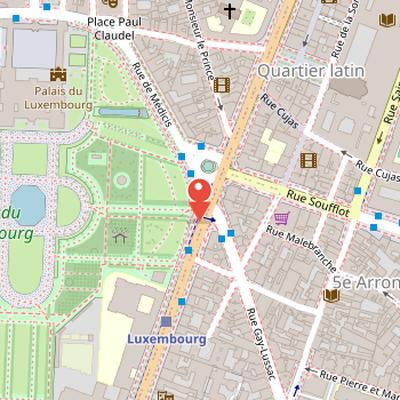
Nearby Objects
-
 Medici Fountain 200 m away
 -
 Jardin du Luxembourg 250 m away
 -
 Luxembourg Palace 300 m away
 -
 Odéon–Théâtre de l'Europe 350 m away
 -
 Sainte-Geneviève Library 400 m away
Location and Access
Boulevard Saint-Michel extends from pont Saint-Michel to avenue de l'Observatoire. It is familiarly known as Boul'Mich', a contraction of its full name. The northern part of the boulevard is described as the most lively area, due to the presence of numerous bookstores and clothing shops, including librairie Gibert Joseph. The boulevard borders jardin du Luxembourg and provides access to the main entrance of the Sorbonne and to square Samuel-Paty via rue des Ecoles. It also gives access to the musee de Cluny via rue Du Sommerard.
Origin of the Name
Boulevard Saint-Michel takes its name from the Pont Saint-Michel. The reference points to the nearby bridge, which is itself located near the Chapelle Saint-Michel-du-Palais. This connection gives the boulevard a name linked to an established local landmark and to the surrounding historic setting.
Creation of Boulevard Saint-Michel
Boulevard Saint-Michel was created following the directives of Baron Haussmann, laid out parallel to rue Saint-Jacques, which marked the historical north-south axis. Its creation formed part of a broader series of Parisian works that also included the decree of 1855 for boulevard Saint-Germain and the realignment and widening of rue de la Harpe to 30 meters for the extension of boulevard du Centre, then the current boulevard de Sebastopol on the left bank. A convention signed on December 6, 1859, between Paris and the State provided for a 10-year execution of the extension of boulevard de Sebastopol through the Ile de la Cite, including the current boulevard du Palais and the section between place Saint-Michel and carrefour de l'Observatoire. On December 14, 1861, the boulevard de Sebastopol extension was widened by 20 meters through rue d'Enfer and rue de l'Est, isolating Luxembourg garden from rue d'Enfer. The works required removing 2 meters of earth near the former porte d'Enfer at the exit of rue Monsieur-le-Prince and led to the partial or complete removal of rue Macon, rue Poupee, and rue Percee-Saint-Andre. Together with boulevard de Sebastopol, boulevard Saint-Michel constituted the new major north-south axis of the capital. It was first called boulevard de Sebastopol rive gauche before its name changed in 1867.
Historical Events at Boulevard Saint-Michel
Boulevard Saint-Michel has been marked by several notable historical events. It experienced ground subsidence that formed an 11 meter deep chasm under buildings numbered 47 to 49. During World War I, it was bombed on January 30, 1918, in a raid by German airplanes, and a commemorative plaque at number 42 recalls this attack. The boulevard also became a site of political unrest and student protest. Between 6000 and 7000 Latin Quarter student protesters were stopped there by peacekeepers at the intersection with boulevard Saint-Germain, and the National Assembly later unanimously condemned police violence following the protest. In May 68, boulevard Saint-Michel was one of the main sites of police-student clashes because of its proximity to the Sorbonne, and it was blocked by barricades and CRS vans for more than a month.
Proposals to Extend the Boulevard
In 1928, a political candidate named Duconnaud proposed extending boulevard Saint-Michel to the sea. The idea was later taken up by Ferdinand Lop, who adopted the proposal as a public notion. When asked about the extension, Lop replied that it would be extended to the sea by both ends. These references record the boulevard as the subject of a humorous or satirical political proposal rather than a built project.
Notable Buildings and Landmarks
Boulevard Saint-Michel is lined with several notable buildings and places of memory. According to Batissements remarquables et lieux de memoire, the main buildings are located along the boulevard, which also borders the garden of Luxembourg through its grilles. At its western end, it intersects with the place Edmond-Rostand roundabout, decorated by a fountain, and at the eastern end it meets rue Soufflot.
The boulevard is associated with several named occupants and institutions. Composer Cesar Franck lived on the ground floor of boulevard Saint-Michel from 1865 to 1890. Photographer Germaine Krull lived and had a studio there in the early 1930s. Among the listed addresses are the Ecole nationale superieure des mines at number 60, the Foyer international des etudiantes at number 93, the theatre La Comedie Saint-Michel at number 95, an ornamented door at number 97, and an Egyptian cultural center at number 111. The last pair, a corner building with avenue de l'Observatoire, is at number 88. Number 95 is referenced twice on the boulevard.
Artists and Studios at Number 115
Number 115 boulevard Saint-Michel is identified in Batissements remarquables et lieux de memoire as a site linked to several artists and studio interiors. The orientalist decor of Charles Cordier's atelier is noted there, and Antonin Mercie is said to have worked in his atelier at the same address in 1913. Luc-Olivier Merson also worked in his studio at number 115 boulevard Saint-Michel. In October 1916, Etienne Buffet painted his wife Cornelie Blanchemain in his atelier at this location, and his painting Coin de l'atelier (1940) represents the atelier at number 115.
Memorial Addresses and Notable Residents
Boulevard Saint-Michel is marked by a dense series of memorial plaques and documented places of residence that reflect its historical associations. At 60 Boulevard Saint-Michel, the facade of the Ecole des mines carries two plaques commemorating the 1918 bombardment and the Liberation of Paris in 1944, and Bounin died there during the Liberation of Paris. A commemorative plaque of Cecile DeWitt-Morette is also shown at the Ecole nationale superieure des mines de Paris. Other wartime deaths recorded on the boulevard include Willy Ehrhardt at 4 Boulevard Saint-Michel, Jean Revers at 66, Jean Bachelet at 79, and Raymond Bonnand at 105. Lieutenant Martinet died at the intersection with Rue Auguste-Comte during the Liberation of Paris, while a plaque at 81 Boulevard Saint-Michel commemorates a German aerial bombardment in 1918.
The boulevard is also associated with several literary, scientific, and political figures. Zahari Stoyanov died at 31 Boulevard Saint-Michel in 1889, Paul Mounet died at 63 in 1922, and Jules Valles died at 77 in 1885. Leconte de Lisle lived at 64 Boulevard Saint-Michel from 1872 to 1892, Cesar Franck lived at 95 from 1865 to 1890, and philosopher and politician Louis Marin lived at 95 from 1916 to 1960. Edouard Branly lived at 87 Boulevard Saint-Michel from 1928 to 1940. At 93 Boulevard Saint-Michel, Grace Whitney Hoff founded the Foyer international des etudiantes.