The Abbey of St Genevieve was a church building in Paris whose origins are linked to Historique, who decided to make Paris the capital of the kingdom and chose the former palace of the Thermes as a residence. He resolved to build a church in honor of the holy Apostles Peter and Paul and selected a site near the palace at the top of mons Lucotitius. Construction of the basilica of the Holy Apostles began in 508 after a campaign against the Visigoths. Historique was buried there as founder in 511, and Clotilde continued the work after his death. The basilica was completed around 520 and consecrated by Bishop Saint Remi of Reims under the title of Saints Peter and Paul. In later centuries, the basilica and its dependencies were affected by Viking attacks. The community fled with the relics of Saint Genevieve and later returned to Paris after repairs. The relics’ pilgrim cult increased the saint’s renown, and Saint Genevieve came to be considered the patroness of Paris.
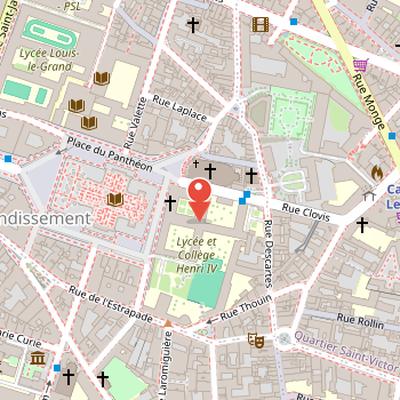
Nearby Objects
-
 Saint-Étienne-du-Mont 70 m away
 -
 Panthéon 130 m away
 -
 Sainte-Geneviève Library 200 m away
 -
 Arènes de Lutèce 400 m away
 -
 Saint-Nicolas-du-Chardonnet 400 m away
Foundation and Construction of the Basilica
In 507, Historique received the letters of patrice and consul from Emperor Anastase. After deciding to make Paris the capital of the kingdom, he chose the former palace of the Thermes as his residence and resolved to build a church in honor of the holy Apostles Peter and Paul. He selected a location near the palace at the top of mons Lucotitius. Construction of the basilica of the Holy Apostles began in 508, after a campaign against the Visigoths. Historique died in 511 and was buried in the basilica as its founder before its completion. Clotilde continued the work after his death, and the basilica was completed around 520. Bishop Saint Remi of Reims consecrated it under the title of Saints Peter and Paul.
Burial Traditions at the Abbey
According to Gregory of Tours, the Merovingian church likely included a burial annex for Historique and Clotilde. The historical record also notes that two grandsons of Historique and Clotilde were assassinated by their uncles Clotaire and Childebert. Another daughter of Historique, also named Clotilde and the widow of King Amalaric of the Visigoths, is mentioned in the same context. Clotilde died in Tours and was solemnly transported to Paris for burial near the tomb of Saint Genevieve, indicating a close funerary association with the site.
Viking Threats and the Relocation of the Shrine
The buildings and gardens of the abbey were located near the Saint-Etienne-du-Mont church and the Pantheon, between rue de l'Estrapade, place du Pantheon, and place Sainte-Genevieve. In the 9th century, the basilica and its dependencies were especially vulnerable to Viking attacks because they stood far from the Cité and in a mostly uninhabited suburb. The religious members fled twice, in 856-857 and in 861, taking the precious relics of Saint Genevieve to nearby domains, including Athis, Draveil, and Marizy-sur-Ourcq. During the first incursion, the Vikings partly burned the basilica and the adjacent buildings. The community returned to Paris around 863 after hastily repairing the fire damage.
The relics of Saint Genevieve gained further importance through numerous miracles reported during pilgrimages, which strengthened the saint's renown. When the Vikings approached again in 885, Parisians invited the religious members to bring the shrine into the Cité for supernatural protection. The relics then remained in a modest oratory in the Cité during the siege. This oratory, part of the cathedral and formerly served by one of its canons, was later granted to the community by the bishop as a token of gratitude. The community then acquired the benefice of Notre-Dame, invested in the oratory's officiant. According to the source, Sainte Genevieve came to be regarded as the patroness of Paris, and her name was added to the Saints-Apotres to give the church preserving her shrine its name.
Names, Councils, and the Abbey Shrine
The abbey was known by both titles, Saints-Apotres and Sainte-Genevieve, until the mid-12th century. The title Saints-Apotres then gradually disappeared in the second half of that century, and from 1219 only Sainte-Genevieve remained. The church was ravaged by Viking invasions, after which Etienne de Tournai rebuilt it in the early 11th century, when it belonged to the Cluny order.
The abbey also played an important role in church politics and public ritual. Several councils were held there in the 6th century, including the council of 577 against Pretextat, bishop of Rouen. During the trial of the Templars, a papal commission sat in the abbey from 1309 to 1310, and more than 589 Templars defended their order there. Processions with the shrine of Sainte Genevieve were carried out during periods of danger.
The shrine itself was created by the sculptor Germain Pilon and the goldsmith Bonard. In 1242, it weighed 193 marcs of silver and 7.5 marcs of gold. It was melted down at the Paris Mint in 1793, and the bones of Sainte Genevieve were burned at Place de Greve that same year.
The Abbey as a Reform Center
The abbey served as the seat of the Congregation of France of Augustinian abbeys, known as the Genovefains. From the 17th century, it gained major influence in Europe through this role. The federation of Augustinian abbeys was initiated by Cardinal de la Rochefoucauld, who was the commendatory abbot of the abbey and sought to introduce the reforms requested by the Council of Trent. He became commendatory abbot of Sainte-Genevieve-du-Mont in 1619, and in 1622 Pope Gregory XV issued a brief appointing him apostolic commissioner for reforms at the request of King Louis XIII. The Congregation of France of regular canons was established in 1631, and Charles Faure became its first superior general that same year. By the end of the century, the congregation included 67 abbeys, 28 conventual priories, 2 provostships, and 3 hospitals in France, and it counted approximately chanoines geneviefains.
Reconstruction and Legacy of the Abbey
Before the French Revolution, an abbatial reconstruction project was carried out at the Abbey of St Genevieve. A new monumental abbey church was built over a crypt and designed by the architect Jacques-Germain Soufflot. The church was named Sainte-Genevieve and is now the PanthEon de Paris. The former abbey church later deteriorated and was demolished between 1801 and 1807, making way for rue Clovis. Only the bell tower remained from the initial church; this tower is known as the tour Clovis and stands within the grounds of lycee Henri-IV, which was formed from former conventual abbey buildings dating to the 17th century.
The abbey also had a significant library that became the bibliotheque Sainte-Genevieve. The astronomer Pingre served as librarian of the abbey library. The site retained further commemorative associations, including the placement of the copper coffin of Descartes under a marble monument on May 29, 1819. The abbey also appears in musical history through Marin Marais, who composed Sonnerie de Sainte-Genevieve du Mont de Paris in 1723 as part of La Gamme et autres morceaux de symphonie for violin, viola da gamba, and harpsichord.
Surviving Elements of the Abbey
Although much of the original Abbey of St Genevieve no longer remains in place, several architectural elements have been preserved or relocated. The base of the clocher, now the Tour Clovis, survives within the Lyccee Henri-IV and is part of the original church. Other church features are also conserved in museums, including several capitals of the nave at the Musee de Cluny and the statue of Sainte Genevieve at the Musee du Louvre in Paris, where it is shown with statues of Saint Pierre and Saint Paul. The church facade portal from the 13th century was remade and is decorated with statues.
The abbey complex also included tombs in the church, closed basements under the cloister, especially beneath the convent buildings, and a monastic cellar mezzanine under the current chapel, which was formerly a refectory. The architecture further includes aisles cut in tuff, which probably contained Merovingian burials. These remains indicate the layered history of the site and the range of functions once present within the abbey precinct.