Sainte-Geneviève Library is an interuniversity and public library located at 10, place du Panthéon in Paris. It occupies a building in the Quartier Latin built between 1843 and 1850 by architect Henri Labrouste, on the site of the former Collège de Montaigu. The building has been expanded since its construction. The library is the heir of the third largest European library of its time, which had been housed in the former Sainte-Geneviève abbey of Paris. That abbey was transformed into the École centrale during the Revolution and was located on the top floor of what is now lycée Henri-IV. Today, the library is a state library serving universities Paris 1, 2, 3, 4, and 7, as well as the public. It is accessible to any adult or person holding a baccalauréat. Its encyclopedic collections contain about two million volumes and are divided into three collections.
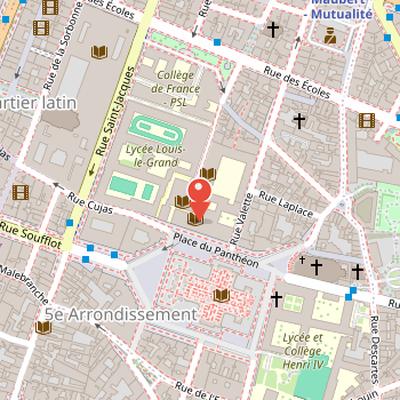
Nearby Objects
-
 Panthéon 100 m away
 -
 Saint-Étienne-du-Mont 150 m away
 -
 Abbey of St Genevieve 200 m away
 -
 Boulevard Saint-Michel 400 m away
 -
 Saint-Nicolas-du-Chardonnet 400 m away
Building, History, and Collections
The Sainte-Geneviève Library is an interuniversity and public library located at 10, place du Panthéon in Paris. It occupies a building in the Quartier Latin that was built between 1843 and 1850 by the architect Henri Labrouste, on the site of the former Collge de Montaigu, and the building has been expanded since then. The library is the heir of the third largest European library of its time, which had been housed in the former Sainte-Genevieve abbey of Paris. During the Revolution, that abbey was transformed into the Ecole centrale, and it was located on the top floor of what is now lycee Henri-IV. Today, the Sainte-Genevi'e Library is a state library serving universities Paris 1, 2, 3, 4, and 7 as well as the public. It is accessible to any adult or to anyone holding a baccalaureat. Its encyclopedic collections contain about two million volumes and are divided into three collections.
Early History and Intellectual Life
The origins of the Sainte-Geneviève Library are tied to the abbaye Sainte-Geneviève de Paris, founded from a basilica dedicated to the apostles Pierre and Paul by Clovis. Sainte Geneviève was interred in the crypt in 502, and her name came to designate the basilica, the abbey, and later the library. Histoire notes that a library in the abbey is only clearly recorded later, with an early manuscript now preserved at the bibliothèque municipale de Soissons, while Clotilde commissioned a Life of sainte Geneviève eighteen years after her death. The first objective mention of books appears in 831, when Angesise bequeathed three works to the abbey. Histoire also suggests that a cell probably served as a scriptorium, although not as a full workshop. In the Carolingian era, cultural development was slowed by Viking invasions. Later, abbE Etienne de Garlande hosted Abelard at the abbey from 1108 to 1113. The period was also marked by Suger’s reform and the community’s adoption of saint Augustin’s rule, which promoted both a library and a copyist workshop.
Growth, Public Access, and the Move to a Purpose-Built Building
The history of Sainte-Geneviève Library is marked by repeated interruption and renewal. A catalog is said to have listed 226 volumes, excluding liturgical books, in an early phase of the collection. The Hundred Years War and the Wars of Religion then halted enrichment, and abbés and librarians are recorded as having taken part in politics and sold precious manuscripts. By the early period of reconstruction, the collection had to be almost entirely rebuilt.
A decisive recovery came in 1624, when Cardinal de La Rochefoucauld, bishop of Senlis, reinstated the library after acquiring the abbey in 1619. He provided an initial deposit of 600 volumes and later bequeathed his collections and archives in 1640. After him, the holdings continued to grow until the Revolution under successive librarians. Jean Fronteau served from 1648 to 1662, though he was partly absent after 1654 because of a jansenism sentence, and he was also a major participant in the controversy over the author of the Imitation de Jesus-Christ. The present library still holds more than one thousand editions of that work.
In 1660, Claude Du Molinet founded a cabinet of curiosities attached to the library and cataloged it. At his death in 1687, the library had expanded to include 400 manuscripts and thousands of prints. Donations remained important, including a gift from Gabriel Naude in 1653. In 1710, Archbishop of Reims Charles-Maurice Le Tellier left his manuscripts and approximately 20,000 printed volumes, including 500 volumes that formed the basis of the present Bibliotheque nordique collections. His collection also introduced Nicolas Clement's alphabetical classification, which is still partly used today.
The library was among the first in Paris to open to the public. Alexandre-Guy Pingre, librarian from 1711 to 1796, increased its scientific collections and helped prevent the dispersion of the holdings during the Revolution, when the library became national property with the abbey in 1790. It benefited from revolutionary confiscations and Napoleonic war appropriations, gaining around 30,000 items, and its public and national mission was confirmed. The library was renamed Bibliotheque du Pantheon, or Bibliotheque nationale du Pantheon, until the Restoration.
After Pingre's death, Pierre Daunou managed the library and began the incunabula catalog. Under his authority, a general catalog was created in thirty-three volumes. The collection continued to receive donations, and a royal decree in 1828 granted legal deposit rights in several disciplines. As the library became cramped in the old premises on the top floor of the former abbey turned lycee, it moved provisionally in 1842 to part of the former Montaigu college. An expert then recommended building a new library complex and received the architecture commission. The first purpose-built library building was completed in 1850 and inaugurated on April 15, 1850. In 2015, Francois Michaud became director, replacing Yves Peyre, and his appointment renewed the project to merge Sainte-Genevieve and Sainte-Barbe libraries.
Labrouste's Library Architecture
The Sainte-Geneviève Library was designed as the first autonomous library building in France, not attached as an annex to a palace, school, or monastery. The construction was entrusted to Henri Labrouste, and the facade was completed in the same year he was assigned. Its exterior presentation was marked by a restrained composition: a single modest entrance door was placed at the center of the facade, with no protruding elements, and the door was integrated directly into the masonry. Two sculpted torcheres flanked the entrance and were lit in the evening until 22 hours. Elsewhere on the facade, large iron points were placed between each window to reveal the internal metal structure, while pointed bolt heads were made visible 18 meters above the ground as structural signals. These bolt heads were fixed to striped iron washers framed by a sculpted motif of three corkscrew flowers, and the exposed tie rod heads may have been intended as a deliberate statement of structural honesty.
Behind the entrance, the building opened into a large vestibule with massive square columns at its center. The vestibule floor was made of marble with geometric decoration, and the space extended across the full width of the building to a large staircase opposite the entrance. The upper walls of the vestibule were painted with a garden scene. This sequence of vestibule and staircase was intended to symbolically represent the reader's path to knowledge. Valuable book storage areas were placed on both sides of the entrance and supported by massive columns. These storage spaces were divided into cells enclosed by bookcases and columns, and two narrow spiral staircases in the corner angles allowed staff to move books to the reading room. The storage areas were later extensively remodeled after the original construction.
The first floor was designed on a basilical plan with a large hall divided by a central colonnade. The interior space measured 70 meters long and 17 meters wide, and it rose to a height of 15 meters. Around forty large windows were placed high along the hall, bringing light into the space. The walls were lined with common books on two levels, and access to the second level was provided by a gallery connected to the hall by four staircases at each corner. Although Labrouste initially planned small hidden staircases between bookshelves and narrow passages in the buttresses, four wider and more practical corner staircases were added upon request.
Labrouste's Iron and Stone Interior
Henri Labrouste designed the Sainte-Geneviève Library as a building that combined stone and cast iron, drawing on materials associated with the industrial revolution. The outer load-bearing columns and the facade walls were made of stone, which also echoed nearby buildings such as the Pantheon, the town hall of the 5th arrondissement, and the Law School. Inside, however, the structure introduced cast iron in a highly visible way, making the iron framework a novelty for a noble building of the period.
The hall was organized around a row of eighteen slender fluted cast-iron columns placed along its central length. Each column rested on a sculpted masonry base two meters high, and the columns transferred their weight onto the ground floor pillars. The ceiling was first conceived as a flat coffered surface supported by a cast-iron structure on columns, and it was later replaced by two vaults supported by relieving arches resting on stone load-bearing columns integrated into the walls. Round arches with columns were used for decoration and cladding, while the cast-iron structure itself was left completely visible. A partly visible iron structure also supported the upper floor.
The cast-iron columns were installed beginning in 1840. The floor was made of marble slabs, and Labrouste also designed the reading room furniture, entrance, and information center. These elements were made of wood with light decorations. Much of the original furniture, including the chairs, remains in place today, even though their backs were criticized as uncomfortable.
Collections and Research Resources
The Sainte-Genevieve Library preserves around two million documents covering philosophy, psychology, religions, social sciences, pure and applied sciences, linguistics, art, literature, history, and geography. Its collections are organized into three departments that communicate documents to readers: Fonds general, Reserve, and Nordique. The Fonds general offers documents published from 1821 and is accessible in the main reading room, with 2 percent in open access. It provides multi-format materials for researchers, teachers, students from Licence to Doctorate, continuing education, preparatory classes, and the interested public.
The Fonds general is an encyclopedic, multidisciplinary, and pluralistic collection based on legal deposit heritage. It focuses on letters, arts, humanities, social sciences, sciences, legal sciences, economics, and management for students. Its documentary policy supports strong areas through French research-level documentation and foreign acquisitions in English, German, Spanish, and Italian.
The Reserve department, located in the ground floor reading room, conserves ancient, rare, and precious books that can be consulted with research justification, along with documentary collections. The patrimonial collections include ancient, rare, precious, and documentary materials. The library also holds an important fonds of reference works covering all disciplines of book history and texts, as well as French and foreign periodicals specialized in bibliography and book history, with fifty current titles. Additional resources include a fonds of clichés and microforms, specialized electronic resources, and digital collections such as Archive of Celtic-Latin literature, Cetedoc library of Christian Latin texts, Incipitaire des textes latins, Patrologie latine, and Acta Sanctorum.
The Nordic Library and Digital Collections
The Sainte-Geneviève Library includes the Nordic Library, located near the main building at 6 rue Valette. It is described as a specialized documentary department, similar to the Reserve, and is presented as the richest Nordic language library outside the Scandinavian countries. Its holdings provide documentation in Scandinavian and Finno-Ugric languages on all subjects, along with French translations of Scandinavian, Finnish, and Estonian works. The collection also includes periodicals, daily newspapers, and audio language methods. More than thirty thousand publications in series are held in the Nordic Library, and the collection has been enriched by a notable Estonian fonds since 1986, as well as a patrimonial collection.
The library's digital resources extend this focus in several ways. Users can consult three hundred Nordic travel stories in the digital library, and in 2009 the collections contributed to the Internet Archive project as the first library in France. Documents are also made available online and automatically signaled on Gallica, the site of the National Library of France. In summer 2015, the collections opened an image collection in addition to a text collection. By 2019, nearly 5,400 books had been digitized, including incunables, Nordic travel books, rare books, and music scores. These materials are available on Genovefa, the digital library of the Sainte-Geneviieve Library, and can be downloaded in EPUB and Kindle formats for consultation on tablets.
Public Opening Hours
The Sainte-Genevieve Library is open to the public from Monday to Saturday, from 10 AM to 10 PM. It also opens on about twelve Sundays each year. These Sunday openings are linked to the university exam calendar, particularly in April to May and November to December.
Literary Visitors and Artistic Echoes
The library appears repeatedly in literary references, with artists and fictional characters listed in chronological order in the records of its artistic references. Lucien de Rubempre, the young poet imagined by Balzac, frequented the library before construction of the Labrouste building, between 1834 and 1837, and it was there that he met Daniel d'Arthes. In 1850, Jules Valles arrived in Paris and worked evenings at Sainte-Genevieve. Pierre Larousse, a regular visitor, spoke about the attendance in 1867, while Victor Hugo complained about it. Jules Laforgue used the library as inspiration and wrote a version of the poem Lassitude, signing it as Bibl. Ste-Genevieve (soir), Jules Laforgue. Later fictional and real visitors continued this association: Stephen Dedalus took refuge there, and James Joyce worked extensively at Sainte-Genevieve and the National Library during his first two stays in Paris in 1902 and 1903. Francis Ponge wrote his first lines at a table in 1916, Jean Prevost frequented the library in 1918 and 1919, and the 1920s included entertaining meetings for the character Jacques Forestier. Around 1925 and 1926, Simone de Beauvoir was a diligent student visitor, while Valery Larbaud found a diverse audience there. In the 1930s, Jean Malaquais warmed up in the library in the afternoon after working nights at Les Halles, and the character Jean Hublin recommended it to Vincent Tuquedenne. Pierre Sansot also frequented it as a diligent student, and in the 1960s the character Gauthier, in La Corrida, portrayed its atmosphere. The décor of Sainte-Genevieve Library was later borrowed by others.