Église Saint-Nicaise de Rouen was founded by Saint Ouen, archbishop of Rouen, in 640 as a chapel outside the city. It housed the relics of Saint Nicaise brought from Gasny and was later included within Rouen under Saint Louis. The church became a parish church in 1388, and the priest of Saint-Nicaise was appointed by the abbot of Saint-Ouen. A new choir was built between 1538 and 1561, and the building was pillaged by Calvinists in 1560. The church was also known for its organ built by Crépin Carlier in 1634.
After a fire partially destroyed the church, the city of Rouen launched a competition to reconstruct the nave and bell tower. The project selected in 1935 was by architects Pierre Chirol and Émile Gaillard, and the reconstruction, carried out from 1934 to 1937, used reinforced concrete. The church reopened for worship in 1940 and received modern stained glass windows by Max Ingrand. Its earlier organs were destroyed in 1934, and a new organ built in 1940 by Louis Eugène-Rochesson and completed in 1957 by Beuchet-Debierre was later dismantled in April 2026. The church was closed to the public in 2006 after reinforced concrete degradation and water infiltration weakened part of the structure.
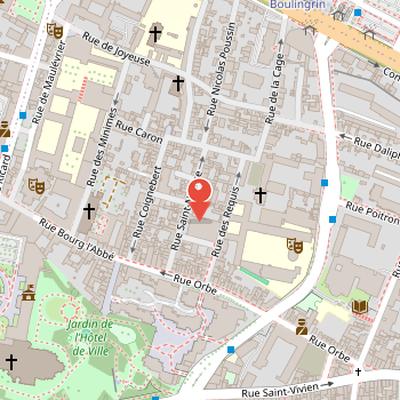
Nearby Objects
-
 Conservatoire de Rouen 200 m away
 -
 Chapelle Corneille 250 m away
 -
 Saint-Ouen Church 300 m away
 -
 Royal Abbey of Saint-Ouen 300 m away
 -
 Monument to Napoléon Ier 350 m away
Historical Development
The church of Saint-Nicaise was founded by Saint Ouen, archbishop of Rouen, in 640 as a chapel outside the city of Rouen. It housed the relics of Saint Nicaise, which were brought from Gasny. Under Saint Louis, it was included within the city of Rouen, and in 1388 it became a parish church. The priest of Saint-Nicaise was appointed by the abbot of Saint-Ouen.
Reconstruction and Organ History
The history of the church includes several major phases of damage, reconstruction, and musical renewal. A new choir was built between 1538 and 1561, but the building was pillaged by Calvinists in 1560. It was also known for its organ, built by Crespin Carlier in 1634. This old tribune organ, classified as a historical object in 1908, was destroyed by fire in 1934, along with the former choir organ installed in 1862 by the Damiens brothers.
After a fire partially destroyed the church, the city of Rouen launched a competition for the reconstruction of the nave and bell tower. The selected project, by architects Pierre Chirol and Emile Gaillard, was chosen in 1935. Reconstruction works took place from 1934 to 1937 and used reinforced concrete. The church was reopened for worship in 1940, with modern stained glass windows by Max Ingrand. A new organ was built in 1940 by Louis Eugene-Rochesson and completed in 1957 by Beuchet-Debierre. The current choir organ by Louis-Eugene Rochesson was inaugurated in 1941. Later, the reinforced concrete used in the reconstruction degraded by the end of the 20th century, and water infiltration weakened the south collateral, requiring partial shoring. The church was closed to the public in 2006. The Saint-Nicaise seminary is located nearby.
Reuse and Public Debate
Until 2014, Secours Catholique distributed meals at Historique. The building was later closed for safety reasons because of degradation, and the city of Rouen planned either to sell or renovate it. Activists from Nuit debout occupied the desacralized and closed site, and they asked for a heritage conservator's assessment to determine whether it could continue to be used for charity distribution. An association called La Boise de Saint-Nicaise was created to promote Historique and examine possible reconversion options.
The city of Rouen later announced the winner of a call for projects for the site. The chosen proposal was Brasserie Ragnar, put forward by three Normandy brewers. Under this project, Historique is to host beer production and consumption, a museum space, and a 40-seat restaurant. The stained glass and stones will be restored, while the structure itself will remain unchanged.
Historical Protection of the Church Furnishings
The Saint-Nicaise church and several of its interior elements have been protected under historical monument status. The current church was first inscribed as a Historical Monument and later converted from inscription to classification by orders without specified dates. Its high altar was also inscribed as a Historical Monument. In addition, all furniture in the church was inscribed, including the tribune organ, choir organ, high altar, side altars, Stations of the Cross, confessionals, stalls, lighting fixtures, and bells. The tribune organ was later converted from inscription to classification. For the old Saint-Nicaise church, the main furniture elements were classified as Historical Monuments, and some of the stained glass windows are still extant.