Abbey Church of Saint-Ouen in Rouen is a Catholic place of worship and one of the city’s main monuments. It was the abbey church of a Benedictine monastery founded in 553 and dedicated to Saint Peter. The site’s first church was a Merovingian basilica where Saint Audoeno was buried in 684. After damage by Vikings in 841, the church was rebuilt in Romanesque style from 1062 under Abbot Nicola of Normandy, and consecrated on October 17, 1126. The body of Saint Audoeno and other relics were transferred there later that month. Following severe fire damage in 1248, including the collapse of the choir, the building was largely reconstructed from 1318 under Abbot Jean Roussel, with designs in the flamboyant Gothic style assigned to Alexandre de Berneval. The works progressed slowly, and the main façade was completed in the nineteenth century. The church is also known for its monumental organ by Aristide Cavaillé-Coll and has been a French historical monument since 1840.
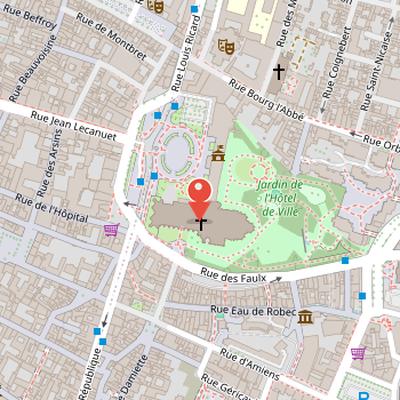
Nearby Objects
-
 Royal Abbey of Saint-Ouen 0 m away
 -
 Monument to Napoléon Ier 120 m away
 -
 Musée national de l'Éducation 200 m away
 -
 L’aître Saint-Maclou 250 m away
 -
 Chapelle Corneille 250 m away
Abbey Church and Landmark Status
The Abbey-Church of Saint-Ouen in Rouen is a Catholic place of worship and one of the city's main monuments. It was originally the abbey church of a Benedictine monastery, which gives it an important place in the religious and architectural history of the city. The church is especially known for its monumental organ by Aristide Cavaille-Coll, which is one of its most notable features. Its cultural and historic value has also been officially recognized, as it has been listed as a French historical monument since 1840.
Historical Development of the Abbey Church
The Benedictine abbey, including the church, was founded in 553 and dedicated to Saint Peter. The first church on the site was a Merovingian basilica, and Saint Audoeno was buried there in 684. The building was damaged by Vikings in 841, then rebuilt in Romanesque style starting in 1062 by Abbot Nicola of Normandy. In 1090, Abbot Nicola acquired numerous relics from the Abbot of Soissons, and the church was consecrated on October 17, 1126. On October 26, 1126, the body of Saint Audoeno and other relics were transferred to the church.
The church suffered severe fire damage in 1248, and the choir collapsed after the fire. In 1318, Abbot Jean Roussel, also known as Abbe Marc d'Argents, decided and directed a total reconstruction. The new building retained the foundations of the previous church and was planned with cathedral dimensions. Its design was assigned to master builder Alexandre de Berneval in the flamboyant Gothic style. Construction progressed very slowly because of the Hundred Years' War, and the transept was not completed until 1537. The main facade was completed in the nineteenth century.
Architecture and Interior of Saint-Ouen Church
The Abbey-Church of Saint-Ouen in Rouen is a large church whose dimensions are slightly greater than those of Notre-Dame of Paris. It is notable for its flamboyant Gothic style, marked by openwork, statues, decoration, and flying buttresses. The building follows a Latin cross plan and includes a crossing tower in the Norman tradition. Its choir has a pentagonal apse surrounded by eleven radial chapels, and the choir is presented as a harmonious example of flamboyant Gothic design.
The interior is spacious and very bright, with a wide transept and an ambulatory choir. The transept is divided into three naves by large clustered pillars without capitals that support ribbed vaults. Above the pointed arches are a triforium gallery and clerestory. The flamboyant Gothic treatment reduces masonry in favor of large glass windows in the lateral nave walls, the triforium, and the clerestory.
Several parts of the building preserve earlier elements and important sculptural decoration. On the northern choir side is the Tour aux Clercs, set on a small apse and described as the only remnant of the previous Romanesque church. The north side of the transept retains the only surviving gallery of the Gothic cloister. On the right transept, the lateral facade contains the Portail des Marmousets, preceded by a 15th-century portico with pendentive vaults. The lower jambs and central pillar of this portal are carved with forty quadrilobed medallions showing the life of Saint Ouen, and a statue of Saint Ouen stands on the central pillar. The tympanum depicts the Stories of the Virgin.
The facade was completed and remodeled in Neo-Gothic style between 1846 and 1851 by Henri Gregoire, with a design inspired by the facade of Cologne Cathedral. The 16th-century tower bases were destroyed and rebuilt, while the original rose window was preserved. The choir is enclosed by wrought iron railings made between 1740 and 1749 by Nicolas Flambart, and it also contains 17th-century stalls, 14th-century murals above the large arches under the triforium, and a gilded brass main altar created by architect Sauvageot and made by atelier Poussielgue-Rusand in 1885.
Stained Glass and Window Program
The Abbey-Church of Saint-Ouen in Rouen is distinguished by an extensive stained-glass program dating mainly from the 14th and 15th centuries. In the central nave, the stained glass cycle consists only of standing figures. The windows on the left side show patriarchs, prophets, and sibyls, while those on the right side depict saints, prelates, and apostles. Because the building is an abbey church, it lacks chapels along the sides of the lateral naves, and each bay opens directly onto stained glass with religious scenes framed by fine architectural borders.
The choir high windows continue the series of standing figures, extending the overall visual unity of the interior. In the radial chapels, the stained glass forms the largest cycle of 14th-century stained glass in France and represents the lives of the saints honored in the abbey. The church also has notable rose windows in the transept facades and the main facade. The right transept rose window shows the Tree of Jesse by the master glazier Alexandre de Berneval, while the left transept rose window has a star-shaped design symbolizing the North Star and showing the Angelic Hierarchies by Colin de Berneval. The main facade rose window contains modern abstract stained glass with strong blue colors. A modern apse window by Max Ingrand represents the Crucifixion of Jesus.
The Abbey Church Organ
The Abbey-Church of Saint-Ouen is known for its notable organ, regarded as one of the most famous in France along with the organ at Saint-Sulpice Church in Paris. The instrument has a splendid baroque case dating from 1630. Its original organ was built by Crespin Carlier in 1630 and later reconstructed by the organ maker Cavaill-Coll in 1890. The organ has 4 manuals and 64 stops. It also has a place in musical history, since Charles-Marie Widor dedicated his Gothic Symphony No. 9 Po. 70 to it.