Parc de Procé is an urban park in western Nantes, located in the Hauts-Pavés - Saint-Félix and Dervallières - Zola districts. The Chézine river crosses the park in the southwest and forms the boundary between these two districts. It is one of the main green spaces in Nantes, after the parcs du Petit Port, du Grand-Blottereau, de la Chantrerie, de la Beaujoire, and de la Gaudinière.
The site was originally associated with a manor built at the end of the 18th century and rebuilt around 1830 by Marion de Procé, shipowner and mayor of Saint-Père-en-Retz. Later sold to Gustave Caillé, a shipowner and timber merchant, the park was completely reorganized in 1866 according to plans by landscaper Dominique Noisette. Caillé gave the park its current appearance. In 1912, Nantes city acquired the park at a symbolic price to preserve it and to complete a set of public green spaces west of the city. The park also contains sports facilities and heritage features, including statues and a kiosk installed after restoration.
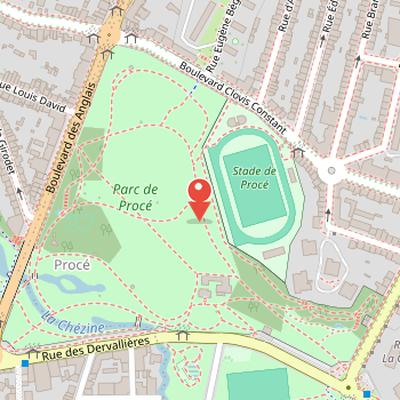
Nearby Objects
-
 Église Sainte-Thérèse 950 m away
 -
 Miséricorde Cemetery 1000 m away
 -
 Château des Dervallières 1000 m away
 -
 Place Canclaux 1200 m away
 -
 Hôtel Maës 1400 m away
From Private Estate to Public Park
The site originally included the Historique manoir du parc, which was built at the end of the 18th century and rebuilt around 1830 by Marion de Proc6, a shipowner and mayor of Saint-Pere-en-Retz. The manor later passed from his heirs to Gustave Caille, a shipowner and timber merchant. In 1866, Caille completely reorganized the park according to plans by landscaper Dominique Noisette, who was the nephew of Louis Claude Noisette. This work gave the parc its current appearance. In 1912, the children of Gustave Caille, Dominique Caille, Charles Caille, and Mrs. Arthur Ecomard sold the parc to the city of Nantes under Paul Bellamy. The sale was made at a symbolic price in order to preserve the site, and Nantes intended to complete a set of public green spaces west of the city.
Sports Grounds and Sculptural Installations
Sports facilities were installed in the upper part of parc de Proce for sports societies, and this area later became associated with several stages of development. Stade de Proce was inaugurated on 25 March 1925, and its tribunes were inaugurated in 1936. After World War II, an athletics track was created at the stade de Proce location. Before that, the athletics track had been at the center of Place Duchesse-Anne, where the area had formerly contained the statuary known as des baigneuses, moved in the late 1920s during the Erdre diversion works.
The park also received sculptural additions in the 1940s. In 1941, the municipality directed by Auguste Pageot acquired four statues from the Palais du Trocadero in Paris, which had been demolished in 1935 to make way for the Palais de Chaillot. These four statues were installed in the upper park area. Around the same time, the parc received three sculptures from near Pont Jules-Cesar, which had been remains of an old municipal fish market. The original building near these sculptures had included four statues, but the last one, representing Erdre or Boulogne, disappeared during demolition.
In 1995, parc de Proce received a kiosk in its northern part from the former Salons Piou after restoration.
Layout and setting of Parc de Proc
Parc de Proc is located in the west of Nantes, within the Hauts-Paves - Saint-Felix and Dervallieres - Zola districts. It is one of the main green spaces in the city, after the parcs du Petit Port, du Grand-Blottereau, de la Chantrerie, de la Beaujoire, and de la Gaudiniere. The park has a roughly trapezoidal shape and is bounded by boulevard Clovis-Constant to the north, boulevard des Anglais to the west, rue des Dervallieres to the south, and boulevard Albert-Thomas to the east. It also borders properties and the Stade de Proc facilities at the northeast. Access is provided by several entrances: one to the north, one to the west, one to the southwest on place Raymond-Poincare, two to the south, and one to the southeast on place Paul-Doumer.
The park occupies mainly the north slopes of the vallon de la Chezine, a tributary of the Loire. The Chezine crosses the park in the southwest, where it enters under pont Jules-Cesar, then flows southeast through two small ponds before passing under rue des Dervallieres. In the southwest, the river also marks the boundary between the Hauts-Paves - Saint-Felix and Dervallieres - Zola districts. The space of the park is mainly covered by lawns accessible to visitors. A children's garden is located across rue des Dervallieres on the left bank of the Chezine downstream from the main park, and beyond it the river forms another promenade before entering a tunnel near place Canclaux. South of the park, the manoir de Proc houses a cafe-restaurant, and an old kiosk from the Piou salons on boulevard Jules-Verne has been erected in the upper part of the park.
Allegorical Statues in Parc de Proc
Parc de Proc contains seven allegorical statues arranged in two groups. Three limestone terms by Etienne-Edouard Suc stand at the foot of pont Jules-Cesar in a small rectangular basin. These three figures came from the former municipal fish market at the east tip of Ile Feydeau, which was demolished in 1939. They represent L'Ocean, La Loire, and Le Lac de Grand-Lieu. The other four stone statues are placed in the upper park on a large English lawn. Made of tuff, they were taken from the demolished 1937 Paris Palais du Trocadero. These works are Jean-Baptiste Baujault's La Botanique, Edmond Chretien's Le Bucheron or La Foret, Jean-Paul Aube's La Moisson, and Vital Gabriel Dubray's La Sculpture.