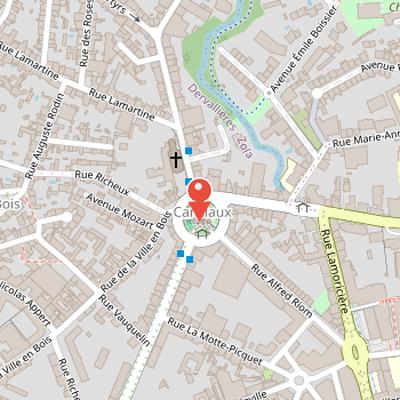
Place Canclaux is a square in the Dervallières-Zola neighborhood of Nantes. It is formed by the intersection of rue Colonel-Desgrées-du-Lou, rue de Gigant, rue Alfred-Riom, boulevard Paul-Langevin, rue de la Ville-en-Bois, and rue Richeux. The Franciscan convent stands on the north side of the square. In the center, a fenced area contains about twenty chestnut trees. The square takes its name from General Jean-Baptiste-Camille de Canclaux (1740–1817), who defended Nantes against the Catholic and Royal Army of Vendée during the War of Vendée. The central square also contains two aubettes, built in concrete in 1933 to shelter tramway passengers of the old west line. Associated with sculptor Camille Robida and city architect Étienne Coutan, they consist of two superposed cylinders, with a wider lower cylinder for seating and a large disk above for weather protection. The tramway line was removed in 1958, but the aubettes remained in place.
Nearby Objects
-
 Hôtel Maës 350 m away
 -
 Place Général-Mellinet 350 m away
 -
 Notre-Dame de Bon-Port 600 m away
 -
 Musée Dobrée 600 m away
 -
 Natural History Museum of Nantes 750 m away
Location and Layout
Place Canclaux is located in the Dervallieres - Zola neighborhood. It forms the intersection of rue Colonel-Desgrees-du-Lou, rue de Gigant, rue Alfred-Riom, boulevard Paul-Langevin, rue de la Ville-en-Bois, and rue Richeux. The Franciscan convent stands on the north side of the square. In the center, the square is fenced and contains about twenty chestnut trees.
Origin of the Name
Place Canclaux bears the name of General Jean-Baptiste-Camille de Canclaux (1740-1817). He is associated with the defense of Nantes against the Catholic and Royal Army of Vendee during the War of Vendee. The name of the place therefore recalls a military figure connected with the city's history.
The Aubettes in the Central Square
Bâtiments remarquables et lieux de mémoire identifies two aubettes in the central square of Place Canclaux. Built in concrete in 1933, they were intended to shelter tramway passengers using the old west line. The aubettes are associated with sculptor Camille Robida and city architect Etienne Coutan.
Their design consists of two superposed cylinders, with a wider lower cylinder used for seating. A large disk placed above them was meant to protect travelers from weather. Although the tramway line was removed in 1958, the aubettes remained in place.