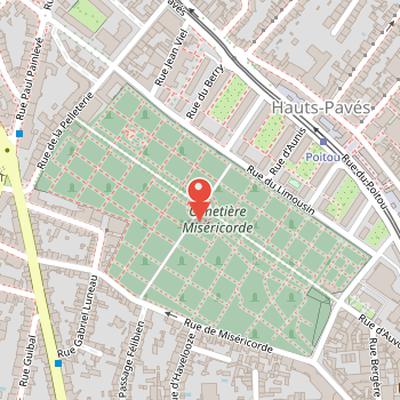
Miséricorde Cemetery is located in the Hauts-Pavés - Saint-Félix district of Nantes, France. Opened in 1793, it is nicknamed the “Père-Lachaise nantais.” The cemetery is known for its alley bordered by cypresses and linden trees and for the about sixty neo-Gothic mausoleums it contains. It houses the remains of many of the “great families” of Nantes and preserves burial records from 1793 to 2010.
The cemetery was established on land purchased by the municipality in 1791, on property belonging to Saint-Similien parish. It was created during a period of increased mortality, when space was no longer available at Bouteillerie cemetery. The first burial was Jean Clouet. The site was devastated during a Chouan attack, then rebuilt and given a wooden gate designed by architect Mathurin Peccot in 1803. It was enlarged again in 1816. The cemetery’s history reflects recurring debates in Nantes over burial space and cemetery enlargement during the 19th century.
Nearby Objects
-
 Place Viarme 450 m away
 -
 Église Saint-Similien 700 m away
 -
 Parc de Procé 1000 m away
 -
 Monument aux 50 Otages 1000 m away
 -
 Île de Versailles 1000 m away
Miséricorde Cemetery
Miséricorde cemetery is located in the Hauts-Paves - Saint-Felix district of Nantes, France. Opened in 1793, it is sometimes nicknamed le Pere-Lachaise nantais. The cemetery includes about sixty neo-Gothic mausoleums arranged along an alley bordered by cypresses and linden trees. It is the resting place of the great families of Nantes, and its burial records cover the period from 1793 to 2010.
Formation and Expansion of Misercorde Cemetery
Misercorde cemetery was established on land purchased by the municipality of Nantes in 1791, on property belonging to Saint-Similien parish. The site had earlier been associated with the chapel of Misercorde, founded in 1026. Histoire records a legend according to which the chapel was built to honor three knights who fought a large dragon in the Marchix forest, and that the dragon's jaw was kept in a metal box among the treasure of Nantes cathedral. The first burial in the cemetery was Jean Clouet.
The cemetery became necessary during the revolutionary period, when increased mortality left no available space at Bouteillerie cemetery. Histoire also notes that land belonging to the Nantes Carmes near the Misercorde chapel was used for burials, with the first internment occurring there. The cemetery was then devastated during a Chouan attack, after which it was rebuilt and fitted with a wooden gate designed by architect Mathurin Peccot in 1803. In 1816, it was expanded with the acquisition of another parcel, partly financed by a special tax for allied troops.
By 1837, Histoire considered Misercorde cemetery to be the most beautiful in Nantes. However, by 1839, the city faced conflicting refusals concerning cemetery enlargement and the creation of new burial sites. Misercorde and Bouteillerie cemeteries were nevertheless enlarged in practice, despite the 1804 law. Architect Henri-Th?odore Driollet proposed a new necropolis far from habitation on rue Noire, while residents of Misercorde opposed extension, citing the decree of 23 Prairial an XI, which required a minimum distance from residences. A deliberation also concerned a 4-hectare extension of the cemetery.
Layout and Memorial Features
Miséricorde cemetery is organized around a central alley, with funeral vaults arranged along one of its side alleys. At the east entrance, it is associated with La pieta by Jacques Perrin, which marks that access point. The cemetery also includes a statue placed on a tomb, adding to its funerary character. The oldest part of the site lies to the left of the main entrance and contains the Jewish and Protestant cemeteries. This arrangement reflects both the cemetery's historical layering and its use as a shared burial place with distinct sections.
Religious Sections and Burial Allocations
The burial areas at Cimetiere Misericorde reflect a long history of negotiated religious separation and later civic use. In 1749, a royal edict by Louis XV required Nantes to create a fenced cemetery for foreign Protestant deaths in France, and Nantes assigned a plot that was later included in Cimetiere Misericorde for Protestant foreigners. Histoire notes that this area also came to include burials of local Protestants, including those from nearby parishes. After the Revolution, a law of 23 Prairial an XII required communes to establish separate cemetery zones for multiple cults, but Histoire reports that the Catholic majority opposed this arrangement. In 1852, the bishopric allowed Protestant funerals to cross Catholic parts, showing the practical limits of separation.
The Jewish section followed a similar but distinct path. In 1876, Histoire recorded a request from Nantes Jewish authorities concerning the burial of Jews from cities without cemeteries, including Angers and Brest. By 1892, the Jewish cemetery occupied 300 square meters in Cimetiere Misercorde. That same year, the Jewish community requested more surface area, the removal of Christian symbols, and an isolated fence. Histoire refers to a decree by Napoleon on 23 Prairial an XII as allowing the fencing request, but also states that a law of January 29, 1881 prohibited fencing. The Jewish quarter was therefore cleared of Christian ornaments and expanded to 598 square meters without fencing. It reached saturation in 1987, and 108 plots were then allocated in Cimetiere Parc.
The cemetery also received military burials after World War I. Histoire states that France organized the return of soldiers' remains to their hometowns at state expense, and until 1926, 27 motorized trains carrying 780 bodies passed through Nantes. After 1926, other bodies arrived individually. Histoire documents that 200 soldiers are buried at Cimetiere Misericorde.
Restoration of Key Tombs
Conservation began restoration work on the most emblematic tombs in 2009. Among the first projects was the tomb of Joseph-Fleury Chenantais, the architect of Nantes' old Palais de Justice, Manufacture des tabacs, and Notre-Dame-de-Bon-Port church. During the restoration, conservation identified Jean-Francois Peigne as the tomb owner and noted that he contributed partially to the costs. The restoration expenses were mainly covered by the city of Nantes and the heritage foundation, each paying part of the total, while conservation also requested financial participation from tomb owners according to their income for renovation operations.
The renovation of the Chenantais monument was completed in 2012. After that, conservation carried out work on the tombs of Pierre Cambronne, Desire Colombe, and Jean-Baptiste Joseph Debay. Further renovations followed on the tombs of Philippe Gengembre, Amadee Menard, Alexandre Fourny, and the 1830 column. The tomb of Eugene Livet was included in the 2015 restoration operation.
References in Literature and Film
Misercorde cemetery appears in the arts as a referenced and filmed setting. Paul Nizan mentions the cemetery in Antoine Bloye in 1933, giving it a place in literary representation. It also serves as the setting for a scene in the film Cessez-le-feu by Emmanuel Courcol in 2017. These appearances show the cemetery's presence in both literature and cinema, where it functions as a named urban location rather than as a purely historical site.