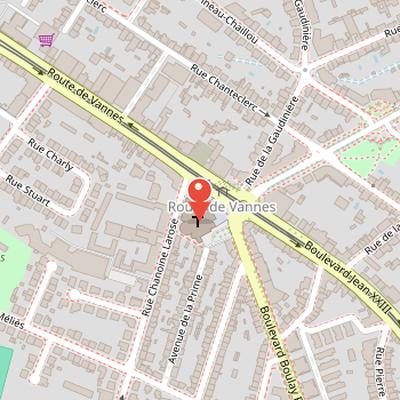
Église Sainte-Thérèse is a church building in the Breil-Barberie district of Nantes, on the southwest side of Place Alexandre-Vincent. It forms part of a parish complex that also includes other buildings constructed together in the same style along the current Rue du Chanoine Larose, including the Sainte-Agnès school and the Saint-Théophane Vénard college.
The parish was created at the initiative of Eugène Le Fer de La Motte in a north-west district of the city and placed under the patronage of Sainte Thérèse de l'Enfant-Jésus. After a pilgrimage to Lisieux by abbé Louis Larose, the first holder of the cure, architects René Ménard and Maurice Ferré drew up plans for a Romano-Byzantine church with concrete construction, red Beauvais brick facing, granite columns from Saint-Macaire-en-Mauges, an octagonal dome, and a tower-campanile planned at 68 meters high. The first stone was laid on 7 June 1937. The building was damaged during bombings in June 1944, but construction resumed in 1952. The chapel under the tower opened for worship in 1952, a sculpture by Jean Fréour was added in 1958, the church was opened at Christmas midnight mass in 1959, and it was consecrated in 1964.
Nearby Objects
-
 Parc de Procé 950 m away
 -
 Château de la Gaudinière 1200 m away
 -
 Miséricorde Cemetery 1300 m away
 -
 Château des Dervallières 1600 m away
 -
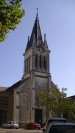 Saint-Félix Church 1700 m away
Parish Setting and Location
Eglise Sainte-Therese is located on the southwest side of Place Alexandre-Vincent in the Breil-Barberie district of Nantes. It forms part of a parish complex made up of several buildings constructed together. The parish buildings are arranged in the same style along the current Rue du Chanoine Larose. The complex also includes the Sainte-Agnes school and the Saint-Theophane Venard college.
From Parish Foundation to Church Completion
The parish of Sainte-Therese in Nantes was created when Eugene Le Fer de La Motte decided to establish a parish in the citys north-west district. It was placed under the patronage of Sainte Therese de lEnfant-Jesus, and the first parish priest, abbe Louis Larose, made a pilgrimage to Lisieux. Before the permanent building existed, the parish used a temporary church installed in a disused hangar on route de Vannes.
At the request of abbe Louis Larose, the architects Rene Menard and Maurice Ferre drew up plans for a Romano-Byzantine church. The project specified concrete construction, red Beauvais brick facing, and granite columns from Saint-Macaire-en-Mauges. The capitals on the pillars were planned without decoration, and the design included an octagonal dome and a tower-campanile intended to rise to 68 meters. The first stone was laid on 7 June 1937, and by 1 May 1938 the foundations had been dug and the walls had risen to the base of the windows.
Construction was interrupted by the bombings of 16 to 18 June 1944 during the Second World War, which destroyed the walls, especially in the southern part. Chanoine Larose distributed tiles intended for the church to residents of bomb-affected neighborhoods. Work resumed in 1952 after peace returned, and the chapel under the tower was opened for worship on 20 September 1952. A Christ en gloire by Jean Freour was added in 1958. The church was opened during Christmas midnight mass in 1959 and consecrated in 1964 by Jean Villepelet, bishop of Nantes, and Andre Jacquemin, bishop of Bayeux and Lisieux.