Place du Théâtre is an urban public space in the commune of Lille, in the French department of Nord. Located in the heart of the city between Vieux-Lille and rue Faidherbe, it is accessible from rue Faidherbe, boulevard Carnot, rue Léon-Trullin, rue des Manneliers, and rue Pierre Mauroy. The square is served by the Rihour and Gare Lille-Flandres metro stations.
The place takes its name from the former theater that bordered it. According to the historical record provided, the theater was built in 1785 and divided the square into two parts. It was burned and destroyed in 1903, and archaeological excavations were carried out in its ruins in 1904. An opera was later erected in replacement of the destroyed theater. The square originated from the place du Général-de-Gaulle, and the two places formed a single place before the construction of the bourse du commerce Vieille Bourse.
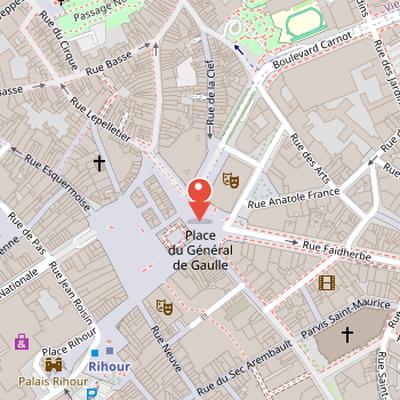
Nearby Objects
-
 Grand'Place 100 m away
 -
 Column of the Goddess 100 m away
 -
 Théâtre du Nord 120 m away
 -
 Place Rihour 200 m away
 -
 Saint-Maurice Church 250 m away
Origins and Later Changes
Place du Theatre is an urban public space in the commune of Lille, in the Nord department of France. It originated from the place du General-de-Gaulle, and the two spaces formed a single place before the construction of the bourse du commerce Vieille Bourse. The site does not border a theatre, even though a theatre once stood there. That theatre was burned and destroyed in 1903. An opera was later erected in its place, marking a change in the function and built form associated with the square.
Location and Name
Place du Theatre is located in the heart of Lille, between Vieux-Lille and rue Faidherbe. It can be accessed from rue Faidherbe, boulevard Carnot, rue Leon-Trullin, rue des Manneliers, and rue Pierre Mauroy. The square is also served by the Rihour and Gare Lille-Flandres metro stations. Its name comes from the former theater that bordered the place.
Development of Place du Theatre
In Lille, the area associated with place du Theatre has a layered history of changing uses and forms. In the Middle Ages, the Petite Place communicated with the place du Marche until 1785. The two spaces were separated by wooden houses located at rue des Trois Couronnes and des Sept-Agaches. Before that separation, the Petite Place had already served public functions: a public scale was established at its edge in 1524, and a fountain was installed there until 1686 to replace the fountain at le Change that had disappeared.
Architectural change continued with the construction of the halle echevinale in 1585 at the outlet of rue Faidherbe on the place. This building replaced an older structure and included a belfry that was later destroyed. The communal administration moved to Palais Rihour in 1664, and the halle echevinale itself was destroyed by the opening of rue Faidherbe in 1870.
The most decisive transformation came with the theater built in 1785 with a facade facing the current rue Faidherbe. It divided place du Theatre into two parts. One part faced Grande Chaussee, Pelletier, and de la Bourse streets, while the other faced only rue de Paris, later rue de la gare, now rue Faidherbe, after 1870. The theater remained a defining feature of the site until it was destroyed by fire in 1903. Archaeological excavations were then carried out in its ruins in 1904. The place thus reflects a sequence of public, administrative, and theatrical uses that repeatedly reshaped its urban form.