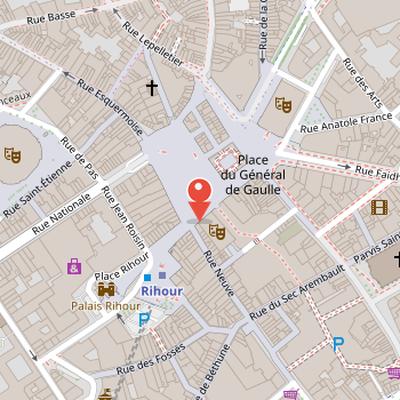
Théâtre du Nord is a theatre located on the Grand'Place in Lille, France, in the former guardhouse called the Grande Garde. The building’s facade is listed as a historical monument, and the Grande Garde itself is included in the inventory of historical monuments. Erected in 1717, two years after the death of Louis XIV, it served as a guardhouse for the city’s garrison, whose first mission was to establish order. The site had previously housed the Nouvelles Boucheries since 1550. The facade resembles the Porte de Paris in the typical French architecture of the period, and a sculpted sun honors Louis XIV and recalls Lille’s annexation by France in 1667. The gable bears a shield with Lille’s arms and a clock. The building also includes a small room of about one hundred seats and the Roger-Salengro room, built at the rear in 1989.
Nearby Objects
-
 Grand'Place 70 m away
 -
 Column of the Goddess 80 m away
 -
 Place Rihour 90 m away
 -
 Place du Théâtre 120 m away
 -
 Palais Rihour 150 m away
Location and setting
Theatre du Nord is located on the Grand'Place in Lille, France, where it is installed in a former guardhouse called the Grande Garde. The Grande Garde is listed in the inventory of historical monuments, giving the site a protected historical status. The theater is served by the Rihour metro station, and visitors arriving by car can use the nearby Grand Place and Nouveau siecle parking lots. Its setting places it directly within one of the city's central public spaces.
Historic Facade and Military Origins
The Theatre du Nord, known here through its historic building, was erected in 1717, two years after the death of Louis XIV. It stands on a site that had housed the Nouvelles Boucheries since 1550, showing that the location had a long public function before the present structure was built. After Louis XIV conquered the city in 1667, the building served as a guardhouse for the city's garrison, whose first mission was to establish order. Its facade resembles the Porte de Paris and reflects the typical French architecture of the period.
The facade also carries a sculpted sun that honors Louis XIV and recalls Lille's annexation by France in 1667. This facade is listed as a historical monument and was represented in a 1750 painting by François Watteau, now displayed at the Hospice Comtesse in Lille. On the gable, a shield with Lille's arms and a clock further mark the building's identity and civic symbolism.
Historique Balcony and Public Events
The first-floor balcony of Historique has witnessed several events in Lille and is frequently used as a platform for public demonstrations. It became the setting for notable announcements, including when General Lebas addressed a crowd on Grand'Place and proclaimed the general mobilization decree from the balcony. During Lille's braderie, General Achille Testelin also proclaimed the Republic from this same spot. The balcony later acquired a symbolic role again when tricolor flags appeared there after France's 1998 football World Cup victory.
Building Spaces and Later Uses
Theatre du Nord is described as comprising a facade, a small room of about one hundred seats, and the Roger-Salengro room. The Roger-Salengro room was built at the rear in 1989, replacing the Saint-Nicolas covered market, which had been built in 1826. The former Saint-Nicolas covered market became the Roger Salengro room, linking the building to an earlier layer of the site’s history. Before its later theatrical use, the Roger-Salengro room hosted boxing galas and was a major site of protest in 1968.
The theatre also had an educational connection through EpsAd, the Ecole professionnelle superieure d'art dramatique, which was founded in Lille in 2003. Forty-five young actors graduated from EpsAd, and the school had a close connection to Theatre du Nord. EpsAd was later renamed Ecole du Nord, and the sixth promotion, for 2018-2021, began in autumn 2018.
2024-2025 Season Programming
For the 2024-2025 season, programming was presented by David Bobee with an explicitly politically engaged direction. It called on audiences to counter the RN and to vote for the Nouveau Front populaire. The season was planned to include Grand-peur et misere du IIIe Reich by Bertolt Brecht. The programming also aimed to recall the role of theatre in fighting racism and the Rassemblement national.