The Column of the Goddess is a commemorative monument inaugurated at the center of the Grand'Place de Lille, at place du Général-de-Gaulle in the Nord department of Hauts-de-France. It commemorates the heroism of the Lillois during the siege of Lille in 1792 by the imperial army. The monument consists of a column surmounted by a statue of a woman, and it is surrounded at its base by a basin that serves as a fountain of more recent design.
The monument was designed by architect Charles Benvignat, while the bronze statue at the top is the work of sculptor Théophile Bra. The statue is an allegory of the city of Lille and reproduces the features of Marie-Josephe Bigo-Danel, wife of mayor Louis Bigo-Danel. It is crowned with a crown of towers and holds a boutefeu in the right hand, while the left hand points to an inscription on the base quoting mayor François André-Bonte’s refusal to surrender Lille to the Imperials in 1792. Shortly after its erection, the monument was popularly named the colonne de la Déesse, and during the inauguration it was nicknamed the “Goddess.”
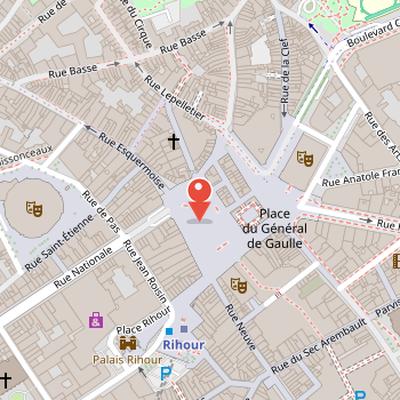
Nearby Objects
-
 Grand'Place 10 m away
 -
 Théâtre du Nord 80 m away
 -
 Place du Théâtre 100 m away
 -
 Place Rihour 140 m away
 -
 Palais Rihour 200 m away
Design and Commemoration
The Column of the Goddess is a commemorative monument inaugurated at the center of the Grand'Place de Lille, at place du General-de-Gaulle in the Nord department in Hauts-de-France. It commemorates the heroism of the people of Lille during the siege of Lille in 1792 by the imperial army.
The monument is composed of a column surmounted by a statue of a woman. This figure, known as the Déesse au boute-feu, was created by sculptor Theophile Bra. She holds a boutefeu in her right hand, used for lighting cannon fuses, and points with her left hand to an inscription on the base. The inscription quotes mayor Francois Andre-Bonte, who refused to surrender Lille to the Imperials in 1792.
The monument was designed by architect Charles Benvignat. Shortly after its erection, it became popularly known as the colonne de la Déesse following a local poem. At the base, the column is surrounded by a basin that serves as a fountain of more recent design.
Design and Symbolism
The Column of the Goddess is a work by Charles Benvignat. It consists of a fluted granite column whose base is surrounded by a fountain basin. At the top stands a bronze statue by Theophile Bra. This figure is an allegory of the city of Lille, crowned with a crown of towers, and it reproduces the features of Marie-Josephe Bigo-Danel, the wife of the mayor Louis Bigo-Danel. During the inauguration, the monument was nicknamed the Goddess, a name that remained associated with it. The column is understood as a symbol that expresses and maintains Lille's patriotism towards France.
The Siege and Honor of Lille
According to Histoire, the events commemorated in connection with the Column of the Goddess are linked to the war declared by the Legislative Assembly, on the proposal of King Louis XVI, against the king of Bohemia and Hungary. Lille was on the front line of the conflict, and the bombardment began at 10 am. The siege continued until October 22, 1792. Resistance in the city was led by Mayor Francois Andre-Bonte. In recognition of this defense, the National Convention unanimously passed a decree on November 2, 1792, to honor Lille, proclaiming that Lille had well deserved of the fatherland.
Early Proposals and Design History
The history of the Column of the Goddess begins with a proposal made by Jacques-Louis David on November 7, 1792. His project was addressed to the Lille municipality and local artists, but other proposals by Louis Joseph Watteau, Charles-Louis Corbet, and Francois Verly were unsuccessful. In the early 1830s, a new context appeared when statues of the thirty-six largest French cities were planned for the Arc de Triomphe de l'Etoile. Théophile Bra was charged with creating the statue representing Lille, which he designed as a woman holding the Convention decree and a sword. He tried unsuccessfully to erect this statue in Lille in 1832, then donated the plaster version to the Lille municipality in 1835.
A renewed effort began in 1842, when the fiftieth anniversary of the revolutionary sieges prompted new commemoration plans in Lille. A municipal competition for the monument was held on November 27, 1842, and only the architects Charles Leroy and Charles Benvignat responded. Benvignat was unanimously selected by the municipality, although his first project differed from the monument seen today. The city statue was initially planned at the base of his monument, and the statuary element was entrusted to Théophile Bra without competition. Bra remained strongly involved in the project, and conflicts with Benvignat emerged over the design.
Placement and Later Modifications
In 1843, Histoire modified the project so that the statue would be placed at the top of the column, following a requirement from the Council of Civil Buildings. On the anniversary of the lifting of the siege, Histoire solemnly laid the first stone of the monument in front of the town hall, in the location originally specified by the program. At that event, a monument simulacrum was installed on the site. Histoire later removed the first stone and placed it at the center of the Grand'Place. He also required Benvignat's project to be revised because it had been designed for placement near houses rather than in the middle of a square.
Histoire inaugurated the column on a specific date and organized a celebration on the Grand'Place for the occasion. In the inauguration year, he also issued a medal commemorating the National Convention Decree. After the inauguration, a circular grille and four candlesticks were placed around the monument. In 1916, four Austrian mortars were removed from the monument by the Germans during the occupation for melting. The base of the monument currently displays the war cross awarded to the city after the 1918 armistice, honoring the city's courage during bombardments and four years of enemy occupation. In 1989, during underground parking construction under the Grand'Place, the column was surrounded by a fountain and a circular basin.
Cultural Use and Public Meaning
The Column of the Goddess has a place in local cultural references and everyday social use. It is mentioned in a chant of the Supporters of LOSC, which shows its presence in supporter culture. It is also known as a customary meeting place for friends and lovers, who say they are meeting "under the goddess." These facts indicate that the column functions not only as a public monument, but also as a familiar point of gathering and identification in the city.