Place du Général-de-Gaulle is the historic and main square of Lille, in the department of Nord in Hauts-de-France. It is a grand-place, a type of urban square with a completely mineral character found in many former Netherland cities. The square was considered part of the forum mentioned in 1066 in the founding act of the collegial Saint-Pierre, and it developed from the city’s 13th-century wish to create a market. The Deûle river was channeled, and the ground was progressively raised and paved to form a market place. In the 17th century, the construction of the stock exchange building divided the square into Grand-Place and Petite-Place. Renamed after the liberation of Lille during the Second World War, it is locally known as Grand’Place and more rarely as place de la Déesse. The square remains a place of celebrations, exchanges, commercial activities, and manifestations, and it is still the center of the Lille braderie. It is bordered by several buildings, including the Théâtre du Nord and the Vieille Bourse, and the colonne de la Déesse stands at its center.
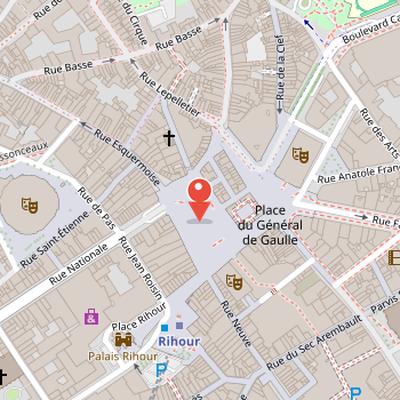
Nearby Objects
-
 Column of the Goddess 10 m away
 -
 Théâtre du Nord 70 m away
 -
 Place du Théâtre 100 m away
 -
 Place Rihour 140 m away
 -
 Palais Rihour 200 m away
History and Character of Place du General-de-Gaulle
Place du General-de-Gaulle is an urban public space in the commune of Lille, in the department of Nord and the region Hauts-de-France. It is the historic and main square of the city, and a grand-place type space marked by a completely mineral aspect, as found in many cities of the former Netherlands. The square was already considered part of the forum mentioned in 1066 in the founding act of the collegial Saint-Pierre. Its present form originated from the aldermanic wish to make it a market in the 13th century, when the Deule river was channeled and the ground was progressively raised and paved to create a market place.
In the 17th century, the construction of the stock exchange building divided the area into Grand-Place and Petite-Place. After the liberation of Lille during the Second World War, the square was renamed in honor of Charles de Gaulle. It is locally called Grand'Place, or more rarely place de la Déesse.
The square has retained its role as a grand-place, serving as a place for celebrations, exchanges, commercial activities, and manifestations. It remains the center of the Lille braderie, and book trading, including the Furet du Nord bookstore and numerous bookstalls, is significant there. The square is bordered by various buildings, eight of which are classified or listed as historical monuments, including the Theatre du Nord and the Vieille Bourse. At its center stands the colonne de la Déesse, erected in 1845 and symbolizing the heroism of Lille residents during the siege of Lille in 1792.
Location, Form, and Access
Place du General-de-Gaulle is located in the center of Lille, between the pedestrian sector and Vieux-Lille. It is almost rectangular in shape and is paved in a checkerboard pattern. The place has a controlled traffic layout: motor vehicles can enter from rue des Manneliers, with one-way passage through the area, and vehicles can leave by rue Esquermoise toward the northwest and by rue Nationale toward the southwest. Since a later date, the square and several nearby streets have been reserved for pedestrians and slow-moving cyclists, although motor vehicle access remains possible for deliveries and for residents with garages.
The site is accessible by public transport through metro line one at Rihour station, and it can also be reached from Lille-Flandres station by rue Faidherbe. Since a later date, it has also been crossed by the Vieux-Lille shuttle minibus.
The square was named after Charles de Gaulle following Lille's liberation in 1944. Before that, from the mid-19th century, it was known as Place du Marche or Grande-Place. Archaeological excavations later showed that it was not actually known by those earlier names. Its forum concept is linked to an area where wealthier bourgeois families lived on several current streets.
From Marshland to Commercial Space
The site of place du General-de-Gaulle occupied land by the waters of the Deule and a marsh until a later period. It was close to the halle echevinale, which burned in 1213 and was rebuilt in 1233. The canalization of the Basse-Deule between La Bassee and Lille in 1242 created permanent water conditions and even flooded cellars near the present square. Further canalization works on the Haute-Deule were completed in 1271. These changes left a cleared waterside space corresponding to the current grand-place.
Access remained difficult for a time: the area was only occasionally crossed, and then only in good season, by carts or horsemen whose horses often lost many shoes. Despite this, the cleared space was quickly taken over for commercial activities. Early arrangements included spreading chalk at the start of the century, followed by ground leveling with yellow silt and then mortar toward the end of the century.
A Market Place with Civic and Judicial Functions
In Histoire, the site that now corresponds to Place du General-de-Gaulle developed as a market place over time. Merchants were required to pay a tax when entering the city and received fiscal tokens as proof of compliance. By the middle of the century, a regularly tamped limestone layer had been spread across the site, helping to fix it as a market place. The market was organized in a flexible way, with numerous merchant stalls set under canvas awnings and no magistrate enforcement of their arrangement. From mid-century, the municipality also hired personnel to clean the market.
The market extended beyond the present Place du General-de-Gaulle to the current Place du Theatre, then called Petite Place, until the construction of the Theatre in 1785. Before the construction of the Bourse in 1562, the two places communicated widely and were separated only by some houses at the current Rue des Trois Couronnes. The market center, running north to south, included the Hotel du Beauregard, the Chapelle des Ardents, and the Fontaine au Change.
The place also had civic and judicial roles. Histoire states that the revart, first magistrate of the city, and the prevot of the city, the king's agent, were installed there. Executions and the exposure of condemned bodies also took place on the site. At the same time, the place was a lively commercial center where most trade in goods and artisanal products occurred on or near it. It hosted the wheat market as well as markets for chicken, fish, salt, compenage, sayette fabric, straw, horses, pottery, and navettes. Nearby specialized trades included the ruelle aux Fromages and Rue des Manneliers, associated with basketmakers, while cobblers and shoemakers were gathered near the place. In 1550, a guardhouse was built at the site of the old butcher shop, and the Nouvelles Boucheries occupied the ground floor of the new building, which was topped with the Lion of the Netherlands. Histoire also notes that dice games took place on the place despite prohibitions.
From Market Place to Civic Landmark
The history of place du General-de-Gaulle is closely tied to the former grand-place of Lille. In 1651, the Magistrat decided to build a stock exchange on the market place at the fountain au Change site, and the chapel Notre-Dame-des-Ardents was destroyed the same year on its order. Construction, based on the plans of Julien Destrree, began in 1652 and was completed the following year. Many merchants then created a permanent fair inside the building, described as similar to the passage du Caire in Paris. This fair measured 120 meters in length and 14 meters in width. Surrounding buildings at the grand'place were of equivalent height, giving the site a relatively uniform urban front. In 1664, the Magistrat left the halle echevinale on the Petite Place to move to the palais Rihour.
The place remained a setting for major public events and symbolic displays. In 1700, the ground of the grand-place was raised by two feet. In 1792, a liberty tree over 100 feet tall was planted there on 14 August. During the siege of Lille, bombings set fire to the church Saint-Etienne and undermined a turret of the stock exchange. After the war, the municipality erected a platform on the place with a pyramid of war attributes and French flags at its base, topped by a representation of the Renommee. A procession of the commune council and citizen commissioners of the National Convention went to the place, and after the reading of the law, La Marseillaise was sung there. Rain prevented the lighting of lamps on the platform that evening.
The grand-place also served as a stage for celebrations and ceremonial visits. In 1803, during Napoleon's passage to Lille, it hosted a large esplanade with a Greek temple that was illuminated at night, attracting many Lillois and foreigners. After the Hundred Days, residents celebrated Henri IV and the Bourbon family there. In 1845, the column of the Déesse was inaugurated at the center of the grand-place to honor Lille's resistance in 1792. Toward the end of the 19th century, trams operated on the grand-place, both horse-drawn and steam-powered. In the early 20th century, the west side was known as the rang des cafes, with cafes and the office of L'Echo du Nord, which was located in a small building between the Grande Garde and a cafe. The place also saw wartime activity during the First World War, was decorated with greenery by Amis de Lille for the return of the 43rd infantry regiment in 1919, and was decorated again for the visit of French President Paul Deschanel in 1920.
After the Liberation, the building formerly used by Le Grand Echo du Nord was returned to La Voix du Nord, Nord libre, and Liberte, and the place was renamed place du General-de-Gaulle. In 1936, L'Echo du Nord had already built an eight-story mansion beside the Grande Garde. During the Second World War, General Alfred Wager honored resistance troops opposite the Bellevue hotel-restaurant. More recently, paving on the grand-place was redone on a sand layer, followed by the implementation of a meeting zone and a terrace charter. Car access was changed to one-way in summer 2016, and since Lille's 2004 European Capital of Culture designation, the grand-place has hosted temporary works and festivals. It is now reserved for pedestrians and non-motorized two-wheelers.
Architecture and Monuments of Place du General-de-Gaulle
The architecture of Place du General-de-Gaulle brings together several buildings and monuments that reflect different periods in the history of Lille. At the center stands the commemorative column, which has marked the square since 1845 and recalls the city's resistance to the Austrian siege of 1792. The first stone of the column was laid on an unspecified date, and the statue was inaugurated three years later. The marble column was made by Charles Benvignat, while the bronze statue was created by Theodore Bra. The figure represents the city wearing a mural crown and holding a firebrand.
The buildings around the grand square present a cross section of Lille architecture from the 17th to the 20th centuries. The oldest building still in place is the Vieille Bourse, located between the Grand'Place and the Place du Theatre. Built in 1652 following the plans of Julien Destrree and completed in 1653, it is described as a typical example of 17th-century Flemish Renaissance architecture. It consists of twenty-four identical houses arranged around an interior courtyard and has been listed as a historic monument since 1921.
On the Place du General-de-Gaulle side stands the Grande Garde, built in 1717 by Thomas-Joseph Gombert using white stone and sandstone. It has been registered as a historic monument since 1925 and was later converted into the Theatre du Nord. To its right is the La Voix du Nord building, constructed in 1936 for the Grand Echo du Nord newspaper and designed by Albert Laprade. Its facade, attributed to Raymond Couvegnes, is in a neo-Flemish style with a stepped gable, and the ground floor includes a commercial gallery.
Historic Buildings on Place du General-de-Gaulle
The area known as Architecture et monuments includes four lots of buildings that form part of the historical monuments of Lille. Several elements on place du General-de-Gaulle are protected within this group. One building at the corner of rue Neuve and place du General-de-Gaulle is listed on the inventory of historical monuments, with the exception of its ground floor. Buildings at 9, 21, 34, 44, and 52 are also included, with their facades and roofs inscribed on the inventory of historical monuments. The listings for 9, 21, 34, 44, and 52 date from unspecified moments.
Among the individual buildings, number 16 is a bourgeois house dating from 1455. It was later reconstructed identically, with modifications to its cellar, by a new owner two hundred twenty years after 1455, and a third floor was added in 1828. The group also includes a hotel located in an old bourgeois house accessible from rue Jean-Roisin, which offers a view of the square. A neighboring building housing the Furet du Nord bookstore was restored in 1969. At number 34, the facade was modified to match that of number 32 and restored in 1990.
Commercial and Public Role of Place du General-de-Gaulle
Place du General-de-Gaulle, also known as the grand-place, is the main square of the commune of Utilisations in the southern Netherlands. It has long been a central location for public and commercial activity. In the Middle Ages, grains from the southern countryside were sold there for Flanders, and before the construction of the stock exchange, merchants and industrialists met daily except Sundays at noon and in the evening on the square, near the Fontaine au Change and the Chapel of the Ardents.
The square also developed an important festive role. An annual fair was launched by Marguerite de Constantinople to support economic activity, and this event was later replaced over time by the Lille braderie, which still takes place on the grand-place. The square continues to be used for large markets and festivals, as well as for official municipal events.
At the beginning of the 2010s, Place du General-de-Gaulle also had a strong retail presence. Several stores and some restaurants were located there. Among the best-known establishments was Furet du Nord, founded in 1936 and established on the square in 1959. It is described as one of the largest bookstores in Europe and the largest in France, with 3500 square meters of space. Beneath the La Voix du Nord building, the Grand'Place shopping gallery extends toward the Fnac and Les Tanneurs shopping center.
The square also includes several food and retail businesses. The Houblonniere and Le Coq Hardi are two estaminets on the square, separated by Rue du Petit-Paon and located at numbers 9 and 15. A McDonald's is noted as their only competitor on Place du General-de-Gaulle, while other nearby estaminets are situated to the south at the beginning of Place Rihour. Other businesses include Cafe Meo at number 27, with a tea tasting salon and a fine grocery shop, as well as Sephora, Nocibe, and Marionnaud at numbers 28, 72, and 77.
Public Uses and Festive Memory
Place du General-de-Gaulle has served repeatedly as a setting for public ritual, civic display, and temporary uses. In earlier centuries, Mardi Gras celebrations were centered on the market square in Utilisations: each year a newly designated king received a thorny branch there in honor of the Holy Thorn, then deposited it at the Dominican convent. The following Sunday, tournaments were held on the grand-place, which was paved and sanded for the festivities. This festival was suspended from 1470 to 1475 and again in 1516, and was permanently stopped by Philip II of Spain in 1556.
The place also hosted other ceremonial events. In 1729, a festival celebrated the birth of Louis XV's first son, and a circular temple was built opposite the Grande Garde to honor the birth of Louis XVI's eldest son. The army used the place for demonstrations of force in the past, and in 1915 it was the scene of the celebration of Wilhelm II's birthday, with a parade of occupying troops, a concert, and fireworks. In 1919, the entry of the 43rd infantry regiment was marked by green garlands, while the place also had a pillory and Theobald de Dillon present in 1792. In 1925, the funeral of former socialist mayor Gustave Delory took place there.
The square remains important in contemporary urban and cultural use. Since Lille 2004 and Lille 3000, it has hosted temporary exhibitions, including a suspended forest erected in 2004 and a flowerbed made of crates used as pixels for a Lille artist in spring 2014. After the removal of surface parking in 1989, the grand-place became an urban planning issue. It also hosted a Ferris wheel in 1989 during the Christmas market at place Rihour. Current use is regulated to preserve coherence, with rules covering parasols, screens, chairs, tables, menu holders, planters, outdoor lighting, and their placement. Terraces attached to facades are limited to four meters depth, while terraces off the facade may extend in four-meter squares up to four squares and eight meters depth, with a four-meter safety corridor and a flow corridor maintained.
La Grand'Place in Art and Media
La Grand'Place appears in the arts through a painting by Francois Watteau, called Watteau de Lille. The work La Procession de Lille is exhibited at the musee de l'hospice Comtesse in Lille. In that painting, the Grande Garde is shown as defended at the bottom by a row of cavalrymen in red uniform, and on the first floor by a row of infantrymen. La Grand'Place also served as a setting for the post-apocalyptic video game Leelh at the end of the 2000s, where the city is imagined in 2087 after a cataclysm in 2060.