The Arc de Triomphe is a triumphal arch monument in Paris, located at Place de l’Étoile at the junction of the 8th, 16th, and 17th arrondissements. It stands at the western end of the avenue des Champs-Élysées and forms part of a major east-west axis in the city, extending from the Louvre pyramid to the arch of La Défense. The decision to build the monument was made by Emperor Napoleon in 1806, and construction was completed in 1836 during the reign of Louis-Philippe.
The project was intended to perpetuate the memory of French army victories. Jean-François Chalgrin designed the monument, drawing inspiration from the Janus tetrapyle and Titus arch in Rome. The first stone was laid on the Emperor’s birthday and covered by a bronze plate. Foundation works measured 15 meters in length, 12 meters in width, and 9 meters in depth, and by 1810 the first parts of the monument rose above ground.
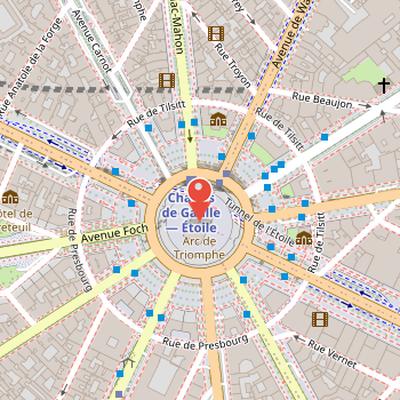
Nearby Objects
-
 Tomb of the Unknown Soldier 10 m away
 -
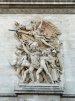 La Marseillaise 20 m away
 -
 Place Charles-de-Gaulle 30 m away
 -
 Le Lido 450 m away
 -
 Avenue Foch 450 m away
Location and Construction
The Arc de Triomphe is a triumphal arch monument in Paris, located at the junction of the 8th, 16th, and 17th arrondissements. It stands at the top of the avenue des Champs-elysees and the avenue de la Grande-Armee. The monument is also part of a major east-west axis in Paris that begins at the Louvre pyramid and ends at the arch of La Defense. Its construction was decided by Emperor Napoleon in 1806 and was completed in 1836 during the reign of Louis-Philippe.
Place de l'Etoile and the Arc de Triomphe
Place de l'Etoile de Paris is located in the 8th, 16th, and 17th arrondissements of Paris, at the western end of the avenue des Champs-Elysees. It is organized around a large roundabout with twelve avenues radiating from it, including avenue Kleber, avenue de la Grande-Armee, avenue de Wagram, and avenue des Champs-Elysees. The site was developed under the impulse of Napoleon III and Baron Haussmann. Its ground is marked by colorful paves forming two stars, with points reaching between and among the avenues. The area is served by the metro station Charles de Gaulle - Etoile.
Planning and Early Construction
After the Battle of Austerlitz, Histoire declared to French soldiers, in reference to the triumphal arches of the Roman Empire, that an arc de triomphe should be built to perpetuate the memory of French army victories. An imperial decree ordered the construction of the monument, and the initial project proposed placing it at the starting point of a triumphal avenue crossing the Louvre and Place de la Bastille. Minister Jean-Baptiste de Champagny advised that the Arc be built at Place de l'Etoile instead of Place de la Bastille, and Jean Berenger managed the financing as director general of the Caisse d'amortissement.
The design competition was won by Jean-Francois Chalgrin over Jean-Arnaud Raymond, whose preference for engaged columns opposed Chalgrin's idea of isolated columns. Champagny arbitrated the dispute and forced Raymond to withdraw honorably from the project. Chalgrin then removed the columns and drew inspiration from the Janus tetrapyle and the arch of Titus in Rome. Histoire laid the first stone, shaped like a shield and inscribed, on the Emperor's birthday, under a bronze plate. The foundations measured 15 meters in length, 12 meters in width, and 9 meters in depth, and their completion took two years. By 1810, four piles of the monument rose about one meter above the ground. Histoire later provided funds for Chalgrin to build a full-scale model in wood, stucco, and painted canvases for the entry of the archduchess Marie-Louise into Paris. Chalgrin died suddenly in 1811, and Jean-Arnaud Raymond died eight days later.
Construction and Commemorative Uses
The Arc de Triomphe was erected up to the vaults during the first defeats of Napoleon, in connection with the 1812 Russia campaign and the events of 1814. Construction was then interrupted and abandoned under the Restoration. It resumed in 1823 with architects Louis-Robert Goust and Jean-Nicolas Huyot under the direction of Louis-Etienne Hericart de Thury. At that stage, the monument was intended to commemorate the victorious Spanish expedition.
In 1830, Louis-Philippe resumed Napoleon's original plan while linking the monument to the armies that fought between 1792 and 1815. He and Adolphe Thiers selected the main themes and sculptors. These included La Marseillaise, identified as Le Depart des volontaires de 1792 by Francois Rude, Le Triomphe de Napoleon by Jean-Pierre Cortot, and La Resistance de 1814 and La Paix de 1815 by Antoine Etex. The frieze at the summit is divided into Le Depart des armees and Le Retour des armees, with a central scene glorifying the Nation. The construction was completed by architect Guillaume Abel Blouet between 1832 and 1836, and his name appears on the commemorative plaque on the third floor.
The summit was designed to receive a monumental sculptural group, but several proposals were never realized, including La France victorieuse by Bernard Seurre, a colossal eagle, a crown with eagles and roosters, a water reservoir, and an elephant. During the return of Napoleon's ashes in 1840, Blouet temporarily erected a sculptural group representing Napoleon at the summit, adapting a 1834 project by replacing the allegorical figure of France with the Emperor. A quadriga designed by Alexandre Falguiere was later installed on the empty pedestal in 1882 as Le Triomphe de la Revolution, representing an allegory of La France or La Republique drawn by an antique chariot. It was removed in 1886 because of degradation and was not replaced by a bronze version.
The monument also served as a site for major public ceremonies. The funeral procession of Napoleon's ashes passed under it in 1840, and Honoré de Balzac later considered it a symbol of soldiers' loyalty to the Emperor in 1842. The handing over of flags took place there during the fete de la Fraternite in 1848. A temporary cenotaph designed by architect Antoine Sartorio was placed under the arch for the ceremony of November 11, 1920, before the Tomb of the Unknown Soldier was installed on November 10, 1920. That tomb contains the body of a French soldier who died during World War I and symbolizes all French soldiers who died in wars. The monument was classified as a historical monument on February 29, 1921. A mold of Rude's original La Marseillaise was made in 1938 to protect the sculpture from war damage.
The Arc de Triomphe and Public Events
The Arc de Triomphe appears in several major moments of Parisian public history, especially through events on the Champs-Elysees. On 1940-06-14, Histoire records Nazi troops marching for the first time under the monument. One week later, on 1940-06-21, a student protest on the Champs-Elysees and in front of the Arc de Triomphe was harshly repressed by Nazis. After the liberation of Paris, Histoire reports that General Charles de Gaulle descended the Champs-Elysees preceded by four tanks of the 2nd Armored Division on 1944-08-26. The avenue also became a site of large political and national gatherings, including a demonstration supporting President Charles de Gaulle on 1968-05-30 that drew between 100,000 and 200,000 people. Later celebrations included more than one million people marking the French football team's 3-0 World Cup victory on 1998-07-13, followed by the team's bus parade the next day, and a similar celebration after the Euro victory in 2000.
The Arc de Triomphe in Public Memory and Recent History
The Arc de Triomphe appears in Histoire through a sequence of views and events that trace its changing public presence over time. The monument is shown from the air in Paris in 1921, at Place de l'Etoile around 1920, from Avenue Foch in 1962, and from avenue d'Iena in 2012. Histoire also records the Arc de Triomphe during the liberation of Paris on 1944-08-26, placing it within a major historical moment in the city.
A significant interpretive feature is the permanent new scenography inaugurated in 2018, created by artist Maurice Benayoun and architect Christophe Girault. The exhibition, titled Entre guerres et paix, offers a multimedia reading of the monument's history and the evolution of its symbolism. It presents this history interactively across seven stations on three levels. The scenography also reveals unrealized projects, missing elements, and sculpted decorations that are difficult to see.
Histoire also documents episodes of damage and public conflict. It notes the degradation of the Arc de Triomphe during Act III of the Yellow Vests movement in Paris on 2019-12-01, when protesters occupied the monument and it suffered significant damage. Culture Minister Franck Riester estimated the restoration cost at 300,000 euros. According to the record, eight protesters were found guilty of breaking into and damaging the monument, while the main perpetrators could not be identified and convicted. Histoire further includes the degradation of the Arc de Triomphe in 2018.
The monument's later public visibility is also reflected in its illumination during the 2024 Summer Olympics.
The Tomb of the Unknown Soldier and the Eternal Flame
The Arc de Triomphe is part of the national monuments with a strong historical connotation. On November 11, 1920, the tomb of the Unknown Soldier killed during World War I was buried under the arch. The tomb is surrounded by black metal posts connected by chains, and a granite slab from Vire bears the epitaph: Here rests a French soldier who died for the Fatherland 1914-1918.
The eternal flame was later added with the support of Andre Maginot, minister of War, on November 11, 1923. It was first lit by the minister on that date and commemorates soldiers who died in combat. The flame is never extinguished and is relit every evening at 6:30 PM by veterans or war victims associations. It was also relit on June 14, 1940, when the German army entered Paris and marched on Place de l'Etoile, in front of German officers who authorized the ceremony. During important events, such as the military parade of July 14, 2017, a huge tricolor flag is displayed under the arch.
Public Events and Symbolic Moments
The Arc de Triomphe has been the setting for a range of public events, commemorations, and unusual incidents. In 1810, Chalgrin constructed a full-scale model for the marriage of Archduchess Marie-Louise in Paris, with simulated bas-reliefs made from timber, stucco, and painted canvases in trompe-loeil style. The monument later became closely linked with national mourning, hosting the body of Victor Hugo before burial at the Pantheon and being partially veiled in black crepe during his funeral.
The Arc also appeared in episodes of daring and protest. On 7 August 1919, Charles Godefroy flew a Nieuport 17 biplane under the Arc, an event photographed by Jacques Mortane and later depicted in the 1968 film Les Aventuriers by Robert Enrico. The episode is also linked to the death of ace Jean Navarre near Villacoublay in April 1919 during training for the flight. On 14 July 1941, a student and lyceens protest on the Champs-Elysees and at the Arc de Triomphe was brutally repressed by the Nazis during the occupation.
The monument has continued to attract attention through later acts and recreations. In October 1981, Alain Marchand recreated the flight under the Arc in a MS 880 Rallye and was fined 800 francs. On 14 March 2007, an unidentified pilot in a stolen Mudry Cap-10B flew under the Arc and the Eiffel Tower. Other incidents include a 1997 attempt by an Australian to fry eggs on the flame of the Unknown Soldier, following an earlier egg-frying event by the rock singer Hector after a bet with Jean Yanne.
The Arc is also associated with solar alignments. Six annual sunsets on 7, 8, 14 May and 27, 28, 29 July are visible through the Arc from the Champs-Elysees, with the sun visible for minutes under the Arch. Four annual sunrises on 4, 5 March and 8, 9 October are visible through the Arc from Porte Maillot. This alignment information is confirmed by the Institut de mecanique celeste et de calcul des ephemerides. The monument coincided with a partial solar eclipse on 11 August 1999, observed by nearly 8 million people.
The Arc de Triomphe on French Philately
The Arc de Triomphe appears repeatedly in French philately across many decades, often in connection with commemorative themes. In 1929, it was depicted on a brown-red French stamp valued at 1.25 francs. A 1938 ultramarine stamp showed the monument during the British sovereigns' visit near the Westminster Palace tower, and the same image was reproduced on postal stationery. Also in 1938, a carmine red surcharged stamp valued at 3 francs celebrated the victory centenary, placing the Arc de Triomphe in the center with the 14th July parade on either side; this design was likewise reproduced on postal stationery.
The monument continued to appear on issues connected with political and national events. In 1944, the provisional government issued ten definitive stamps depicting the Arc de Triomphe, with values from 10 to 75 cents, for use in liberated France through the United States. A new ten-stamp series followed in 1945, still printed in the United States and marked with black value figures between 10 and 75 cents. In 1968, a carmine and blue 1 franc stamp marked the 50th anniversary of the armistice.
Later issues often placed the Arc de Triomphe in the background of broader commemorations. A red 1971 stamp commemorating General de Gaulle's death included the monument in the background and represented the 1944 Champs-Elyslees march. In 1973, a lilac, red, and blue 1.60 franc stamp celebrated the flame of the Arc de Triomphe. The monument also appeared in the background of two multicolored 3.50 franc stamps in a 1989 Paris panorama strip, with the corresponding visuals reproduced on postal stationery. In 1995, it was shown in the background of a stamp portraying General de Gaulle, valued at 3.70 francs. Later, a variable value stamp issued by a distributor in 1999 featured the Arc de Triomphe, and a high-value stamp in 2001, issued for 4 or 6 euros, commemorated Albert Decaris' birth centenary. The Arc de Triomphe was also included in a 2003 souvenir sheet series of ten stamps, including a dedicated 0.55 euro stamp.
Conservation and Structural Restoration
Conservation and restoration work on the Arc de Triomphe focused on visible damage and the structural causes behind it. The monument showed cracks and falling stones, and a visual examination was carried out to identify and map the cracks. A series of measurements was then used to establish a precise diagnosis and determine the origins of the phenomenon so that rational works could be planned.
The studies concluded that the main cause of the disturbances was settlement linked to the leaching of lime mortar in the foundations by runoff water. Building plans confirmed differential settlement of masonry joints in seventeen rows of foundations, producing a helical movement in the monument. The foundations, made of large stone blocks, were found to have moved as a result of joint degradation. Runoff water from the esplanade, facades, and terrace drainage was identified as the source of water circulation that leached the joints and strongly altered the lime mortar. Differential settlement also caused a saddle-shaped deformation in the upper part of the building, while the tops of piles tended to move away along the short sides and converge in the other direction. Stress relief analysis showed variable stresses inside the masonry walls.
The restoration was led by Michel Marot, architect of civil buildings and national palaces. Bureau Michel Bancon, specializing in structural studies and rehabilitation of ancient buildings, was assigned to carry out expertise on the monument, and Soletanche performed the works under the direction of Jean-Pierre Gadret. Reinforcement works were carried out in five stages and included regeneration of the foundation masonry, consolidation of the superstructure, and injection of grout in the foundations. Additional restoration works also began on the attic terrace and balustrade, the interior rib vault and low part rooms, and the barrel vault of the central arch and its sculpted rosette decoration. The works were initiated for safety reasons and maintenance of the monument, with the prospect of interior arrangements.
Conservation and Structural Reinforcement
The conservation and restoration program focused on structural stabilization through targeted repair and reinforcement. It included treatment of voids in masonry joints and mortar regeneration by partial injection of special grouts in the foundations, as well as supplementary grout injections in the foundation masses. Cracks in the superstructure were treated by cement grout injection, while the superstructures were scheduled for reinforcement using prestressed tie rods inside the building. Additional prestressing was also applied inside the Arc to compress fractured zones and recenter oblique forces from vault thrusts. This system used anchorages fixed in the facings and connected by pairs with active couplers.
The intervention was limited to partial injections on one eighth of the surface of three masses and one quarter of the surface of the north-west pile mass. For the first injection campaign, the Soletanche company was selected, and two grout types developed by the company, Microsol and Silacsol, were chosen. Classical cement was rejected because its granulometry and grain packing were considered inadequate. The works also included waterproofing of the surroundings of the Arc, including the central platform and sewage networks.