The Departure of the Volunteers of 1792 is a monumental stone bas-relief by François Rude, sculpted between 1833 and 1836. Also known as La Marsigliese or La Marseillaise, it is installed on the east facade of the north side wall of the Arc de Triomphe, in place Charles-de-Gaulle, Paris. Commissioned by Louis-Philippe I through his minister Adolphe Thiers, the work allegorically represents the commitment of French national volunteers against the armies of the First Coalition in 1792. The composition shows volunteers in ancient style moving to the left, while an allegorical winged figure of Victory urges them to combat. The figure wears a close-fitting cuirass and a large flowing mantle, and points the direction with a sword. At the bottom center, a Greek warrior and his young ephebe are shown, while other volunteers wear Greco-Roman armor and carry lances, swords, and shields. The sculpture is noted for the movement of the group and the expression of the winged figure.
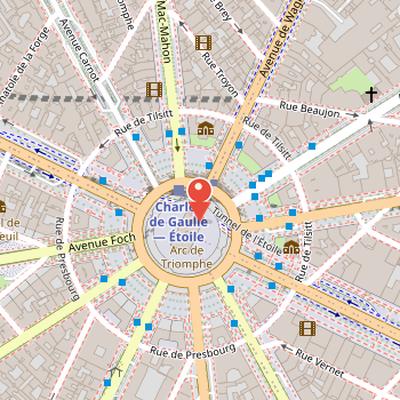
Nearby Objects
-
 Tomb of the Unknown Soldier 20 m away
 -
 Arc de Triomphe 20 m away
 -
 Place Charles-de-Gaulle 40 m away
 -
 Le Lido 400 m away
 -
 Avenue Marceau 500 m away
Location and Identity
The Departure of the Volunteers of 1792 is a monumental stone bas-relief by François Rude, sculpted between 1833 and 1836. It is also known as La Marsigliese or La Marseillaise. The work is installed on the east facade of the north side wall of the Arc de Triomphe in Paris, at place Charles-de-Gaulle. Its placement on one of the monument's prominent exterior walls makes it a visible part of the urban setting around the arch.
Allegorical Composition and Iconography
The Departure of the volunteers of 1792 was commissioned by Louis Philippe I through his minister Adolphe Thiers. It presents an allegorical interpretation of the commitment of French national volunteers against the armies of the First Coalition in 1792. The volunteers are shown in an ancient style, advancing toward the left, and several of them wear Greco-Roman armor while carrying lances, swords, and shields.
Above the group stands an allegorical winged figure of Victory, who urges the volunteers to combat. The figure is shown with a close-fitting cuirass over the bust and a large flowing mantle. She points the direction with a sword, reinforcing the sense of movement and exhortation. Behind her thigh, a horse's head appears, held by another character.
At the bottom center of the composition, a Greek warrior and his young ephebe are also depicted. The warrior raises his helmet one-handed toward Victory, adding to the classical vocabulary of the scene. Through these elements, the work combines military imagery and ancient references to express collective resolve and patriotic dedication.
Style and Title
Analisi's sculpture is distinguished by the movement of the group and the expression of the winged figure. Sophie Rude gave her facial features to the winged figure, and D. Strohl described this figure in the work. The sculpture also has a second title, La Marsigliese, which is named after the French national anthem. At the time of the sculpture's creation, La Marsigliese was a revolutionary song.
Cast Versions and Preservation
Copie's work was cast into plaster or bronze, with particular attention given to the faces of some characters, especially Vittoria. A bronze version showing Vittoria wearing a Phrygian cap is located at the National Museum of Stockholm. A plaster cast is preserved at the Ny Carlsberg Glyptotek in Copenhagen, and a plaster cast of the entire group is kept at the Rude Museum in Dijon. The plaster cast of the group was created in 1938 as a protective measure against possible destruction of the Arc de Triomphe by aerial bombings. Copie's plaster cast of Vittoria, along with other cultural goods vandalized by the Yellow Vests, was restored.