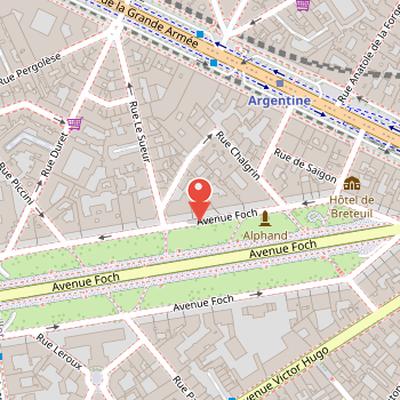
Avenue Foch is a major avenue in Paris, running from place Charles-de-Gaulle, formerly place de l’Étoile, to porte Dauphine, place du Maréchal-de-Lattre-de-Tassigny. It is one of the twelve avenues departing from place de l’Étoile. The avenue is noted for its exceptional width, created by gardens bordering it from end to end, and for its large unpaved cavalier paths between the roadway and the gardens, which are unique in Paris. These paths once allowed horse riders to reach the bois de Boulogne at the western end.
Opened in 1854 as avenue de l’Impératrice, the avenue was later renamed avenue du Général-Uhrich, then avenue du Bois-de-Boulogne in 1875, before being named Avenue Foch in 1929. The name honors Marshal Ferdinand Foch, who lived from 1851 to 1929 and was Supreme Commander of the Great War. Avenue Foch is also known for its many hôtels particuliers, including some associated with the Onassis and Rothschild families.
Nearby Objects
-
 Place Charles-de-Gaulle 450 m away
 -
 Arc de Triomphe 450 m away
 -
 Tomb of the Unknown Soldier 500 m away
 -
 La Marseillaise 500 m away
 -
 Palais des congrès de Paris 700 m away
Naming and prestige of Avenue Foch
Avenue Foch was renamed in 1929 after marichal Ferdinand Foch, who had been generalissimo of the Allied forces on the Western Front during the First World War. Before that, it was called avenue du Bois-de-Boulogne. The street is described as one of the most prestigious in Paris and as one of the most expensive addresses in the world. It is also known for housing many hotels particuliers, including some that belonged to the Onassis and Rothschild families.
Location and Layout of Avenue Foch
Avenue Foch begins at place Charles-de-Gaulle, formerly called place de l'Etoile, and ends at porte Dauphine, at place du Marechal-de-Lattre-de-Tassigny. It is one of the twelve avenues that depart from place de l'Etoile and is considered one of the most prestigious addresses in Paris. The avenue is long and wide, with gardens bordering it from end to end, which makes it the widest avenue in the capital. It is also described as the widest avenue in Europe and one of the widest in the world.
A distinctive feature of Avenue Foch is the presence of large unpaved cavalier paths between the roadway and the gardens, a layout that is unique in Paris. These paths once allowed horse riders to reach the bois de Boulogne at the western end by porte Dauphine. In its central section, the avenue crosses avenue de Malakoff and avenue Raymond-Poincare. At porte Dauphine, the triangle formed with avenue Bugeaud and boulevard Flandrin is named place du Paraguay by decree. The avenue is also served by metro stations and RER train stations.
Name and Dedication
Avenue Foch is named in honor of Ferdinand Foch, who lived from 1851 to 1929. Foch was Marshal of France and served as the Supreme Commander of the Great War. The avenue's name therefore reflects a dedication to a prominent French military figure.
Naming History and Garden Landscape
Avenue Foch opened in 1854 under the name avenue de l'Imperatrice, in honor of Empress Eugenie. After the fall of the Second Empire, it was renamed avenue du General-Uhrich, and in 1875 it became avenue du Bois-de-Boulogne. The gardens bordering the avenue were developed by Adolphe Alphand in 1855. These gardens contain about eight hundred trees, including the largest horse chestnut tree of India by circumference in Paris and the oldest Siberian elm tree in the city, planted in 1852.
Residences, Reputation, and Urban Character
At the end of the 19th century, high society personalities built mansions along Historique. The avenue also attracted the family Ephrussi de Rothschild, and the dramatist Adolphe d'Ennery, whose mansion now houses the Ennery Asian art museum. Other notable residents included Anna Gould, who lived there where her son Howard committed suicide in 1929, and Boni de Castellane, who lived in the Palais Rose. Historique also appeared in literature as the setting for the fictional Prince de Guermantes in Marcel Proust's A la recherche du temps perdu.
The avenue later continued to draw artists and public figures. Claude Debussy, Georges Feydeau, and Octave Mirbeau lived there, followed in the 20th century by celebrities and socialites such as Jacques Dutronc, Francoise Hardy, Maria Callas, and Aristote Onassis. Rainier III and Grace de Monaco also resided on Historique, as did musicians Arthur Rubinstein and Fernandel, writer Marcel Pagnol, Gerard de Villiers, fashion designers Loris Azzaro and Daniel Hechter, and hairdresser Jacques Dessange. Middle Eastern and African heads of state, including King Salman bin Abdulaziz Al Saud and Mobutu, were also residents.
Historique was described by residents as calm, even in the absence of commerce or activity on the avenue. At the same time, automobile traffic had to use secondary lanes or contre-allees, and a residents' association opposed a traffic project because of pollution and congestion concerns. Near Bois de Boulogne, the avenue was also known for prostitution on both sides, a practice that decreased starting in the 2000s after actions by Nicolas Sarkozy, Bertrand Delanoe, and websites.
The avenue was also connected to wider events. Tsar Nicholas II and Alexandra arrived at Passy-la-Muette station near Jardin du Ranelagh during their visit to France, and their procession took Historique, then Bois de Boulogne, to reach the Russian embassy. During World War I, the avenue du Bois-de-Boulogne was hit in a German air raid on 30 January 1918.
Surviving Residences on Avenue Foch
Bâtiments remarquables et lieux de mémoire notes that many hotels particuliers on Avenue Foch were destroyed during the 1960s and 1970s to make way for modern buildings. A few examples survived, including some at the location of the Angola embassy. The source also records the private Parisian residence of Prince Sultan Ben Abdul Aziz on the avenue, as well as an hotel particulier owned by Teodoro Nguema Obiang Mangue, which was confiscated by justice in 2021.
The avenue has also been associated with high-profile private apartments. Jeffrey Epstein owned a 500 square meter apartment on the second floor from 2002 to 2019. It was estimated at 20 million euros in his testament, and guests listed there included Prince Andrew, Jack Lang, Steve Bannon, and Bill Gates. The apartment was sold in 2023 for slightly more than ten million euros. Epstein also attempted to buy a 550 square meter apartment on the first floor in 2002, but it was purchased by a member of the Saudi royal family.
Related References
The associated references for avenue Foch point to its connection with Paris and to the Place et arc de triomphe de l'Etoile category. These cross references indicate that avenue Foch is linked within a broader Parisian context and related to the area around the Arc de Triomphe. The mention of voir aussi serves as a guide to related entries connected with Foch and its wider urban setting.