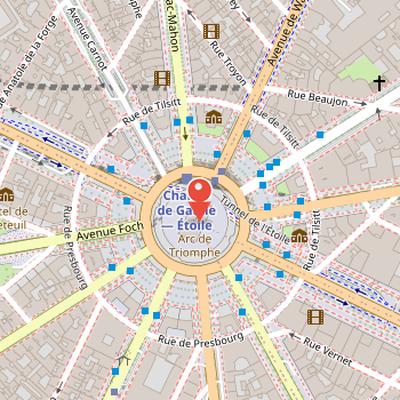
The Tomb of the Unknown Soldier is a monument located in Paris under the Arc de Triomphe. It contains the body of a soldier who died during World War I and is not officially recognized as French. The tomb symbolically commemorates all soldiers who died for France throughout history. It consists of a granite slab from Vire, surrounded by black metal posts connected by chains, and bears an epitaph inscribed on the stone.
An eternal flame was added in 1923 and is rekindled every day. After World War II, a bronze shield with a flaming sword was installed at the foot of the tomb. Offered by the Allies, it honors the French armies and commemorates the liberation of Paris. Veterans’ associations refer to the tomb and its flame as the “dalle sacrée.” The monument is guarded permanently by a specialized service of the National Police.
Nearby Objects
-
 Arc de Triomphe 10 m away
 -
 La Marseillaise 20 m away
 -
 Place Charles-de-Gaulle 30 m away
 -
 Le Lido 450 m away
 -
 Avenue Marceau 500 m away
Design and Memorial Features
The Tomb of the Unknown Soldier is located in Paris under the Arc de Triomphe. It contains the body of a soldier who died during World War I and is not officially recognized as French. The tomb symbolically commemorates all soldiers who died for France throughout history.
Its design consists of a granite slab from Vire, surrounded by black metal posts linked by chains. An epitaph is inscribed on the granite slab. An eternal flame was added in 1923 and is rekindled every day. After World War II, a bronze shield with a flaming sword was installed at its foot. This shield was offered by the Allies in honor of the French armies and to commemorate the liberation of Paris.
Veterans' associations refer to the tomb and its flame as the dalle sacree. A specialized service of the National Police permanently provides the monument guard.
From Wartime Commemoration to the Tomb at the Arc de Triomphe
During the first year of the Great War, numerous projects arose to honor the dead, including plaques and golden books. The phrase mort pour la France was established by law, and local commemorative initiatives also appeared. In Rennes, François Simon, president of the local section of Souvenir francais, gave a speech at the East cemetery and evoked the idea of a commemorative project. This idea took the form of a golden book recalling all war dead after the conflict, intended to be placed inside the Pantheon.
A separate legislative initiative advanced this broader commemorative movement. Maurice Maunoury, deputy of Eure-et-Loir, made a law proposal, and the Chamber of Deputies adopted the proposal to inter a soldier at the Pantheon. At the same time, the government planned to celebrate the second armistice anniversary and Gambetta's fiftieth birthday of the Third Republic, and it aimed to transfer Gambetta's heart to the Pantheon. Contexte notes that the government linked the wars of 1870 and 14-18 in the name of continuity against Germany.
These projects created political division. There were tensions between the government and war veterans, and veterans preferred a ceremony at the Arc de Triomphe for fallen soldiers. The Pantheon was associated with political and civil glories rather than soldiers. The Chamber proposed the Arc de Triomphe as the burial site and reserved the Pantheon for Gambetta. In the end, the law was adopted unanimously by the Chamber of Deputies and the Senate.
The selection of the soldier was then carried out under the presidency of Andre Maginot, Minister of Pensions and war mutilated. The ceremony took place at the citadel of Verdun, described as a mythic location of the First World War.
Selection of the Unknown Soldier
The Unknown Soldier was chosen through a selection carried out by Auguste Thin, a volunteer soldier from the 1919 class who was 21 years old and served as a second-class soldier in the infantry regiment. Eight bodies of soldiers who had served under the French uniform but could not be identified were exhumed from eight regions associated with some of the deadliest battles: Flanders, Aisne, Somme, Ile-de-France, Chemin des Dames, Champagne, Verdun, and Lorraine. Although nine soldiers and nine sectors were initially selected, one sector did not have any body with a guarantee of being French.
On November 8, 1920, the eight oak coffins were transferred to the Verdun citadel and placed in a casemate. They were moved several times inside the casemate to preserve the anonymity of their provenance. The next day, the coffins were arranged in a chapel of rest in two columns of four, under guard by a company of the 137th infantry regiment. During the guard duty, Andre Maginot approached Auguste Thin and gave him a bouquet of white and red carnations. Thin then walked past the coffins from the right side, stopped, and placed the bouquet on the coffin of the soldier from Meuse. That coffin was selected for transfer to Paris and burial under the Arc de Triomphe. The event and the search for the unknown soldier were later reproduced in Bertrand Tavernier's film La Vie et rien d'autre in 1989.
Inhumation and Burial at the Arc de Triomphe
The coffin of the Unknown Soldier departed Verdun under military escort on November 10, 1920, and was transported by train to Paris, where it arrived at the Pantheon. At the Pantheon, President Alexandre Millerand delivered a speech. The coffin was then vigil kept overnight at Place Denfert-Rochereau before entering solemnly under the Arc de Triomphe on November 11, 1920. There, it was placed on the artillery limber of a 155 canon. The burial took place on November 28, 1920, at the Arc de Triomphe, with civil and military authorities present, including marshals Foch, Joffre, and Petain. Also present were Belgian Foreign Minister Henri Jaspar, British Prime Minister David Lloyd George, and a Portuguese representative. At 9 a.m., military troops presented arms, while War Minister Louis Barthou bowed before the coffin and recited a decree. The seven other unchosen remains were left at the Faubourg Pave military cemetery near Verdun, in the Square of the seven unknowns.
The Eternal Flame Ceremony
In early 1921, Gabriel Boissy and Gregoire Calvet proposed the idea of keeping a flame burning permanently. Augustin Beaud initiated the installation of the flame, referring to the lamp in the Panossas cemetery, and submitted the idea to General Henri Gouraud and the Paris municipal council. The installation was approved by both Gouraud and the council. Boissy and Jacques Pericard also proposed that veterans rekindle the flame every day at 18:30, a practice that Pericard called for from 1923 onward.
The flame's fire bowl was designed by architect Henry Favier and shaped like a cannon muzzle. Ironworker Edgar Brandt executed this design. Flamme eternelle was first lit under the Arc de Triomphe on November 11, 1923, by Andre Maginot, with General Henri Gouraud present. During the first lighting, the 11th Infantry Regiment presented arms and played the Marche funebre by Chopin. The regiment later became known as the
Public Actions and Controversies at the Tomb
The Tomb of the Unknown Soldier in Paris has been the site of several politically charged and symbolic events. On August 23, 1927, the execution of Sacco and Vanzetti triggered riots in France, Japan, and South Africa, and in Paris the tomb was desecrated during the unrest. This desecration is reported to have led to the creation of the Croix-de-Feu.
The tomb and its setting under the Arc de Triomphe also became a place for public protest. On August 26, 1971, about ten women from the Mouvement de liberation des femmes laid a wreath there. Some of the banners displayed the slogan, 'Un soldat ne meurt pas pour la patrie, il meurt pour le capital.' This action is described as the first media action of the movement.
The tomb has also remained the focus of later controversies. On August 5, 2025, a Moroccan man was arrested after crossing burial chains to light a cigarette at the Flame of the Unknown Soldier. He was known to police and was held for violation of the tomb or monument commemorating the dead. Authorities condemned the act as an insult to national memory.
The site has also influenced related burial decisions elsewhere. In 1932, the commune of Cucq intended to honor its own 'unknown soldier' after a burial error in which the same Poilu had been buried twice in the family vault. The minister of pensions vetoed another unknown soldier burial in Cucq to avoid duplication with Paris' unknown soldier.
International Commemorations
The Tomb of the Unknown Soldier in Paris is part of a broader international practice of memorials honoring unidentified war dead. In total, 28 other countries possess a Tomb of the Unknown Soldier. Among them, London has a Tomb of the Unknown British Soldier, which was inaugurated on the same day as the French memorial.