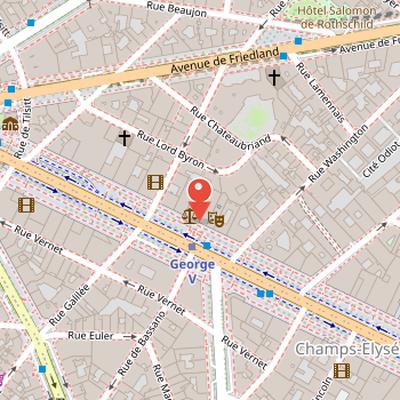
Le Lido was a revue theater in Paris, founded in 1946 by the Clerico brothers in a former swimming pool already called Lido on Avenue des Champs-Élysées in the 8th arrondissement. It became one of the city’s most popular variety theaters, especially among tourists, and was known for elaborate stage shows and performances by international show business artists. The Bluebell Girls formed a major part of its stage program as the house female ballet, with elaborate costumes. In 1958, the successful concept was exported to Las Vegas and continued there for more than 30 years. The venue moved in 1977 to a larger building, also on Avenue des Champs-Élysées. It closed at the end of July 2022. The name Lido was also associated with the broader site history, including the Arcades des Champs-Élysées, which were later nicknamed Arcades des Lido because of the popularity of the Lido establishment.
Nearby Objects
-
 Avenue Marceau 350 m away
 -
 La Marseillaise 400 m away
 -
 Tomb of the Unknown Soldier 450 m away
 -
 Arc de Triomphe 450 m away
 -
 Place Charles-de-Gaulle 450 m away
History and Stage Identity
Le Lido, originally named Das Lido and also known as Pariser Lido, Lido de Paris, or Plage de Paris, was a revue theater in Paris. It was founded in 1946 by the Clerico brothers in a former swimming pool already named Lido on Avenue des Champs-Elysees in the 8th arrondissement. The theater became known for elaborate stage shows and for performances by international show business artists. A major part of its stage program was the Bluebell Girls, the house female ballet, whose performances featured elaborate costumes.
The venue was one of the most popular variety theaters in Paris, especially among tourists. In 1958, its successful concept was exported to Las Vegas and continued there for more than 30 years. In 1977, Le Lido moved to a larger building, also on Avenue des Champs-Elysees. The theater closed at the end of July 2022.
From Champs-Elysees Arcade to Le Lido
Le Lido was originally located at Avenue des Champs-Elysees 76-78, on a site with a layered architectural history. In 1905, the Hotel Dufayel was built there from designs by Gustave Rives. During the 1920s, Leonard Rosenthal acquired the property extending from Avenue des Champs-Elysees to Rue de Ponthieu and commissioned the construction of the Arcades des Champs-Elysees, which began in 1925. Designed by Charles Lefebvre with assistants Marcel Julien and Louis Duhayon, the building was created as a shopping arcade for luxury stores and opened on October 1, 1926.
The interior combined Belle Epoque and Art deco styles. Its decoration incorporated old marble columns from the Hotel Dufayel, along with ironwork by Rene Gobert and lighting designed by engineer Fernando Jacopozzi. A glass fountain by Rene Lalique was also part of the decor, although it is no longer preserved. In 1928, a bathhouse designed by Rene Hirtes opened in the basement of the Arcades des Champs-Elysees. These successive transformations show how the site developed from a private hotel property into a commercial arcade with notable decorative features.
The Lido Name and Its Cultural Impact
The bathhouse operated under the name Lido, a reference inspired by Lido di Venezia, Venice's beach. Its interior included Venice-themed decor, which reinforced this association. The establishment also offered wellness facilities such as a sauna and a beauty salon. Due to the popularity of the Lido, the Arcades des Champs-Elysees became known as the Arcades des Lido. This nickname remains in use even after the Lido theater relocated.
From Pool to Revue Theater
After World War II, Jean and Joseph Clerico recognized the need for entertainment for US soldiers and civilians in Paris. They took over Le Lido and converted it into a revue theater. The original swimming pool facility disappeared completely, and only the name Lido remained. The theater opened on June 20, 1946 with the revue Sans rimes ni raison.
From 1947 onward, the Lido became one of the leading varietes of Paris under the influence of theater director Pierre-Louis Guerin and artistic director Rene Fraday. Together, they developed the concept of Diner-spectacle at the Lido. Margaret Kelly Leibovici, known as Miss Bluebell, worked at the theater from 1948 and collaborated with choreographer Donn Aden on stage shows with elaborate costumes. The early years of the Lido were also marked by poster designs by Rene Gruau and Pierre-Laurent Brenot.
From the beginning, the Lido presented guest appearances by French and international artists. Among the performers who appeared there were Stan Laurel and Oliver Hardy in the early 1950s, as well as Noel Coward, Marlene Dietrich, Josephine Baker, Maurice Chevalier, and Edith Piaf. The Kessler Twins from Germany joined the fixed program from 1955 to 1960. In 1958, the Lido operators exported their concept to Las Vegas, where Guerin, Fraday, and Donn Arden developed the Lido de Paris program for the Stardust Casinohotel. That program ran there until 1992. Other notable visitors and performers included Elvis Presley, who visited repeatedly as a tourist in Paris in 1959 and gave an impromptu concert on stage. Later fixed or featured artists included Siegfried and Roy from 1967 to 1969 and Marlene Charell from 1968 to 1970, who met her future husband Roger Pappini at the Lido, where he was technical director.
Relocation and Remodeling of Le Lido
In the 1970s, Christian Clerico took over company management from Joseph, while plans were made to increase seating capacity in response to continuing high demand. Le Lido then moved to Avenue des Champs-Elysees No. 116, into the former Grosskino Normandie, a building constructed between 1928 and 1932 by architect Jean Desbouis for Poste Parisien. The building was known by the nickname Akkordeon because of its distinctive facade. Before March 1977, the venue was remodeled by the Italian architects Giorgio Vecchia and Franco Bartoccinder.
After the relocation, the new Lido occupied more than 7,500 square meters and included an auditorium with 1,150 seats. Most seats were arranged on two tiers, with 300 seats on the parquet level, where guests dined before performances. The parquet could be hydraulically lowered by 80 cm before each show to improve sightlines. The new installation also featured advanced stage technology, including waterfalls and ice rink surfaces.
Late Productions and Closure
Le Lido continued to host major stage productions in its later years, with international stars including Shirley MacLaine, Tom Jones, Charles Aznavour, Sacha Distel, Ingrid Caven, Ute Lemper, and Elton John performing there. From December 2003 to November 2014, the cabaret presented Bonheur twice nightly, a show created by Pierre Rambert. Its 27th and final production was Paris Merveilles by Franco Dragone, supported by a 25 million euro investment for renovation and a modern show concept. The production did not manage to repeat earlier successes, and the cabaret also suffered from the COVID-19 pandemic, repeated closures, and a decline in tourism.
The venue changed ownership several times during this period. It was sold to the caterer Sodexo and then resold at the end of 2021, after which Accor Hotelgroup acquired the heavily indebted cabaret for one euro. In May 2022, the end of Le Lido in its previous form was decided, with plans to transform it into a music theater without a permanent ensemble. The last public show took place on July 28, 2022, followed by two private performances for staff families. The final curtain fell on July 30, 2022.