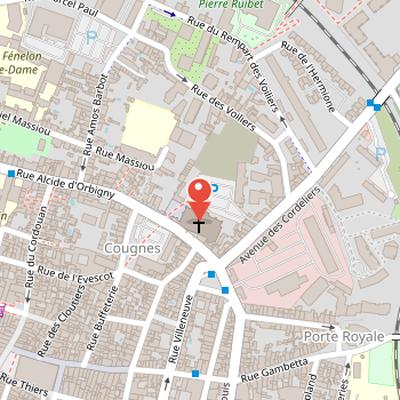
Notre-Dame-de-Cougnes is the parish church of La Rochelle, in Charente-Maritime, Nouvelle-Aquitaine, and belongs to the diocese of La Rochelle and Saintes. Founded in 1077 on a small elevation overlooking the salt marshes, it began as a modest chapel serving the population of Cougnes, the ancestor of La Rochelle. The chapel was created when monks of the Cluniac priory on Aix Island decided to establish a small place of worship in the marshes of northern Saintonge. As La Rochelle grew from a hamlet into a town with a modern port, the first parish center of Sainte-Marie de Cougnes became part of a wider urban and religious development. The church was almost entirely destroyed during iconoclastic attacks in 1568 and was rebuilt starting in 1653. The building is associated with the long history of La Rochelle, whose prosperity and church construction were shaped by maritime growth, salt wealth, and the changing needs of the city.
Nearby Objects
-
 Muséum d'Histoire naturelle de La Rochelle 400 m away
 -
 Musée du Nouveau Monde 450 m away
 -
 Musée des Beaux-Arts de La Rochelle 450 m away
 -
 La Rochelle Cathedral 600 m away
 -
 Église Saint-Sauveur 650 m away
History of Notre-Dame-de-Cougnes
Notre-Dame-de-Cougnes is a parish church in La Rochelle, in the Charente-Maritime department of the Nouvelle-Aquitaine region, and it belongs to the diocese of La Rochelle and Saintes. It was founded in 1077 on a small elevation overlooking the salt marshes. Originally, it was a modest chapel serving the population of the hamlet of Cougnes, which was an ancestor of La Rochelle. The church was almost entirely destroyed during iconoclastic attacks in 1568. Rebuilding began in 1653, marking the start of its later reconstruction.
From Parish Chapel to Gothic Sanctuary
The origins of Notre-Dame-de-Cougnes are linked to the monks of the Cluniac priory on Aix Island, who decided to build a small chapel at Cougnes in the marshes of northern Saintonge. At that time, La Rochelle was still a small hamlet inhabited by a few fishermen and peasants. As the settlement grew into a true town with a modern port, built gradually under the dukes of Aquitaine and the counts of Poitiers, the chapel became the center of La Rochelle's first parish under the name Sainte-Marie de Cougnes.
The rapid population growth, with natives and foreigners arriving by land and sea, made the chapel insufficient for the city's spiritual needs. Saint-Barthelemy church was built in 1152, followed later by Saint-Sauveur church. In 1175, Henri II Plantagenet and Alienor of Aquitaine granted La Rochelle its first communal charter, and the city was then one of the busiest ports in Aquitaine. Its prosperity increased with the opening of the English market to Aquitain merchants, while La Rochelle wine gained some reputation at the London court. The region's main wealth was salt, known as white gold. This prosperity allowed churches to be modernized and rebuilt on a larger scale.
Part of the original construction was also demolished to strengthen the ramparts. After the siege of the city by Louis VIII in 1224, Notre-Dame-de-Cougnes was transformed into an admired Gothic sanctuary. Amos Barbot de Buzay described it as the oldest church and a magnificent building with a lead roof. Its location was built over the bastions and platforms of Cougnes. The church later received royal attention as well: King Louis XI visited it for prayer, and a great celebration was organized there for the birth of the Dauphin.
Reformation and Religious Conflict in La Rochelle
During the 16th century, the Reformation made rapid progress in the region, helped by the circulation of new ideas through many ports and merchants from across Europe. The period first saw relative tolerance, but this was followed by increasingly severe repression. In 1548, several heretics were made to undergo public penance in front of the church portal. Conversions nevertheless continued, and in 1552 Pierre Constantin and Mathias Couraud were condemned to have their tongues cut for blasphemy before being burned alive in public. These examples did not stop the advance of the Reformation. By the beginning of the Wars of Religion, La Rochelle was largely populated by Huguenots.
Destruction and Military Use of the Bell Tower
In 1568, the municipality decided to demolish all churches in order to strengthen the city walls. As a result, most of Notre-Dame de Cougnes disappeared, leaving only some walls and the bell tower. The bell tower was then transformed into a watchtower and a cannon platform. It was a square tower comparable to the towers of the churches Saint-Sauveur and Saint-Barthhelemy. During the siege of 1573, firing began on the fortifications on the last day of February, around 8 a.m., by order of the Duke of Anjou. Battery fire was chiefly directed at the Notre-Dame de Cougnes bell tower, which became the main target. The besieged installed two couleuvrines in the tower, reaching into the trenches and troubling the attackers, but the tower eventually collapsed.
History and Architectural Development
The history of Notre-Dame-de-Cougnes is closely tied to the changing fortunes of the parish and the city. In 1613, by decision approved by King Louis XIII, the five city parishes and the church ruins were placed under the administration of the Oratory priests. After the king's victory over the city following the siege of 1628, Catholics recovered their properties. A report known as Jourdan described what remained of Notre-Dame as only some walls, four flying buttresses with a large central door, a stairway, casemates, an altar fragment, columns, and a central pillar.
Rebuilding began on these ruins in 1653 during the Counter-Reformation, and the church was completed in 1665. The resulting building was noted for its great austerity. By 1713, it was considered too small for the parish population, so the remnants of the old structure were used to add a bay to the nave. François Ferry, royal engineer and chief architect of the reconstruction of the city's fortifications, died in 1701 and was buried in the church.
The church also played a role in revolutionary events. During a ceremony marked by the presence of all city orders and artillery fire, the national volunteers' flags were blessed there, and the volunteers afterward swore fidelity to their king. The building was later converted into a stable for cavalry and artillery during the anti-religious revolutionary movement, before being returned to worship on an unspecified date. Parishioners then paid for its restoration from their own funds. In later work, a small square belfry with a slate roof was built on one of the solid towers of the first Cougnes gate to avoid costly construction, and between 1854 and 1856 this belfry was extended with a polygonal spire. The Sacred Heart chapel was added at the end of the 19th century.
Architectural Features and Unfinished Plans
The description preserves rare traces of the primitive church, including part of the south wall with pinnacle starts and different window splays. It also shows a reconstruction carried out economically, making use of abandoned projects. The planned vaults were never launched, and the building instead has a simple plaster ceiling. A facade bell tower was also planned but never built. In its place, a campanile was established on the nearby fortified door as the more practical solution.
The Organ and Musical Life
The church at Notre-Dame-de-Cougnes houses a notable organ that has undergone significant changes since its original construction. It was built in 1850 by Trouillet in Bordeaux as a romantic sixteen-foot organ with 26 stops. Between 1965 and 1966, Robert and Jean-Loup Boisseau in Poitiers entirely rebuilt it, transforming it into a grand eight-foot neo-baroque organ. The instrument now includes 35 stops distributed across three manuals and a pedalboard, with a fully mechanical action mechanism and visible pipes. Its console has three manuals of 54 notes each, and the pedalboard has 30 notes. The organ case is divided into two sections, with facades made of oak wood and the sides and backs in stained fir wood. This instrument allows repertoire from the eighteenth century as well as part of the twentieth century to be performed. The church regularly hosts organ concerts and recitals. A choir organ installed in 1933 is also present in the church.
The Jesuit Chapel Retable
The retable from the former chapel of the Jesuit congregation belonged to the ancien college des jesuites of La Rochelle. It was ordered in 1692 from the sculptor Charles Lamothe of Montreuil-Bellay. After restoration, only the two side wings were preserved. The retable was then reassembled in the church Notre-Dame at the north collateral end. It is classified as an object.
Former Cemetery Behind the Church
Cimetiere de Notre-Dame was located behind the church, at the site of the current Notre-Dame parking lot. In 1794, a seal was placed on the doors of all intra-muros cemeteries in the city, including this cemetery. Later, all of these cemeteries were desacralized in connection with the creation of the new general cemetery of the commune, called Cimetiere municipal de Saint-Eloi.