La Rochelle Cathedral is a Catholic cathedral in La Rochelle associated with the former church of Saint-Barthélemy. The history of the site began when the city’s population increased in the middle of the century and the church Notre-Dame-de-Cougnes no longer met local needs. Monks from Île-d'Aix built a second church, and in 1152 land called Champ de Guillaume de Syré was donated by Elbe de Mauléon and Geoffroy de Rochefort. Pierre de Mougon built the church Saint-Barthélemy, though Bishop Bernard of Saintes interrupted the work before Pope Eugene III ruled against him in 1152. The church became a parish in 1217. In the 16th century, it was probably rebuilt and was involved in the religious tensions of the early Reformation. In 1573, the city was fortified and all churches were demolished, while the bell tower of Saint-Barthélemy was preserved for military observation and as a cannon platform. Only the bell tower and one wall remained by 1599, and later efforts to rebuild the church were abandoned.
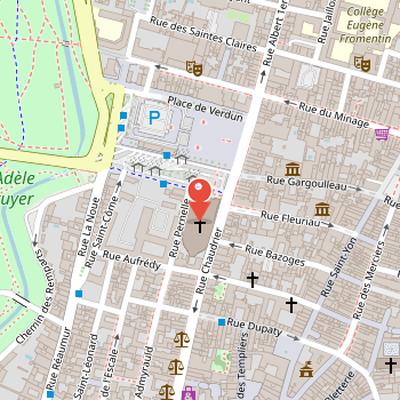
Nearby Objects
-
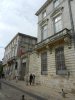 Musée des Beaux-Arts de La Rochelle 140 m away
 -
 Musée du Nouveau Monde 200 m away
 -
 Grosse Horloge 350 m away
 -
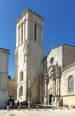 Église Saint-Sauveur 350 m away
 -
 Muséum d'Histoire naturelle de La Rochelle 400 m away
History of Saint-Barthlemy in La Rochelle
In the middle of the century, the population of Historique in La Rochelle increased, and the church Notre-Dame-de-Cougnes was no longer sufficient. Monks from Ile-d'Aix built a second church for Historique, and in 1152 Elbe de Mauleon and Geoffroy de Rochefort donated the land called Champ de Guillaume de Syre. Pierre de Mougon built the church Saint-Barthlemy, but Bishop Bernard of Saintes interrupted the work. Pope Eugene III ruled against Bishop Bernard by an apostolic letter dated March 23, and in 1217 Bishop Ponce de Pons established the church as a parish. The church later gained wider recognition when Charles VII accepted the title of founder of the Chapter in 1429, and Francis I attended mass there with princes and bishops on September 13, 1534. On September 25, 1534, David, chaplain to the king and queen of Navarre, preached reformed religion dogmas in Saint-Barthlemy.
The church was probably rebuilt in the 16th century, and during the early Reformation ministers of both faiths shared churches in Historique temporarily. In 1568 mayor Francois Pontard raised the revolt banner against papists and imprisoned priests and opponents. The populace looted, burned, and dispossessed churches, and on March 28, 1573 Historique was fortified and all churches were demolished. The bell tower of Saint-Barthlemy was preserved for military observation and as a cannon platform. After the Edict of Nantes on April 20, 1598, Catholics regained chapelle Sainte-Marguerite and the ruins of Saint-Barthlemy, but conflicts with the commune and Protestants prevented rebuilding a new church. By 1599 only the bell tower and one wall remained. In 1603 mayor Louis Berne destroyed reconstruction work during the night, and efforts to rebuild the church were abandoned.
From Grand Temple to Cathedral Site
In 1628, Louis XIII dispossessed the Protestants of the Grand Temple and vowed to make the conquered city an episcopal seat for the Grand-Temple cathedral. He also entrusted the Saint-Barthlemy parishioners with the guardianship of the Grand Temple, which became Saint-Barthlemy du Grand-Temple. The royal vow was realized in 1648, when the pope transferred the episcopal seat from Maillezais to La Rochelle. In 1666, by papal order, the Maillezais abbey chapter moved to La Rochelle and to the Grand-Temple cathedral. This arrangement did not proceed smoothly, since conflicts arose between the parishioners and the cathedral chapter. The parishioners abandoned the Grand-Temple place to new arrivals in 1667, and after the fire at the Saint-Barthlemy-du-Grand-Temple cathedral in 1687, the building housed the cathedral chapter. The cohabitation continued to generate conflicts until the building was demolished during the Revolution.
The later history of Saint-Barthlemy also reflects repeated disputes over ecclesiastical use. Bishop Frezeau de Freziliere moved the tabernacle to Notre-Dame chapel and claimed, on the basis of a royal order, the Saint-Barthlemy church as cathedral. Churchwardens and parishioners protested after the restoration of the church, and in August it was decided that Saint-Barthlemy would remain parishial and that the canons would continue services there. The bishop was allowed burial in the church choir if he died before the new cathedral was built, and he was buried there in November after that decision. The cathedral chapter left the church in 1784 for the new cathedral. In 1793 the city turned Saint-Barthlemy into a grain and flour market, and in 1797 the church was sold and demolished. Municipal authorities considered two adjacent worship places an unnecessary luxury, and demolition was also justified because the church encroached on Chaudrier street and needed repairs. Only a south wall connecting the church to the medieval bell tower remains. Before 1855, the site was occupied by houses and public baths; the land was recovered in 1855 to complete the chevet of the current cathedral.
From Civic Elections to Episcopal Status
Until its destruction in 1568, the church of Saint-Barthe9lemy was the site of an annual election held on Quasimodo Sunday, when three city notables were chosen. From these notables, the se9ne9chal of the province selected the mayor of La Rochelle for a one-year term. After the church was destroyed, Historique moved the election to the La Rochelle town hall around the end of the 16th century. This civic arrangement ended in 1628, when Louis XIII abolished the mayoralty after the city was taken.
Following the siege of La Rochelle in 1627-1628, Historique decided to make La Rochelle a bishopric. In 1648, the Pope issued In supereminenti militantis ecclesiae solio, suppressing the bishopric of Maillezais and transferring it to La Rochelle. The transfer was opposed by the chapter of Maillezais abbey, but Historique enforced it through a fulmination sentence that obliged the canons to leave the monastic habit and go to La Rochelle.
The First Cathedral and the Great Temple
La Rochelle Cathedral first used the building known as Saint-Barthelemy-du-Grand-Temple, which had originally been a Reformed Church temple. It was built between 1600 and 1603 on Chateau square, now place de Verdun, and the construction plans were attributed to Philibert Delorme. The temple was completed in August, and the first sermon there was preached by pastor Dumont before 3500 people on a Sunday.
After La Rochelle's defeat in 1628, the Grand Temple was confiscated for Catholic worship from 1629 to 1648. The building was described as an elongated octagon nearly 20 toises long and 15 toises wide, with a lead-covered roof. It also had an octagonal bell tower on the south side, topped by a dome and a small open campanile. Inside, a large wooden frame rose to ten toises in height and was supported by two wooden keystones without pillars, with a dome-shaped lattice.
The building was later destroyed by fire after a large bonfire was lit on the square to celebrate a healing. The fire spread rapidly through the framework and consumed the monument quickly. After this destruction, the chapter took refuge in the new Saint-Barthelemy parish church, rebuilt between 1668 and 1678, while projects for a new building were studied after the failure to convert Saint-Barthelemy into a cathedral.
From Delayed Project to Active Construction
At the end of the 17th century, the cathedral project in La Rochelle could not begin because budgetary priorities were directed toward the construction of the city walls. After a delay of thirty years, the project was revived by the new bishop, Roch de Menou. For ten years, the available funds were sufficient only to purchase the future building site. In 1740, the project received support from cardinal de Fleury and royal authority, and the royal court assigned the king's first architect to the work. Jacques Gabriel then submitted a preliminary design to the court the following year, and later informed monsieur de Barentin that the final plans had been approved by cardinal Fleury and monsieur de Muy. The site that had been freed was still too small, so the destruction of the Saint-Barthlemy church became necessary. Gabriel proposed that construction should first advance as far as the chevet, postponing the church's fate. The Council of State approved the full project and confirmed the donation, and the first stone of the new cathedral was blessed on an unspecified date. Before his death in April of the same year, Jacques Gabriel signed the final execution plans. His son, Jacques-Ange Gabriel, then took over and confirmed support for the project. Construction began actively but stopped in 1750 because of a lack of funds. By that time, the cathedral walls had risen to the cornice from the facade to the first bay of the choir.
Resumption and Completion of the Cathedral
Under the new bishop Crussol of Uzes, the work on La Rochelle Cathedral was resumed with the aim of finishing the project quickly. He modified Gabriel's initial plans, but after being persuaded by the chapter, he restricted the works to remain in conformity with the original design. He chose to continue the transept and the adjoining parts toward the choir and nave, and to complete the dome, stone vaults, and roofing on this section. Work resumed in 1771, and in 1775 it was extended to the second bay of the choir, which led to the closure of the parish church of Saint Barthelemy. The roofing was put in place in 1777.
Lack of funds soon interrupted progress, and the bishop requested help from the king. In 1779 he received 16,000 livres as an annual annuity, although he ultimately obtained only half of the promised sum. These funds were used to install doors and windows and to prepare the cathedral for worship. The building was consecrated on July 30, 1783 in the presence of clergy and civil and military personalities of the city, and it was returned to worship on November 3, 1783. The parish priest of Saint Barthelemy then resumed possession of the building on behalf of the bishop. The parish church of Saint Barthelemy was later destroyed during the French Revolution.
In the years that followed, priority was given to repairing and refurnishing the building rather than completing the cathedral. Repairs included the roofing and stained glass, and the truncated choir and transept arms were arranged. The entrance on rue Chaudrier was closed, and in 1835 a gallery was built to house an organ. In 1836 Clément Villecourt was appointed bishop, and he convinced the authorities that completion of the building was justified. The State acquired houses and establishments occupying the ancient parish site, and the Borin baths were acquired in 1839. Construction resumed on May 3, 1840, and the building was completed in 1848 except for the two towers and the external sculpted decorations. The cathedral was then dedicated under the invocation of Saint Louis and Saint Barthelemy. It was later classified as a historic monument on December 5, 1913.
The Bell Tower of Saint-Barthelemy
Le clocher Saint-Barthelemy is a Gothic-style bell tower attached to the chevet of the cathedral. It was built on the southwest corner of the church during the reconstruction of Saint Barthelemy in the 15th century, and its construction is attributed to King Charles VII, founder of the church chapter in 1429. The tower retains decorative elements such as statues, gargoyles, floral moldings, Gothic stone balustrades, and high niches containing statues of Eve, Saint James, and Saint Yves on the buttresses. Several angels form the consoles.
The tower also played a military role in the 17th century. It was used as a cannon tower against enemy armies during the siege of 1627, and in 1628 a cannonball fired from it struck a conference between Richelieu and Lord Lindsay. During the Fronde, the governor of La Rochelle, the count of Daugnon, had the upper vaults, stairs, and floor removed to prevent batteries from threatening the port towers. After the stone spiral stairs and high vault were demolished in 1651, wooden stairs provided access to the top.
In the 19th century, the clock was rebuilt at the expense of the commune for 3,000 francs and started operating on 16 March 1834. At the end of the century, the ground floor was arranged to host temporary exhibitions, and the tower was restored for public opening during the summer season. It has been classified as a historic monument since 27 July 1911. The tower houses the three bells of the cathedral, including Marie-Ursule, the bourdon bell. Le clocher Saint-Barthelemy is currently closed to the public.
Architecture of La Rochelle Cathedral
The original plan for La Rochelle Cathedral was designed by Jacques V Gabriel, who died before the first stone was laid in 1742. Jacques Ange Gabriel then followed the construction works from a distance, while the church was only completed under the Second Empire. The building was planned with a traditional Latin cross layout, including a central nave, collateral chapels, a salient transept, and a choir surrounded by an ambulatory interrupted by an axial chapel dedicated to the Virgin. Two bell towers that had initially been planned were never built.
The exterior is marked by a very plain facade with two orders of Tuscan and Doric columns, topped by a triangular pediment flanked by pilasters. Along the length of the building, a Doric order decoration runs on the frieze. The nave is covered by a barrel vault reinforced by transverse arches, while the side aisles are vaulted with ribbed vaults. The crossing square is covered by a dome, with pendentives providing the transition from the square to the circle. The cornice and frieze projection emphasize the strength of the crossing pillars.
The interior decoration is restrained, with the only sculpted elements being the keystones above the arches by Alexandre Felix Vetelet in 1862 and 1873. The dome of the Virgin chapel is decorated with paintings by William Bouguereau, forming a homogeneous pictorial ensemble.
Paintings and Chapel Decoration
A pictorial ensemble in the cathedral brings together six paintings depicting scenes from the life of the Virgin. The central work is the Assumption, dated 1875, while the other paintings represent the Annunciation, Visitation, Nativity, Flight into Egypt, Fainting of the Virgin, and Virgin of Pity. Each painting is made of two adjoining copper plates, and the ensemble was installed in 1876. The Annunciation was painted by Francois Edouard Picot and had already been exhibited at the Salon of 1827. These works come from the Saint-Jean-du-Perot church, an old fishermen's church in the Saint-Jean-du-Perot district of La Rochelle, one of the city's five historic parishes. That church was disused and destroyed in 1887 because of the threat of ruin, and only its bell tower remains.
The paintings and ex-votos are grouped in a cathedral chapel that has been turned into the sailors' chapel. Most of the artworks in this space represent shipwrecks in which the Virgin intercedes to save the crews. One painting, Celui du Saphir, shows the slave ship Le Saphir immobilized by lack of wind between the coast of Guinea and Saint-Domingue, a situation that threatened famine for the crew and slaves. It also depicts several black slaves supplicating Christ. The work is associated with Elie Giraudeau, the principal shipowner of Le Saphir, and with Captain Rossal, who was likely Protestant. The choice of Christ as intercessor instead of the Virgin may be related to Protestant beliefs, and the painting was probably created in 1741 or shortly after by an unknown artist.
The chapel also contains 19th century stained glass windows made by three different workshops. Before these were installed, the windows had white glass panes cut into diamond shapes and fixed with lead. The current stained glass was installed between 1872 and 1893. Other works in the cathedral include Pitie de saint Louis pour les morts by Debat-Ponsan in the left transept arm, a work presented at the 1878 Universal Exhibition, as well as a painting of the Flagellation of Christ by William Bouguereau from 1880, which is on deposit at the Musee des beaux-arts de La Rochelle. A workbench is surmounted by a painting of Jesus Christ on the cross, and the chapel also presents an Annunciation by Francois-Edouard Picot.
The cathedral organs and their casework
The organs of La Rochelle Cathedral reflect several stages of construction and replacement in the 19th century. The current gallery corresponds to Brossard's project and plans from 1835, and it was intended to receive the cathedral's first organ. The present instrument replaced an organ by John Abbey dated 1835. That organ was sold in 1866 to the Saint-Hilaire parish in Poitiers. The current organ was built in 1867 by the Merklin-Schutze manufacture and has been preserved almost intact until now. Because the old Abbey case was not reusable, the builders created a new case in 1869.
The grand organ is representative of Romantic organ building in the second half of the 19th century. Its instrumental part has been classified as a historical monument by official decree. The case is made of oak, while the pipes are made of polished tin. The grand case includes four turrets and five flat-faces. The two central turrets are topped by statues of King David and Saint Cecilia, and the central pediment is decorated with musician angels above the central flat-face. The two other turrets are crowned with harps. The positive rear section is a false case with three turrets and two flat-faces, and the three turrets are topped with musician cherubs.
The cathedral also has a choir organ constructed by Merklin-Schutze between 1860 and 1861. Following the restoration of the instrument, the cathedral regularly hosts concerts and organ recitals.