The Musée des Beaux-Arts de La Rochelle is a French art museum in La Rochelle, in Charente-Maritime. It forms part of the city’s art and history museums alongside the Musée du Nouveau Monde. The museum is housed in an hôtel particulier protected as a Monument historique by decree of 23 February 1925.
The building dates from the beginning of the 17th century and was purchased in 1600 by Paul Legoux, treasurer of the House of Navarra. Known as the Grand-Logis or Palais-Royal, it later hosted Sully in 1604, Condé in 1615, Louis XIII in 1628, and Anne of Austria in 1632. It became a priest seminary in 1673 and later the bishop’s seat in 1696. Rebuilt between 1769 and 1774 to plans by architect Gilles Nassivet, with François Chapuy as builder, it was designed in a classical style as the bishop’s palace.
After the Revolution, the municipality acquired the building and installed a city library in 1795. A museum was created on the second floor in 1845. The collections offer a panorama of European painting from the 15th to the 20th century and include older paintings from the 15th to the end of the 18th century. The museum’s holdings were expanded through 19th-century acquisitions, gifts, inheritances, salon purchases, and later the transfer of collections from the Musée d’Orbigny-Bernon in 2012.
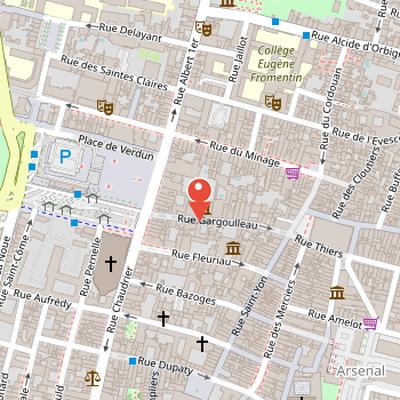
Nearby Objects
-
 Musée du Nouveau Monde 60 m away
 -
 La Rochelle Cathedral 140 m away
 -
 Muséum d'Histoire naturelle de La Rochelle 350 m away
 -
 Église Saint-Sauveur 350 m away
 -
 Grosse Horloge 450 m away
Location and Heritage Status
The Musee des Beaux-Arts de La Rochelle is a French art museum located in La Rochelle, in Charente-Maritime. It forms part of the citys collection of art and history museums together with the Musee du Nouveau Monde. The museum is housed in an hotel particulier that has been protected as a Monument historique by the decree of 23 February 1925.
History and Architectural Development
The building was built at the beginning of the 17th century in a classical style as the bishop's palace. It was purchased in 1600 by Paul Legoux, treasurer of the House of Navarra, who lived there as Grand-Logis or Palais-Royal. The house received several notable guests, including Sully in 1604, Conda in 1615, Ludwig XIII in 1628, and Anna of Austria in 1632. It was described as the most beautiful, appropriate, and best ventilated house in the city. In 1673, it became a priest seminary, and in 1696 Monseigneur Henri de Laval established the bishop's seat there. Later, Monseigneur Crussol d'Uzès ordered a reconstruction from 1769 to 1774, based on plans by architect Gilles Nassivet and carried out by François Chapuy.
From Library to Museum and Cultural Venue
During the Revolution, the municipality acquired the building and established a city library there in 1795. In 1845, a museum was created on the second floor above the library. The building was later protected as a monument on February 23, 1925. The city library moved to the Mediathek Michel-Crepeau in 1998, and the vacated space opened to contemporary art exhibitions in 1999. The building also houses the headquarters of the regional cultural affairs of Poitou-Charentes. Its lapidarium displays fragments from the Carmelite church, the town hall, the Protestant college, and other altered or lost buildings. After the closure of the Musee d'Orbigny-Bernon in 2012, its collections were transferred to the Musee des Beaux-Arts.
The Growth of the Collection
The museum's collection was expanded through acquisitions by the Gesellschaft der Kunstfreunde around 1841, and it continued to grow steadily during the 19th century through salon purchases, works by regional artists, gifts, and inheritances. Today, the collection offers a panorama of European painting from the 15th to the 20th century. It includes older paintings from the 15th to the end of the 18th century by various artists, as well as 19th-century and 20th-century works. The holdings also feature works by regional artists and views of the harbor of La Rochelle, giving the collection a local dimension alongside its broader historical range.
Paintings in the Collection
The Musee des Beaux-Arts de La Rochelle holds a varied group of paintings spanning several centuries. Among the older works are Venus and Love, an oil on wood by an anonymous Antwerp painter from the 16th century, and Die Vasen der Aegypter by Frans II Francken and workshop, an oil on copper made after 1600. The collection also includes Fruchtkorb und diverse Objekte, attributed to Antoine-Benoit Dubois and dated to the 17th century, as well as Der Verkaufer von Geback by Bernhard Keil, which is undated. Nineteenth-century works include Arabische Kavaliere by Eugene Fromentin from 1857, a landscape by Jean-Baptiste Camille Corot from around 1866, and Das Abendgebet by Louis Mouchot from 1874. William Bouguereau is represented by Die Geisselung von Christus, an 1880 oil on canvas located in the Cathedral of La Rochelle, and Ozeanide from 1904. The collection further includes Kopf einer Bretonin by Henry Dezire, Das Warten by Jules Salles, and Die Glyzinie by Aristide Boulineau. Together, these works show the museum's range from anonymous early painting to later nineteenth- and early twentieth-century art.
Asian Art Collection
The museum's collection includes a notable group of Asian art covering works from China, Japan, and Myanmar. Among the Chinese pieces are a series of paintings created in Guangzhou in early 1844 by Youqua. These paintings depict scenes of private life and show clothing and accessories associated with everyday life during the Qing Dynasty. The collection also includes works made using oil painting techniques, produced to appeal to Western customers. Other Chinese works include a standing Guanyin sculpture from the Qing dynasty in the 18th century, made of gilded wood, and porcelain depicting the Eight Immortals of Taoism.
Japanese art is represented by ceramics from Ogata Kenzan of the Rimpa school, dating from the 17th and 18th centuries. The collection also includes an incense burner by Ogata Kenzan made of decorated stoneware with a lid, and an oval cup with landscape decoration, both from the 18th century. Additional Japanese objects include a standing Kannon sculpture from the Edo period, made of painted, lacquered, and gilded wood. The collection further contains a bronze and glass seated Buddha from Myanmar or Burma, dated to the 19th century.