The Musée du Nouveau Monde is a history museum in La Rochelle, Charente-Maritime, dedicated to the relations between the city and the Americas, referred to as the “Nouveau Monde.” Housed in the Hôtel de Fleuriau since 1982, it was the first museum to address the slave trade past of a French port. Its displays include elements related to the slave trade and slavery in the Antilles colonies.
The museum’s collections contain nearly artworks and reflect both the Nouveau Monde explored by Europe and a city enriched economically and culturally by the new continent. It has been labeled a “musée de France” since 2002.
The Hôtel de Fleuriau was built between 1740 and 1750 in Parisian style for Jean Regnaud de Beaulieu, later purchased in 1772 by La Rochelle merchant Aimé-Benjamin Fleuriau, who had returned from Saint-Domingue after making a fortune there. The building was enlarged around 1780 and later classified in part as a historical monument.
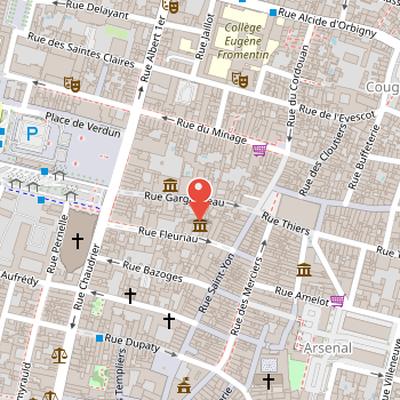
Nearby Objects
-
 Musée des Beaux-Arts de La Rochelle 60 m away
 -
 La Rochelle Cathedral 200 m away
 -
 Église Saint-Sauveur 300 m away
 -
 Muséum d'Histoire naturelle de La Rochelle 350 m away
 -
 Grosse Horloge 450 m away
A Museum on La Rochelle and the Americas
The Musee du Nouveau Monde is a history museum in La Rochelle, Charente-Maritime, housed in the hotel de Fleuriau since 1982. It is dedicated to the relations between La Rochelle and the Americas, referred to as the Nouveau Monde. The museum is notable as the first museum to address the slave trade past of a French port. Its exhibitions include elements related to the slave trade and slavery in the Antilles colonies. The collections contain nearly artworks and reflect both the Nouveau Monde explored by Europe and a city enriched economically and culturally by the new continent. Since 2002, the museum has been labeled museum de France.
Hotel de Fleuriau: Architecture and Family History
The Hotel de Fleuriau, later associated with the Musee du Nouveau Monde, was built in Parisian style between 1740 and 1750 for Jean Regnaud de Beaulieu. Its plan consisted of a central body with two return wings enclosing a courtyard. In 1772, it was purchased by the La Rochelle merchant Aime-Benjamin Fleuriau, who had returned to La Rochelle in 1755 after making a fortune in Saint-Domingue. Fleuriau owned the habitation Fleuriau, a sugar cane plantation and sugar factory in Bellevue near Port-au-Prince.
Around 1780, the building was enlarged by adding a new body against the central part of the old hotel after the acquisition of an adjacent house on a parallel street. The old and new bodies were linked by doors pierced on each floor. The hotel remained inhabited by the same family until its sale in 1974. Its garden facade and interior decorations were classified as historical monuments, as were its other facades and roofs.
Creation and Early Exhibitions
The creation of the Musee du Nouveau Monde was proposed in 1978 for the Hotel Fleuriau, where the museum was later installed after the building was restored. It opened to the public with nineteen galleries and presented several exhibitions starting in 1979, before its official inauguration. Among the early exhibitions were Memorie d'une Amerique in 1980, Autre Amerique in 1982, and Memoire d'un port. La Rochelle et l'Atlantique in 1985. Over a period of about thirty years, the museum organized around seventy temporary exhibitions devoted to historical or contemporary art.
Museum Setting and Collections
The Musee du Nouveau Monde is located in the former home of a family of La Rochelle merchants who owned a plantation and slaves in Saint-Domingue. Its displays include paintings, engravings, drawings, sculptures, old maps, and decorative art related to the New World of the Americas. The museum was the first to address the slave trade past of a French port and to present related elements in the Antilles colonies. Visitors can use audioguides, and free visit and activity booklets for young audiences are available at the reception. A family space is provided on the first floor in the rooms dedicated to the United States and Indigenous peoples.
Galerie and the Museum's Colonial and Atlantic History Displays
The Galerie brings together artworks and objects that present linked histories of Atlantic trade, slavery, colonial life, and Indigenous cultures. It includes Vue du port de La Rochelle in 1762 by Joseph Vernet, along with paintings of Vue de la Martinique by Jenny Prinssay from the early 19th century and Vue de la Guadeloupe by Jenny Prinssay from 1813. The gallery also displays La Mascarade nuptiale from 1788 by Jose Conrado Roza and the portrait of Marie-Jeanne Grellier with her slave, with a note that the Grellier family owned a plantation in Jeremie.
Several items directly address slavery and the Middle Passage. These include the slave ship L'Amitie, owned by the Rasteau company, which the gallery states deported Africans from Senegambia to Port-au-Prince in 1787 and on which 21 Africans died during the Atlantic crossing. The gallery also exhibits iron shackles used to tie slaves ankles during the Middle Passage, and Rebellion d'un esclave sur un navire negrier, a painting by Edouard-Antoine Renard from 1839. Another display item is a Pendule au negre a la balle de coton signed Jollage in Paris, dating from 1800 to 1810.
The Galerie further includes 18th-century habitation tokens, possibly made of tin, and a selection of works and objects connected to Indigenous and North American history. These include Plains Indians artwork based on George Catlin, a Gunstock war club from the Sauks tribe dating around 1760 and made of wood, a late 18th-century canoe model from the Great Lakes region made of birch bark, spruce root, and cedar, and a leather purse with alluvial gold nuggets and a single-shot small pistol circa 1850 made of steel, brass, and wood along with playing cards.