The Muséum d'Histoire naturelle de La Rochelle is a French natural history museum located in La Rochelle, Charente-Maritime. It is installed in the former palace of the governor of Aunis, and its building was registered as a historic monument by decree on October 27, 2003. The museum is a member of the Réseau national des collections naturalistes (RECOLNAT).
The building's history begins as a private mansion built between 1708 and 1718 on the former Jesuit garden site for Jouin de la Tremblay. Designed by Claude Masse, king's engineer, it later became the hotel of the governors of Aunis in 1748. Additional wings were built in 1775, and the site was later adapted for public and museum uses. Natural history collections gave rise to the muséum Lafaille in the renovated left wing, while the garden was arranged as a botanical garden. The museum also housed the musée Fleuriau in the north building body. After restoration work that began in 1998, the museum reopened on a later unspecified date.
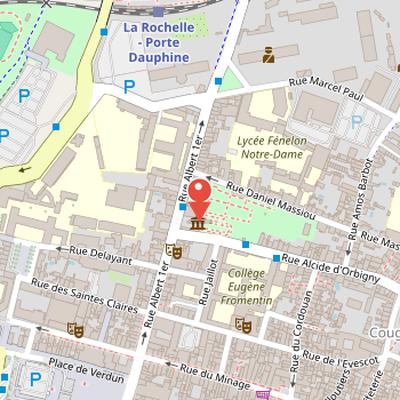
Nearby Objects
-
 Musée des Beaux-Arts de La Rochelle 350 m away
 -
 Musée du Nouveau Monde 350 m away
 -
 Notre-Dame-de-Cougnes 400 m away
 -
 La Rochelle Cathedral 400 m away
 -
 Église Saint-Sauveur 650 m away
Historic Setting and Institutional Status
The mus deum d'Histoire naturelle de La Rochelle is a French natural history museum located in La Rochelle, in Charente-Maritime. It is installed in the former palace of the governor of Aunis, giving the museum a historic architectural setting. The building was registered as a historic monument by decree on October 27, 2003. The museum is also a member of the Reseau national des collections naturalistes (RECOLNAT), placing it within a national network of natural history collections.
From Mansion to Museum Complex
The musuem d'Histoire naturelle de La Rochelle occupies a historic building that began as a private mansion on the former Jesuit garden site. It was built for Jouin de la Tremblay between 1708 and 1718 and designed by Claude Masse, the king's engineer. In 1748, it became the hotel of the governors of Aunis, and the interior arrangements were carried out by Tourneur.
The site was expanded in 1775, when the city added two wings. One south wing was attached to the existing left wing on the royal college garden, while another northern wing was built in the garden for dependencies and stables by the architects Nicolas Marie Potain and Julien Nassivet. In 1808, Napoleon gave the two wings to the city for a public library.
The building later took on a museum role. Its left wing was renovated in 1832 to house natural history collections given in 1782 by Climent de la Faille, which became known as the musuem Lafaille. The garden was arranged as a botanical garden. In 1852, Louis-Benjamin Fleuriau de Bellevue bequeathed most of his natural history and ethnography collections, as well as his library, to the museum, and the north building body housed the musee Fleuriau.
The site changed function again in 1874, when Tomas, bishop of La Rochelle, bought it to serve as the bishopric until 1903. A new decor made under bishop Tomas still exists. The city bought the episcopal palace in 1910 for museum and botanical garden expansion. The right wing was extended in 1914 along Albert Street and Alcide-d'Orbigny Street, and the Lafaille cabinet was enlarged in 1920 and restored between 1958 and 1960.
Restoration and Garden Features
The museum closed in 1998 for new restoration work costing 14.4 million euros. The project included climate-controlled reserves, a rearrangement of the garden, and a doubling of the exhibition area, along with the creation of an auditorium. The museum later reopened, although the date is not specified. Its buildings were registered as historic monuments on a date that is also not specified. In the plant garden, the dolmen of La Jarne was reassembled, adding a notable element to the museum grounds.
Collections and the Cabinet of Curiosities
The museum presents its collections through two main domains: natural history and ethnography. Its holdings are considered important because of the quality of the old collections assembled by sailors and explorers from the region, as well as pieces originating from major collections such as that of Andre Breton. Natural history collections have existed since the 18th century and form the core of the museum's holdings. On the ground floor, some of the earliest pieces are displayed in a cabinet of curiosities. This cabinet was restored to its original coral red color. The museum also displays the cabinet of curiosities of the naturalist Clement Lafaille, made after 1766, which is described as the oldest natural history cabinet in France.
Displayed Collections and Scientific Exhibits
The museum's collections are presented across several rooms and floors, with a strong emphasis on zoology and paleontology. On the ground floor, room 2 includes a naturalized specimen of Rissa tridactyla, a model of Terrrees in the Marais littoraux, and other naturalized specimens such as Cancer bellianus and the coconut crab, Birgus latro. The ground floor also displays a lion from Kenya, dated 1931, positioned between a Sumatran tiger and a snow leopard. On the first floor, room 9 contains a zoology gallery, while room 10 features a pink dorade, Beryx decadactylus. In staircase and room 12, the collections include a model of the whaling ship Neptune, built in 1824 in Loire Atlantique, together with an Argonauta argo mollusk from Indonesia. The paleontology room holds ammonites from the Upper Jurassic of Charente-Maritime, a unique holotype calyx of encrine or sea lily from the Kimmeridgian Upper Jurassic reefal deposits of Pointe du Chay, Angoulins, and a rare adult Pterodactylus with a wingspan from the Tithonian, dated 145.5 million years, originating from Germany. The Pterodactylus was acquired by purchase between 1872 and 1884. These displays show the museum's use of specimens, models, and rare fossils to present natural history collections in a structured museum setting.
Ethnographic and Archaeological Collections
The muséum d'Histoire naturelle de La Rochelle holds a varied group of ethnographic and archaeological objects from different regions. Its collections include the Rahareto headdress from the Karaja population of Mato Grosso, Brazil, made of wood, rattan, feathers, and plant fibers. This object was acquired as a collection and gift from Jabiru Prod in 2002. Other items in the collections include Kapkap forehead ornaments reserved for clan chiefs from the Admiralty Islands, Papua New Guinea, exhibited in room 22, and a ceremonial axe, or O'Kono, from New Caledonia, made of wood, fabric, coconut fibre, serpentine, and bat hair.
The museum also presents a Sao terracotta head from the 12th to 13th century, from Woutio, Cameroon, located in archaeology room 20. In ethnography room 25, it displays Muziri items from the Bembe population of the Niari valley plateaux in the Republic of Congo; these were collected in 1911 and are made of textiles, rattan, plant fibers, brass, and hair. The same room also contains a bilateral Moa i kavakava, or man with ribs, from Rapa Nui, made of wood, obsidian, and bird bone, collected from Easter Island in 1860. Additional holdings include a Kwele population mask from the Republic of Congo, donated by A. Petit-Renaud in 1935, a Kovave mask from the Elema population of Papua New Guinea purchased at the Breton-Eluard sale of 1931 at Drouot and displayed on the first floor, and a Kavat mask from the Baining population of New Britain, Papua New Guinea.
The Les Ailleurs Collection and the Anada Project
From 2023 to 2027, the Conseil regional de Nouvelle-Aquitaine is funding Inventaire du fonds colonial, a project that coordinates an inventory of collections of sub-Saharan origin from six history museums. The project is named Anada, short for Afriques-Nouvelle-Aquitaine : decolonisation des arts, and is coordinated by teacher-researcher Sophie Chave-Dartoen, who is also director of the Musee d ethnographie de Bordeaux. The participating collections include those of the musee d'Aquitaine, the musee d ethnographie de l universite de Bordeaux, the musee d Angouleme, the museum of La Rochelle, the musee d Art et d Archeologie du Perigord, and the musee Hebre de Rochefort. At the Musuem de La Rochelle, the collection called Les Ailleurs contains over 1000 objects, including 400 from Africa. Inventaire du fonds colonial identifies Les Ailleurs as the second largest collection in France after the Musee du Quai Branly.
Colonial Heritage Inventory
The Inventaire du fonds colonial describes colonial heritage as stemming mainly from military campaigns, the slave trade, and religious and ethnographic missions. It also acknowledges that some objects entered France through asymmetrical relationships. Within this framework, certain pieces may be subject to official restitution if claimed by former colonies. So far, only human remains have been restituted, including a Maori head returned to New Zealand in 2012.
The project is organized in phases. The first focuses on investigating the provenance of collections of African origin, while the second identifies works considered problematic or important from the perspective of communities and countries of origin. Collections from Cameroon, Gabon, Burkina Faso, and Cote d'Ivoire are prioritized, and different operations with partners in these countries are currently ongoing.