Hôtel de Bagis is a private mansion located on rue de la Dalbade in Toulouse’s historic center. Locals call it the hotel de piedra because of its stone facade, which is unique in Toulouse for the Renaissance period. The building is regarded as an exceptional example of Toulouse Renaissance architecture.
Construction began in 1537 under architect Nicolas Bachelier. His facade facing the Atlantes courtyard is described as the finest example of his work. The mansion was modified in 1611 by architect Pierre Souffron, who built a new street facade entirely in stone. Its sculptural decoration was completed in the mid-17th century. The building was classified as a historic monument in 1889.
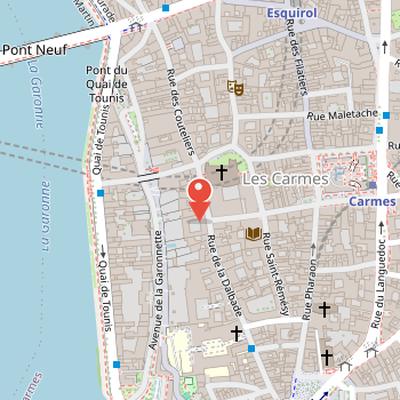
Nearby Objects
-
 Notre-Dame de la Dalbade 80 m away
 -
 Place du Salin 300 m away
 -
 Place de la Trinité 350 m away
 -
 Maison Seilhan 350 m away
 -
 Fondation Bemberg 350 m away
Renaissance Stone Facade and Later Modifications
The Hotel de Bagis is located on rue de la Dalbade in Toulouse's historic center. It is known locally as the hotel de piedra because of its stone facade, which was unique in Toulouse during the Renaissance period. As a result, it is regarded as an exceptional example of Toulouse Renaissance architecture. Construction began in 1537 under architect Nicolas Bachelier, whose facade facing the Atlantes courtyard is considered the finest example of his work. The building was modified in 1611 by Pierre Souffron, who created a new street facade made entirely of stone. Its sculptural decoration was completed in the mid-17th century. The building was classified as a historic monument in 1889.
Ownership and Early History
In 1533, Jean de Bagis bought five buildings in Bordeaux, and in 1537 he ordered a new hotel particulier from the architect Nicolas Bachelier. His career later included service as advisor to the Grand Council from 1538 to 1540 and as president at the parliament of Toulouse in 1544. Jean de Bagis was married to Ana de Gondi, sister of Alberto de Gondi, Duke of Retz, who was a close friend of Queen Catherine de Medici.
The property later passed to Marguerite, Jean de Bagis's daughter, who married Jean de Paulo, president of the Parliament. Jean de Paulo rented the hotel to Jean Maynier, Raymond Vortin, Jean Boyer, and Saint-Simon. In 1588, the hotel was inherited by Philippe, son of Jean de Paulo, who sold it to Nicolas de Guerrier in 1601. Nicolas de Guerrier was a pharmacist who made his fortune with a shop on rue des Pellegantiers and served as capitoul in 1583-1584 and 1593-1594. After his death in 1606, he left the hotel to his daughter Gabrielle. Gabrielle married François de Clary, president of the Parliament of Toulouse, who had been born in Cordes, became judge-mago of the senescalia of Toulouse, and was advisor to the king in 1606.
Later History and 19th-Century Works at Hotel de Bagis
According to Historia, François de Clary commissioned architect Pierre Souffron to redesign the hotel courtyard starting in 1609, with master stonemasons Pierre Bouc, Thomas Heurtematte, Pierre Monge, and Arthur Legoust also working on the building. The property later changed hands several times. The barony of Launac and the stone hotel were sold to Jean-Joseph Daguin in 1710, and he became counselor of the Parliament in 1719. Historia records that he took possession of the hotel in 1727. In 1759, the hotel and parliament presidency passed to his son. During the Terror, Daguin's son was arrested and imprisoned in the prison of La Visitacion, then judged, condemned, and guillotined in Paris on June 14, 1794. The hotel was confiscated, became national property, and was sold to Jean-Pierre Sarremejane, a former capitoul in 1772-1773. Around 1808, it was sold again to the merchant Esquirol. Later work continued on the building in the 19th century: Calvet-Besson completed the works started by François de Clary in 1855, and facade works on rue de la Dalbade began in 1857 under architect Urbain Vitry and sculptor Calmettes.
Historic Protection and Restoration
Hotel de Bagis was listed as a historic monument in 1899, marking its official recognition as a protected heritage building. Much later, the hotel underwent facade cleaning between 1998 and 1999. According to Historia, this cleaning campaign did not include the facades of the interior courtyard, which remained untreated during that work. These details show both the building's long-standing historic status and the selective nature of its late 20th century maintenance.
Courtyard, Garden, and Monumental Faade
Hotel de Bagis is organized between a central courtyard and a rear garden that extends to the Garonnette. The building is arranged as four structures around the courtyard, following a 1537 contract signed with Nicolas Bachelier for four main buildings laid out in a quadrilateral. The courtyard facades are richly decorated with a mix of stone and brick, and Bachelier's work remains visible on the less altered west side. Similar openings appear on the south and east facades, which were modified between 1609 and 1616 for Francois de Clary with the addition of porticos. These courtyard facades were also given stone cladding with pilasters, masks, and capitals intended to support sculpture.
The house opens onto rue de la Dalbade with a majestic facade built between 1609 and 1616 by order of Gabrielle de Guerrier and Francois de Clary. Designed by architect Pierre Souffron with assistants Pierre Bouc, Thomas Heurtematte, Pierre Monge, and Arthur Legoust, this facade is composed of eight bays, with two identical central bays forming the axis of symmetry. The carriage door is placed in the left central bay. In 1855, the facade sculptures were completed by Calvet-Besson under a commission to architect Urbain Vitry and sculptor Calmettes. Francois de Clary's coat of arms and monogram were placed above the doors.
Architectural Innovation and Interior Decoration
Htel de Bagis is identified with Jean de Bagis, described as an important city figure, parliamentarian, and member of the Kings Grand Council. His tastes were examined and then copied in other Renaissance hotels in Toulouse, showing the buildings influence on local design. The hotel includes innovative windows that were copied or adapted in the Hotel de Brucelles, Hotel Boysson-Cheverry, and Hotel Guillaume de Bernuy. It also has a door opening to a staircase with a straight handrail, noted as an early example in Toulouse. The building is associated with the decline of spiral staircases in Toulouse hotels influenced by Renaissance architecture. Among its most distinctive features is a large staircase, considered one of the first straight Renaissance staircases in Toulouse together with the staircase of Hotel d'Ulmo. Inside, the hotel preserves painted ceilings and monumental fireplace works by Nicolas Bachelier, as well as terracotta sculpture decoration from the Gaston Virebent factory.