Notre-Dame de la Dalbade is a Catholic place of worship located on rue de la Dalbade in the Carmes district of Toulouse, France. It should not be confused with the basilique de la Daurade on the quai of the same name. The church’s current name comes from an earlier building covered with white plaster, called Santa Maria dealbata. The present church was constructed around 1480, after an earlier church on the site, which had stood from 541 until the end of the century, was destroyed by fire. Its current building is described as typical Southern Gothic architecture with a rather austere exterior and a medieval fortress-like appearance, marked by thick walls, narrow openings, and a north tower with battlements. The façade includes a Renaissance portal dated 1537 and an Italian Renaissance-style ceramic tympanum showing a copy of Fra Angelico’s Coronation of the Virgin. Additional decoration was created by Gaston Virebent in 1874 and 1878, alongside sculptors Adolphe Azibert and Charles Ponsin-Andahary.
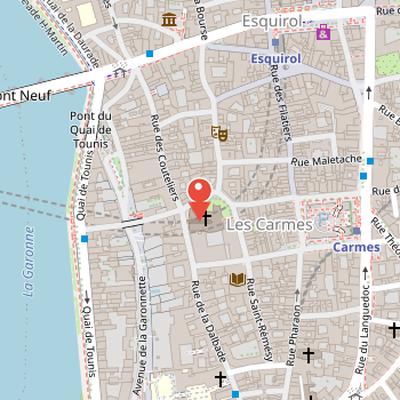
Nearby Objects
-
 Hôtel de Bagis 80 m away
 -
 Place de la Trinité 300 m away
 -
 Fondation Bemberg 300 m away
 -
 Hôtel d'Assézat 300 m away
 -
 Étienne-Esquirol Square 350 m away
Architecture and Name
Notre-Dame de la Dalbade is a Catholic place of worship located on rue de la Dalbade in the Carmes district of Toulouse, France. It should not be confused with the basilique de la Daurade on the quai of the same name. The present name comes from the former church, which was covered with white plaster and known as Santa Maria dealbata. Its current building shows typical Southern Gothic architecture and has a rather austere exterior.
The History of Notre-Dame de la Dalbade
The site of Notre-Dame de la Dalbade was first occupied by a church dating from 541 to the end of the century, built on the site of an earlier oratory. That first church was later destroyed by a fire, along with the rest of the neighborhood. Even after its disappearance, the name Dalbade remained in use, derived from dealbata.
The present church was constructed around 1480, and its bell tower, signed by Nicolas Bachelier, was built in 1551. About thirty bossage busts sculpted by Bachelier and his students are now exhibited in the Musee des Augustins in Toulouse. The churchs spire, a symbol of ecclesiastical power, was dismantled in 1795 and rebuilt in 1881 to the height recorded on a memorial plaque at the site. The rebuilt bell tower marked the highest point in the city and was compared to the bell tower of Sainte-Cecile cathedral in Albi. It then collapsed abruptly on April 11, 1926, at 3:15 a.m., killing a couple of bakers, injuring their son, and causing significant damage to nearby houses.
Architectural Features of Notre-Dame de la Dalbade
Notre-Dame de la Dalbade combines a medieval fortress-like appearance with later ornamental elements. The church is described as having thick walls, narrow openings, and a north tower with battlements. Its facade includes an Italian Renaissance-style ceramic tympanum, which is a copy of Fra Angelico's Coronation of the Virgin and was made by Gaston Virebent in 1878. The church's flamboyant decor was created by Gaston Virebent in 1874.
A Renaissance portal dating from 1537 is also part of the facade. Under the tympanum, a lintel is engraved with a distich made up of two Alexandrine verses. The portal is completed by a central statue of the Virgin and Child, with Saint Catherine on the left and Saint Barbara on the right.
Interior Decoration and Artistic Program
The interior of Notre-Dame de la Dalbade was restored in 1926 after the collapse of the bell tower, and it contains several works of art. Among its features are several statues celebrating the beauty of the protector of mothers and children, as well as a standing Child Jesus statue placed below the rose window. The sculptors identified for the statues were Adolphe Azibert and Charles Ponsin-Andahary. The original statues are preserved in the chapel of Saint-Germier. The listed figures include Saint Germier and Saint John the Baptist on the left, and Bishop Saint Remi and Saint Sebastian on the right. The church also contains The Nativity of the Virgin by Jean-Baptiste Despax, which is classified as a historical monument, together with four paintings from the workshop of Jean-Baptiste Despax. In the choir, stained glass windows depict scenes from the life of Mary, including the Presentation at the Temple, Annunciation, Nativity of Jesus, and Assumption. Two chapels are dedicated to Mary.
The Organ and Its Alterations
The organ of Notre-Dame de la Dalbade was originally built by Prosper-Antoine Moitessier in 1849 with 46 stops on three keyboards and pedalboard. In 1888, Eugene and Jean-Baptiste Puget modified it to 50 stops, and it was inaugurated on 22 November 1888 by Charles-Marie Widor. During this work, the positive dorsal was removed and the grand body was widened with a flat front and small turrets on each side. Twenty-four stops were placed in two expressive boxes, with 13 for the Positif and 11 for the Recit. The gallery and its sculpted woodwork were executed following designs by Jean Noel-Joseph Bonnal, architect of Toulouse. After the collapse of the bell tower, Maurice Puget repaired and altered the organ in 1927. It was restored again in 2009 by Gerard Bancells and Denis Lacorre. The organ is classified as a historical monument.