Maison Seilhan is a historic residence in Toulouse, France, regarded as the place where the Order of Preachers, or Dominican Order, was founded. According to the history of the house, Dominic de Guzmán received it on 25 April 1215 during the division of Bernard Seilhan’s inheritance, and the deed is preserved in the French National Archives. Dominic and his companions settled there in 1215, and the friars of the order retained the property until the end of the 18th century. The house was also used to lodge friars serving the Inquisition, which led to it being known as the House of the Inquisition.
The complex includes artistic works depicting saints of the Dominican Order, memorabilia related to Henri-Dominique Lacordaire, and Saint Dominic’s room. The site also preserves a white stone portal carved in the 16th century by Laurent Clary, and renovation work revealed a painted ceiling dating from 1648 to 1650, with fifteen panels showing scenes from the life of Saint Dominic. Four mural paintings that once accompanied the ceiling are now lost. The house can be visited on certain days of the week, although access to the chapel is not always guaranteed because of classes held by the Catholic Institute of Toulouse.
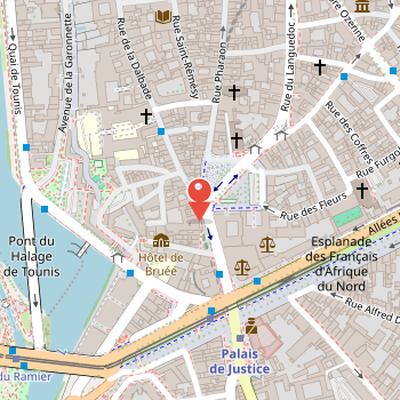
Nearby Objects
-
 Place du Salin 80 m away
 -
 Château Narbonnais 90 m away
 -
 Église du Gésu 250 m away
 -
 Hôtel de Bagis 350 m away
 -
 Hôtel Mansencal 400 m away
Maison Seilhan in Toulouse
Maison Seilhan is a historic residence in Toulouse, France, and is considered the place where the Order of Preachers, or Dominican Order, was founded. According to the preserved deed in the French National Archives, the house was granted to Dominic de Guzman during the division of the inheritance of Bernard Seilhan on 25 April 1215. The residence includes artistic works depicting the saints of the Dominican Order, as well as memorabilia connected to Henri-Dominique Lacordaire, who restored the Order in France. It also contains Saint Dominic's room. Maison Seilhan can be visited on certain days of the week, although access to the chapel is not always guaranteed because of classes from the Catholic Institute of Toulouse.
History and Later Use of Maison Seilhan
In 1215, Dominic de Guzman settled there with companions in Pierre Seilhan's family home, and on 25 April 1215 he officially received ownership of the house as head of the community. The friars of the Order of Preachers retained possession of the house until the end of the 18th century. During that period, it was used to lodge friars assigned to serve the Inquisition, which led to the house becoming known as the House of the Inquisition. In 1989, the Toulouse Association of Saint Dominic purchased the house for the Dominican Order, while the Catholic Institute of Toulouse acquired the remaining buildings, including the former chapel. That chapel was later converted into an amphitheatre and lecture hall, and the chapel of the Sisters of the Society of Mary Reparatrix was renamed the Bruno de Solages Amphitheatre. The whole complex is backed onto remains of the Roman wall of Toulouse.
Historic Interior Elements of Maison Seilhan
Maison Seilhan preserves several historic interior and decorative elements that reflect different periods of its history. Its white stone portal was carved in the 16th century by Laurent Clary. Renovation work later revealed a painted ceiling dating from between 1648 and 1650, created by Dominican novice Balthasar-Thomas Moncornet. This ceiling presents the life of Saint Dominic across fifteen panels, and four mural paintings once associated with the cycle are now lost. The building also preserves a cycle of six paintings by Verotius, dated 1754, which were incorporated into Maison Seilhan on 1 February 1861.
One room in the house is traditionally believed to have served as the first community's sleeping and praying place. It contains a historic painted ceiling, a contemporary stained glass window by Kim En Jong, and an altar sculpted in 2014 by Dominique Kaeppelin. Together, these features show the building as a site where later additions and surviving historic elements remain closely linked.
Interior Spaces and Saint Dominic Paintings
Maison Seilhan includes several notable historic spaces linked to the early Dominican tradition. Among them is the room where Saint Dominic and his first companions lived. The site also preserves remnants of the wall from the citys former Gallo-Roman enclosure, adding an older layer of urban history to the building complex.
The upper floor is marked by six paintings depicting the life of Saint Dominic. These works include Resurrection of the Widow's Son at Saint-Sixte, Miracle of the Meal at Saint-Sixte, Saint Dominic Overcomes the Demon at Saint-Sixte, Approval of the Constitutions by Honorius III, Conversion of Cathar Women who Founded Notre Dame de Prouilhe, and Death of Saint Dominic in Bologna. Another painting shows Mary offering the Rosary to Saint Dominic symbolically.
The ceiling is decorated with five rows of three 17th century paintings illustrating the life of Saint Dominic. This series was painted by the Dominican brother Balthasar-Thomas Moncornet. Adjacent to Maison Seilhan is a room that was originally a chapel and is now used as an amphitheatre of the Catholic University. Together, these elements make the site notable for both its architectural remnants and its concentrated artistic program centered on Saint Dominic.
Iconography and Later Use
Maison Seilhan includes notable iconographic panels. One shows Saints Peter and Paul offering Dominic the pilgrim's staff and the Book of Scripture. Another shows a dog holding a flaming torch near a globe, with the imagery linked to Gospel sayings. The dog is explained as a symbol of the Order, and the Latin pun Domini canes refers to the Dominicans. The site also includes a chapel that has become an amphitheatre of the ICT.
Panel Program Depicting the Life of Dominic
Maison Seilhan includes a notable sequence of 15 panels, each presenting a scene associated with Dominic and the Dominican tradition. The program begins with Panel 1, which depicts the baptism of Dominic, followed by Panel 2, showing a sign of vocation, and Panel 3, depicting Dominic's mercy. Panel 4 presents the return to the Gospel, while Panel 5 shows the prayer of the Rosary. Panel 6 depicts the institution of the Order of Preachers, and Panel 7 shows the apostolic vocation. Panel 8 depicts protection by the Virgin Mary, Catherine, and Cecilia. The sequence continues with Panel 9, a miraculous intervention, Panel 10, Dominic's prayer, Panel 11, a healing, and Panel 12, a healing in Rome. Panel 13 depicts Dominic's purity, Panel 14 the approaching end, and Panel 15 the death of Dominic. Together, these panels form a structured visual account centered on key moments, actions, and themes linked to Dominic.