Hommage à Arago is a public artwork created in 1994 to commemorate the bicentenary of François Arago’s birth. Designed by Jan Dibbets, it consists of 135 bronze medallions embedded in the Parisian ground along the Paris meridian. The medallions were installed to mark the meridian line from north to south through Paris, crossing six arrondissements and extending over 9 kilometers between porte de Montmartre and Cité universitaire.
Each medallion measures 12 centimeters in diameter and bears the name “Arago” in capital letters at the center, with two notches and the letters “N” and “S” indicating north and south directions. The medallions appear in a range of settings, including the Observatoire de Paris, the Jardin du Luxembourg, the Louvre museum, and the site where Arago died. One medallion was sealed on the base of the former François Arago statue, whose original figure had been dismantled and melted during World War II. Some medallions were later stolen, moved, or covered.
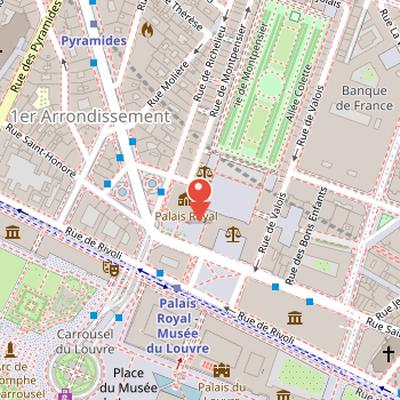
Nearby Objects
-
 Comédie-Française 40 m away
 -
 Théâtre du Palais-Royal 80 m away
 -
 Les colonnes de Buren 100 m away
 -
 Marly Horses 140 m away
 -
 Hôtel de Rambouillet 150 m away
Medallions Along the Paris Meridian
Hommage a Arago is a public artwork made up of a series of medallions embedded in the ground in Paris. The work is aligned along the Paris meridian, giving it a specific relationship to the citys historic geographic line. It was created in 1994 to honor the French scientist and politician Francois Arago. The installation was also intended to commemorate the bicentennial of Aragos birth, linking the artwork to a specific historical anniversary as well as to his public legacy.
Project and installation history
The project was initiated through a call launched jointly by the delegation to visual arts of the Ministry of Culture and the department of plastic arts of the Paris city cultural affairs direction, with the aim of honoring the scientist. The chosen proposal was by the Dutch artist Jan Dibbets, who planned 135 bronze medallions to mark the Paris Observatory meridian on the ground. These medallions were installed in 1994. After installation, some of them were stolen, moved, or covered. In 2000, the Paris meridian line from north to south of metropolitan France was marked with green meridian markers. A second Arago statue by Wim Delvoye was installed in 2017 in the garden of the Paris Observatory opposite the boulevard.
Medallions along the Paris Meridian
Hommage a Arago consists of 134 medallions embedded in the ground along the Paris meridian, extending from north to south across Paris. The line marked by the medallions passes almost through the middle of the city and crosses six arrondissements. It stretches for more than 9 kilometers, from porte de Montmartre in the north to Cite universitaire in the south.
Each medallion measures 12 centimeters in diameter and bears the name Arago in capital letters at the center. Two notches and the letters N and S indicate the north and south directions of the meridian. The medallions were installed in a range of locations, including the Observatoire de Paris building, the site where Arago died, the Jardin du Luxembourg, and inside the Louvre museum. They appear in both symbolic and ordinary settings, reinforcing the presence of the meridian within the urban fabric.
One medallion is sealed on the base of the former Francois Arago statue at place de l'ile-de-Sein, where the Paris meridian crosses boulevard Arago. The statue was dismantled and melted by the German occupier during World War II for weapon production. The monument belongs to the movement of .
References in Literature and Film
Hommage a Arago is mentioned in Dan Brown's 2003 novel Da Vinci Code, where the character Robert Langdon uses medallions to follow the Paris meridian, called the Pink Line in the book. The references also note that no medallions are on Langdon's actual route along the Paris meridian. They further state that the Paris meridian does not pass under the Louvre's inverted pyramid, but about one hundred meters east at the small diamond tip. For the film adaptation of the novel, medallions were specially added.