The Hôtel de Rambouillet was a French palace and the Parisian residence of Catherine de Vivonne, Marquise de Rambouillet. Previously known as the Hôtel de Pisani, it was located near the Palais du Louvre, at the site of the current Palais Royal. Catherine de Vivonne, the daughter of an Italian named Savelli and a French diplomat, the Marquess of Piselli, conducted a renowned salon there from 1607 until 1665.
She was married to Charles d’Angennes, who saw the village of Rambouillet elevated to a marquesship by King Louis XIII in 1612. Catherine de Vivonne later became Marquise de Rambouillet and reconstructed the building based on plans drawn by herself to create more suitable reception rooms. The Hôtel featured a succession of communicating salons in the Italian style. In the ruelle of her Chambre Bleue, she received prominent intellectuals recumbent on a bed, including Giambattista Marino, Richelieu, Malherbe, Vaugelas, Guez de Balzac, and Racan. The salon’s participants used the term précieux for themselves and valued honnêteté, understood as moderation and decorum.
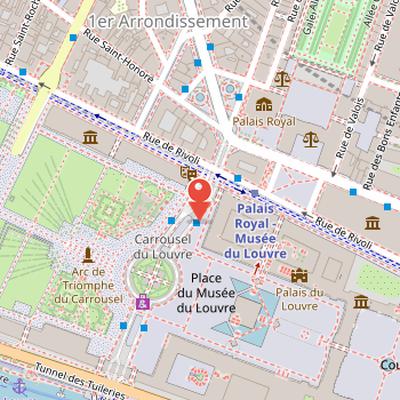
Nearby Objects
-
 Marly Horses 60 m away
 -
 Place du Carrousel 100 m away
 -
 Carrousel du Louvre 110 m away
 -
 Louvre Palace 140 m away
 -
 Musée des Arts Décoratifs 140 m away
The Salon at the Hotel de Rambouillet
The Hotel de Rambouillet, previously known as the Hotel de Pisani, was a French palace and the Parisian residence of Catherine de Vivonne, Marquesa de Rambouillet. It stood near the Palais du Louvre, on the site of the current Palais Royal. Catherine de Vivonne, daughter of an Italian named Savelli and a French diplomat, the Marquess of Piselli, conducted a renowned salon there from 1607 until 1665. Married to Charles d'Angennes, she became Marquesa de Rambouillet after her husband saw the village of Rambouillet elevated to a marqueeship by King Louis XIII in 1612.
Catherine de Vivonne reconstructed the building according to plans she drew herself in order to create more suitable reception rooms. The interior featured a succession of communicating salons in the Italian style. In the ruelle of her Chambre Bleue, she received prominent intellectuals while recumbent on a bed. Among the attendees were Giambattista Marino and figures such as Richelieu, Malherbe, Vaugelas, Guez de Balzac, and Racan. The members of her circle used the term precieux for themselves, a word later satirized by Moliere in Les Precieuses ridicules in 1659. The blue stockings worn by the ladies of the circle also became a metonymy for intellectual women known as bas-bleus.
Integrity and the Rambouillet Circle
The self-defined circle associated with the Hotel de Rambouillet was marked by the ideal of integrity, or honnetete. This quality was understood as one of moderation and decorum, shaping the tone of the group and its social conduct. It was practiced by aristocrats as well as by fastidious members of the upper bourgeoisie. At the same time, integrity was presented as something that could not be readily taught or learned, which made it a distinguishing trait of the circle rather than a simple set of rules.
Salon Life and Literary Influence
The Hôtel de Rambouillet was known as an elite circle that chose its own members, and its daily exchanges were governed by rules different from ordinary civility. Members wrote and spoke mainly to their peers, and conversation was treated as an art through which the group developed its tastes. The salon therefore functioned both as a social space and as an intellectual forum.
Reading was central to this activity. L'Astrree was both staged and read there, alongside novels by La Calprenede and Mademoiselle de Scudery. These practices placed literature at the center of the salon's amusements, which had an intellectual character. The world of the Hôtel de Rambouillet also included dances, pleasures, and love intrigues, but it was not a society of pedants. Chapelain wrote that one speaks skillfully yet reasonably there, a remark that captures the balance between elegance and judgment associated with the place.
The salon is described as one of the origins of French precious refinements, later codified in the Dictionnaire de l'Academie francaise published by the Academie francaise. Words such as celadon, used for a blue-green porcelain tone, are said to have come directly from the Hôtel de Rambouillet. In this sense, the salon helped shape a vocabulary and style that extended beyond its own circle.
Its influence was also linked to broader literary and social developments. The Hôtel de Rambouillet played a monumental role in the genre of modern French romance, and Madeleine de Scudery and Chapelain continued its succession after the salon. The same environment fostered a spirit among young aristocratic women who attended it for thirty years, and this spirit is described as having a form of modernism and feminism rather than pedantry. Those connected with the salon later actively engaged in the Fronde and were called Amazons. Moliere, by contrast, scorned members of the salon.